


























Views
Downloads
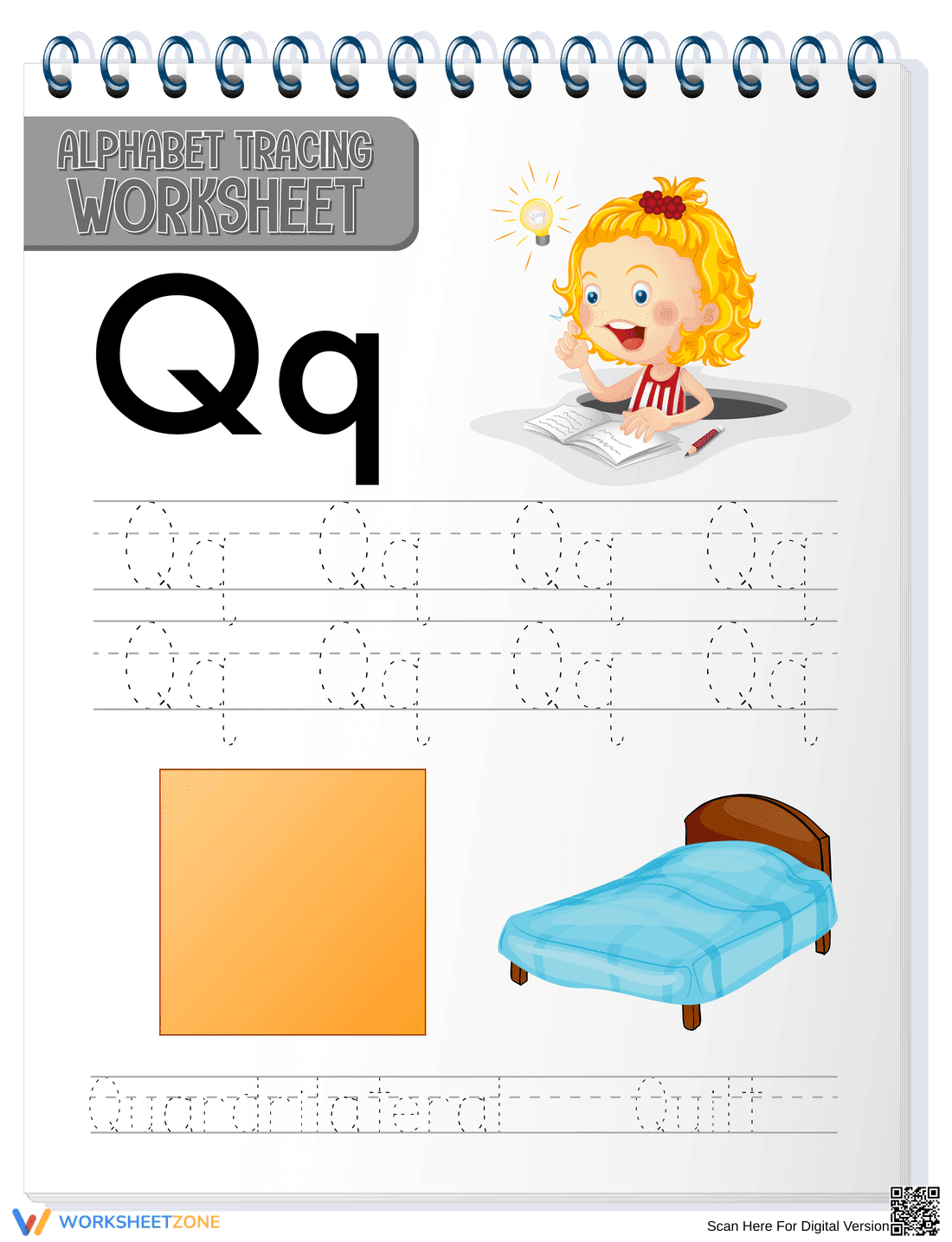

Letter Q Alphabet Tracing Worksheet | Essential Grade K
Paste this activity's link or code into your existing LMS (Google Classroom, Canvas, Teams, Schoology, Moodle, etc.).
Students can open and work on the activity right away, with no student login required.
You'll still be able to track student progress and results from your teacher account.
This Grade K letter Q worksheet helps early learners master uppercase and lowercase letter formation through structured tracing. Students develop the fine motor control necessary for legible handwriting while connecting the letter Q to specific vocabulary words like quadrilateral and quilt. This resource ensures students gain confidence in their foundational literacy skills.
At a Glance
- Grade: Kindergarten · Subject: ELA
- Standard:
CCSS.ELA-LITERACY.RF.K.1.D— Recognize and name all upper- and lowercase letters of the alphabet- Skill Focus: Letter Q formation
- Format: 1 page · 10 tasks · No answer key needed · PDF
- Best For: Daily morning work or literacy centers
- Time: 10–15 minutes
The worksheet features a clear example of uppercase 'Q' and lowercase 'q' at the top. Below, students find two rows of dotted tracing lines containing 8 pairs of letters. The bottom section introduces vocabulary reinforcement with 'Quadrilateral' and 'Quilt,' accompanied by illustrative graphics to support phonemic awareness and word association.
Zero-Prep Workflow
This resource is designed for immediate classroom implementation with a total teacher prep time of under 2 minutes. Follow these three simple steps: First, Print the single-page PDF (30 seconds). Second, Distribute the sheets to students during your literacy block or as a transition activity (1 minute). Finally, Review the letter formation by walking around the room to provide immediate corrective feedback on stroke order (5 minutes). This worksheet is also highly suitable for emergency sub plans.
Standards Alignment
This resource aligns with `CCSS.ELA-LITERACY.RF.K.1.D`, which requires students to recognize and name all upper- and lowercase letters of the alphabet. By focusing specifically on the letter Q, the worksheet provides the targeted repetition needed for mastery. This standard code can be copied directly into lesson plans, IEP goals, or district curriculum mapping tools.
How to Use It
Use this worksheet during the "You Do" phase of a gradual release model after demonstrating the circular stroke of the 'Q' on a whiteboard. It also serves as an effective formative assessment tool; observe if students start their strokes from the top or bottom to identify who needs additional handwriting intervention. Completion typically takes 12 minutes.
Who It's For
This activity is designed for Preschool, Kindergarten, and Grade 1 students who are beginning their handwriting journey. It is particularly helpful for English Language Learners who benefit from the visual cues of the quadrilateral and quilt. Pair this worksheet with an alphabet anchor chart or a tactile sand-tracing tray.
Research from RAND AIRS 2024 emphasizes that explicit instruction in letter formation is a critical precursor to reading fluency and written expression. This worksheet addresses the specific mechanical needs of early writers by providing high-frequency tracing opportunities for the letter Q. By isolating the letter and providing dotted-line scaffolds, the resource reduces cognitive load, allowing students to focus entirely on the motor patterns required for CCSS.ELA-LITERACY.RF.K.1.D. Systematic practice with both uppercase and lowercase variants ensures that students develop a robust orthographic memory of the alphabet. This targeted approach is supported by evidence-based literacy frameworks that prioritize phonics and handwriting as foundational pillars of early childhood education. By integrating vocabulary words like quadrilateral and quilt, the worksheet also bridges the gap between letter recognition and phonemic awareness, which is essential for decoding.


