


























Views
Downloads
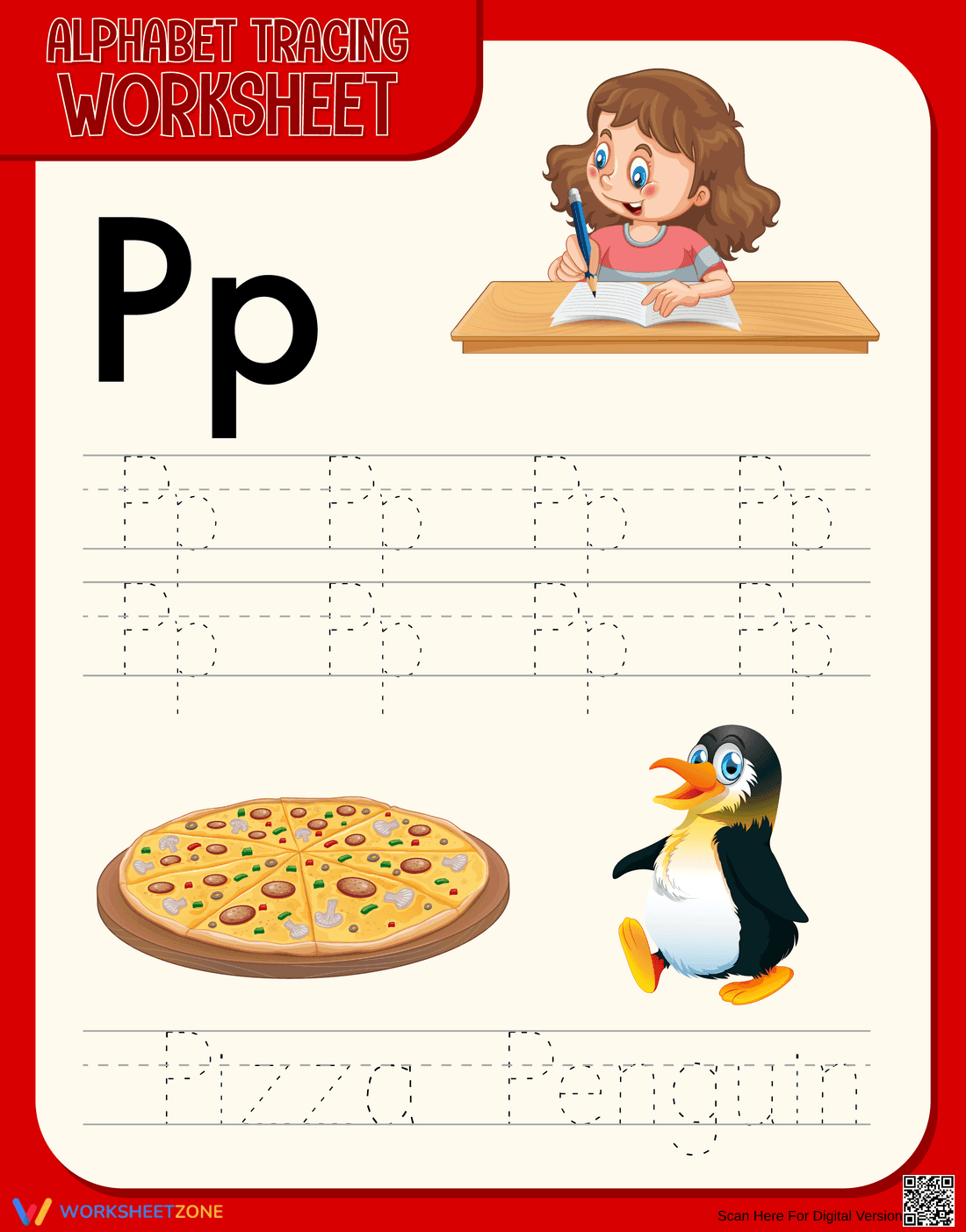

Grade K Letter P Tracing — Printable No-Prep Worksheet
Paste this activity's link or code into your existing LMS (Google Classroom, Canvas, Teams, Schoology, Moodle, etc.).
Students can open and work on the activity right away, with no student login required.
You'll still be able to track student progress and results from your teacher account.
This foundational handwriting worksheet helps early learners master the letter P through targeted tracing practice. Students develop fine motor control and letter recognition by tracing both uppercase and lowercase forms, along with familiar vocabulary words. This resource builds essential pre-reading skills while reinforcing proper letter formation and beginning sounds.
At a Glance
- Grade: K · Subject: ELA
- Standard:
CCSS.ELA-LITERACY.L.K.1.A— Print many upper- and lowercase letters- Skill Focus: Letter P Tracing
- Format: 1 page · 10 problems · No answer key needed · PDF
- Best For: Independent practice
- Time: 10–15 minutes
This single-page resource offers a structured layout for early writers. It features eight pairs of uppercase and lowercase 'Pp' letters with dashed lines for guided tracing. Below, students find vibrant illustrations of a pizza and a penguin, accompanied by corresponding words for tracing. This combination of isolated letter practice and whole-word application provides a comprehensive approach to alphabet mastery.
Zero-Prep Workflow
- Print (1 minute): Simply download the PDF and print the required number of copies.
- Distribute (1 minute): Hand out the sheets along with pencils or crayons. The visual cues make the task immediately obvious to young learners.
- Review (0 minutes): As a tracing activity, students receive immediate visual feedback by following the dashed lines, requiring no formal grading.
Total teacher preparation time is under two minutes, making this an ideal, reliable option for emergency sub plans or quick morning work.
Standards Alignment
This worksheet is directly aligned to CCSS.ELA-LITERACY.L.K.1.A, which requires students to print many upper- and lowercase letters. By providing structured, dashed-line models for the letter P, the activity supports the physical mechanics of handwriting and letter formation. Both standard codes can be copied directly into lesson plans, IEP goals, or district curriculum mapping tools.
How to Use It
This tracing sheet serves as excellent morning work, taking 10 to 15 minutes to complete. It also works well in literacy centers for independent practice after direct instruction. As a formative assessment tip, observe students' pencil grip and stroke direction while they trace to ensure they form shapes efficiently from top to bottom.
Who It's For
This material is primarily designed for preschool and kindergarten students who are developing their fine motor skills and learning the alphabet. It is also highly effective for first-grade students who need remedial practice with letter formation or occupational therapy students working on pencil control. For a complete lesson, pair this worksheet with a read-aloud book featuring a protagonist whose name starts with P, or an anchor chart displaying other P-words.
Effective handwriting instruction remains a critical component of early literacy development. According to Fisher & Frey (2014), providing students with structured, repetitive practice in letter formation significantly improves both writing fluency and subsequent reading comprehension. This worksheet supports CCSS.ELA-LITERACY.L.K.1.A by allowing students to print many upper- and lowercase letters through guided tracing. The physical act of writing the letter P, combined with visual associations like pizza and penguin, reinforces the neural pathways necessary for letter recognition and phonemic awareness. By integrating fine motor skill development with foundational alphabet knowledge, educators can ensure that young learners build the automaticity required for more complex writing tasks later in their academic journey. Research consistently shows that isolated skill practice, when paired with meaningful vocabulary, accelerates early reading milestones.


