


























Views
Downloads
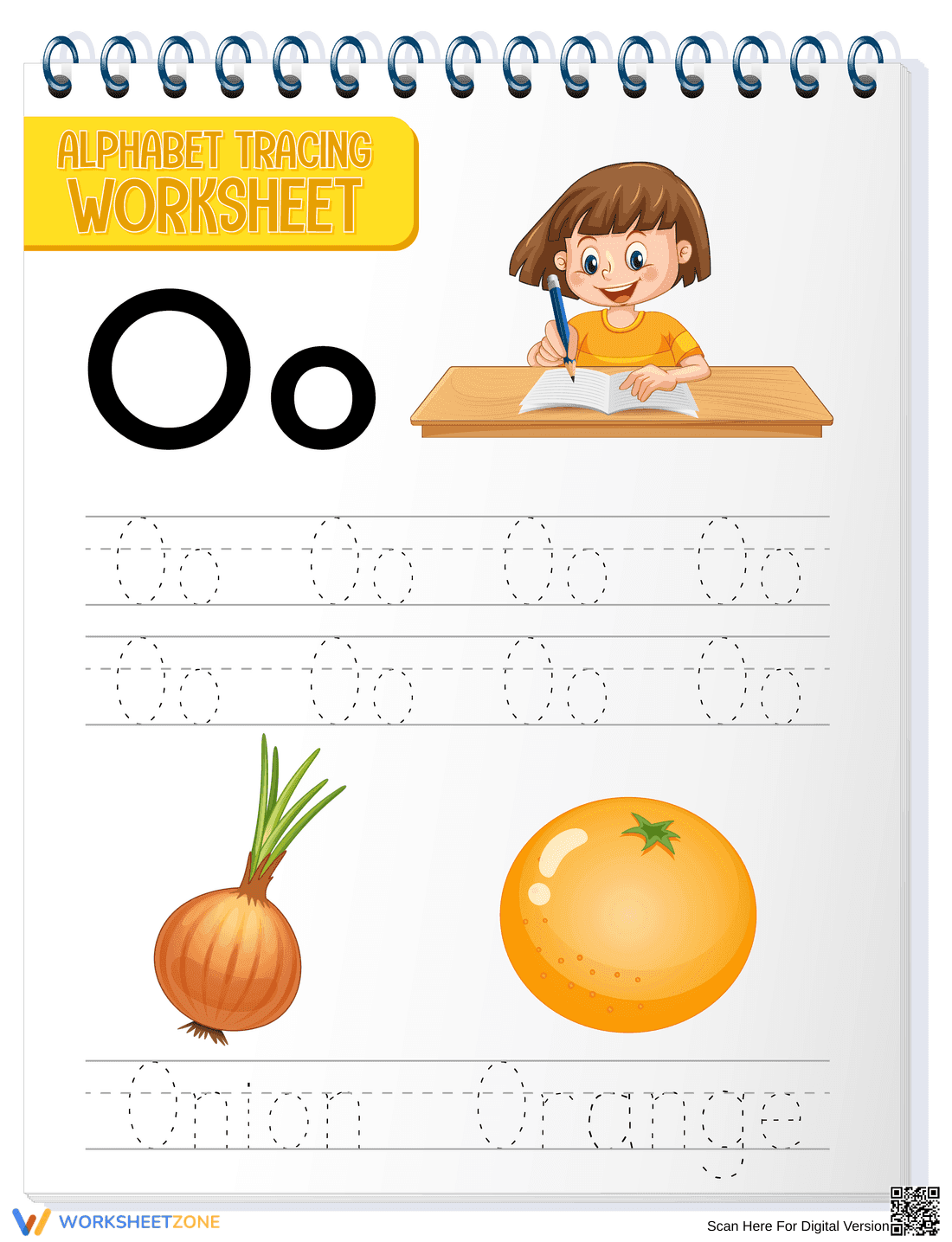

Printable Letter O Tracing Worksheet for Kindergarten
Paste this activity's link or code into your existing LMS (Google Classroom, Canvas, Teams, Schoology, Moodle, etc.).
Students can open and work on the activity right away, with no student login required.
You'll still be able to track student progress and results from your teacher account.
This printable letter O tracing worksheet helps early learners master uppercase and lowercase letter formation while building essential fine motor skills. Students practice tracing the letter pairs and foundational vocabulary words starting with the letter O. This resource ensures immediate engagement and clear learning outcomes for preschool and kindergarten students.
At a Glance
- Grade: Kindergarten · Subject: English Language Arts
- Standard:
CCSS.ELA-LITERACY.RF.K.1.D— Recognize and name all upper- and lowercase letters of the alphabet- Skill Focus: Letter O formation and identification
- Format: 1 page · 10 tasks · Open-ended tracing · PDF
- Best For: Morning work and fine motor practice
- Time: 10–15 minutes
The worksheet features a clean, structured layout containing eight pairs of uppercase and lowercase letter O tracing paths across two guided lines. The bottom section includes two real-world vocabulary words, onion and orange, accompanied by clear, colorful illustrations to reinforce initial letter sounds and letter-sound correspondence.
Zero-Prep Classroom Workflow
Incorporate this resource into your daily routine with three simple steps:
- Print (1 minute): Select the page and print copies for your entire group.
- Distribute (1 minute): Hand out the sheets with pencils or crayons; no extra instructions are required.
- Review (2 minutes): Walk around to check pencil grip and stroke direction as students work.
Total teacher preparation time is under 2 minutes, making this an ideal option for emergency substitute plans or independent center rotations.
Standards Alignment
This activity directly aligns with the primary standard CCSS.ELA-LITERACY.RF.K.1.D, which requires students to recognize and name all upper- and lowercase letters of the alphabet. By tracing both forms of the letter O, students solidify their visual recognition and muscle memory. Both standard codes can be copied directly into lesson plans, IEP goals, or district curriculum mapping tools.
How to Use It
Use this worksheet during independent center time after direct instruction on the letter O sound. It also functions perfectly as a quiet morning arrival activity. While students trace, observe their stroke directionality, noting if they start from the top of the circle, which serves as a vital formative-assessment observation tip. Expect completion within 10 to 15 minutes.
Who It's For
This resource is designed for preschool, kindergarten, and first-grade students who need targeted handwriting practice or remedial fine motor support. It pairs naturally with an alphabet anchor chart or a read-aloud book focused on the short vowel sound of the letter O, helping diverse learners connect print concepts to spoken language.
According to research from EdReports 2024, structured and repetitive print awareness activities are critical components of early childhood literacy acquisition. This letter O tracing worksheet provides the explicit, isolated practice necessary for developing automaticity in letter recognition and fine motor control. By combining visual cues from the illustrations with tactile tracing paths, the worksheet reinforces the phoneme-grapheme connection required for early reading success. Early childhood educators can confidently integrate this tool into their phonics blocks, knowing that repetitive tracing supports long-term orthographic mapping. This resource ensures that students meet foundational benchmarks efficiently while minimizing teacher prep time. The alignment with standard CCSS.ELA-LITERACY.RF.K.1.D guarantees that the student actions directly support state and national literacy goals, making it a reliable addition to any early childhood classroom curriculum.


