


























Views
Downloads
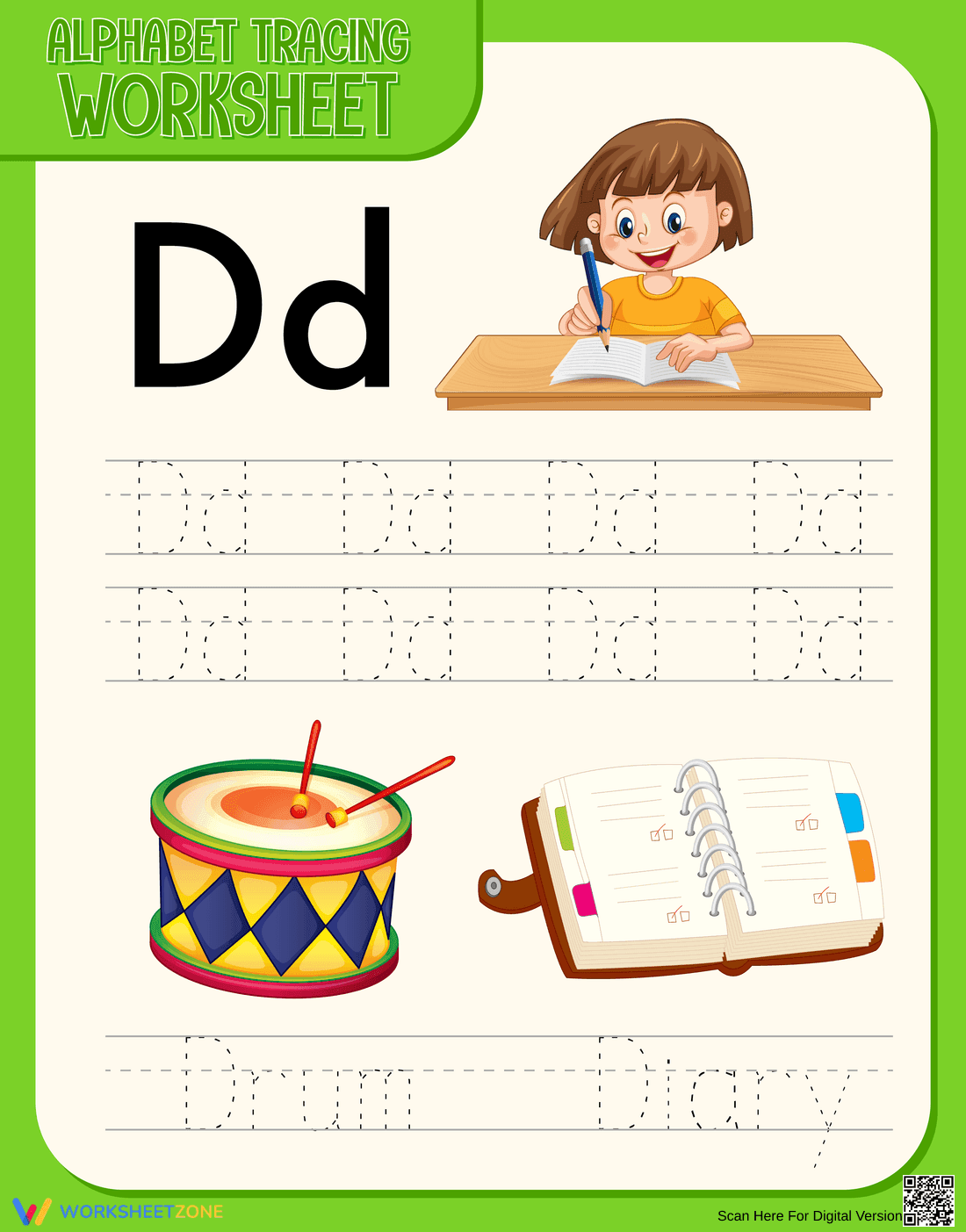

Letter D Alphabet Tracing Worksheet | Essential Grade K
Paste this activity's link or code into your existing LMS (Google Classroom, Canvas, Teams, Schoology, Moodle, etc.).
Students can open and work on the activity right away, with no student login required.
You'll still be able to track student progress and results from your teacher account.
This Grade K alphabet tracing worksheet provides foundational practice for letter D formation. Students develop fine motor control while connecting the visual shape of the letter to its phonetic sound through repetitive tracing. By mastering the uppercase and lowercase 'D', learners build the muscle memory required for fluent handwriting and early reading success.
At a Glance
- Grade: Kindergarten · Subject: ELA
- Standard:
CCSS.ELA-LITERACY.RF.K.1.D— Recognize and name all upper- and lowercase letters of the alphabet- Skill Focus: Letter D formation and phonics
- Format: 1 page · 12 tasks · No-prep · PDF
- Best For: Morning work or literacy centers
- Time: 10–15 minutes
What's Inside
This single-page PDF features clear, dotted-line guides for both uppercase 'D' and lowercase 'd'. The layout includes two full rows of letter practice followed by two vocabulary-building tracing tasks: "Drum" and "Diary." High-quality illustrations of a drum and a diary provide visual cues to reinforce the initial /d/ sound, making it a comprehensive tool for phonemic awareness.
Zero-Prep Workflow
- Print: Select the single-page PDF and print enough copies for your class in under 30 seconds.
- Distribute: Hand out the sheets during morning arrival or as a transition activity for immediate engagement.
- Review: Walk around to check for proper pencil grip and stroke direction as students work independently.
Total teacher preparation time is under 2 minutes, making this an ideal resource for sub plans or emergency literacy blocks.
Standards Alignment
The primary focus is `CCSS.ELA-LITERACY.RF.K.1.D`, which requires students to recognize and name all upper- and lowercase letters of the alphabet. Additionally, it supports `CCSS.ELA-LITERACY.L.K.1.A` by encouraging the print of many upper- and lowercase letters. Both standard codes can be copied directly into lesson plans, IEP goals, or district curriculum mapping tools.
How to Use It
Use this worksheet during the "You Do" phase of a gradual release model after demonstrating the vertical stroke and curve of the letter D on the board. It also serves as an excellent formative assessment tool; observe if students start their strokes from the top down to identify who needs additional fine motor intervention. Completion typically takes 10 to 15 minutes.
Who It's For
This resource is designed for preschool, kindergarten, and first-grade students who are beginning their handwriting journey. It is particularly effective for English Language Learners (ELLs) who benefit from the visual pairing of the letter with concrete nouns. Pair this with a letter D anchor chart or a phonics song for a multi-sensory learning experience.
According to the RAND AIRS 2024 report on early literacy, repetitive tracing of graphemes is a critical component of orthographic mapping, helping children transition from letter recognition to automaticity. This worksheet targets `CCSS.ELA-LITERACY.RF.K.1.D` by providing structured opportunities to practice the specific geometry of the letter D. Research from Fisher & Frey (2014) emphasizes that such guided practice reduces cognitive load, allowing young learners to focus on the relationship between the letter shape and its corresponding phoneme. By integrating vocabulary words like "Drum" and "Diary," the worksheet bridges the gap between isolated letter formation and functional word writing. This evidence-based approach ensures that students develop the foundational skills necessary for the National Assessment of Educational Progress (NAEP) reading benchmarks. Educators can confidently integrate this tool into any curriculum requiring systematic, explicit instruction in the alphabetic principle.


