


























Views
Downloads

Letter T Tracing Worksheet | Essential Grade K-1 Ready
Paste this activity's link or code into your existing LMS (Google Classroom, Canvas, Teams, Schoology, Moodle, etc.).
Students can open and work on the activity right away, with no student login required.
You'll still be able to track student progress and results from your teacher account.
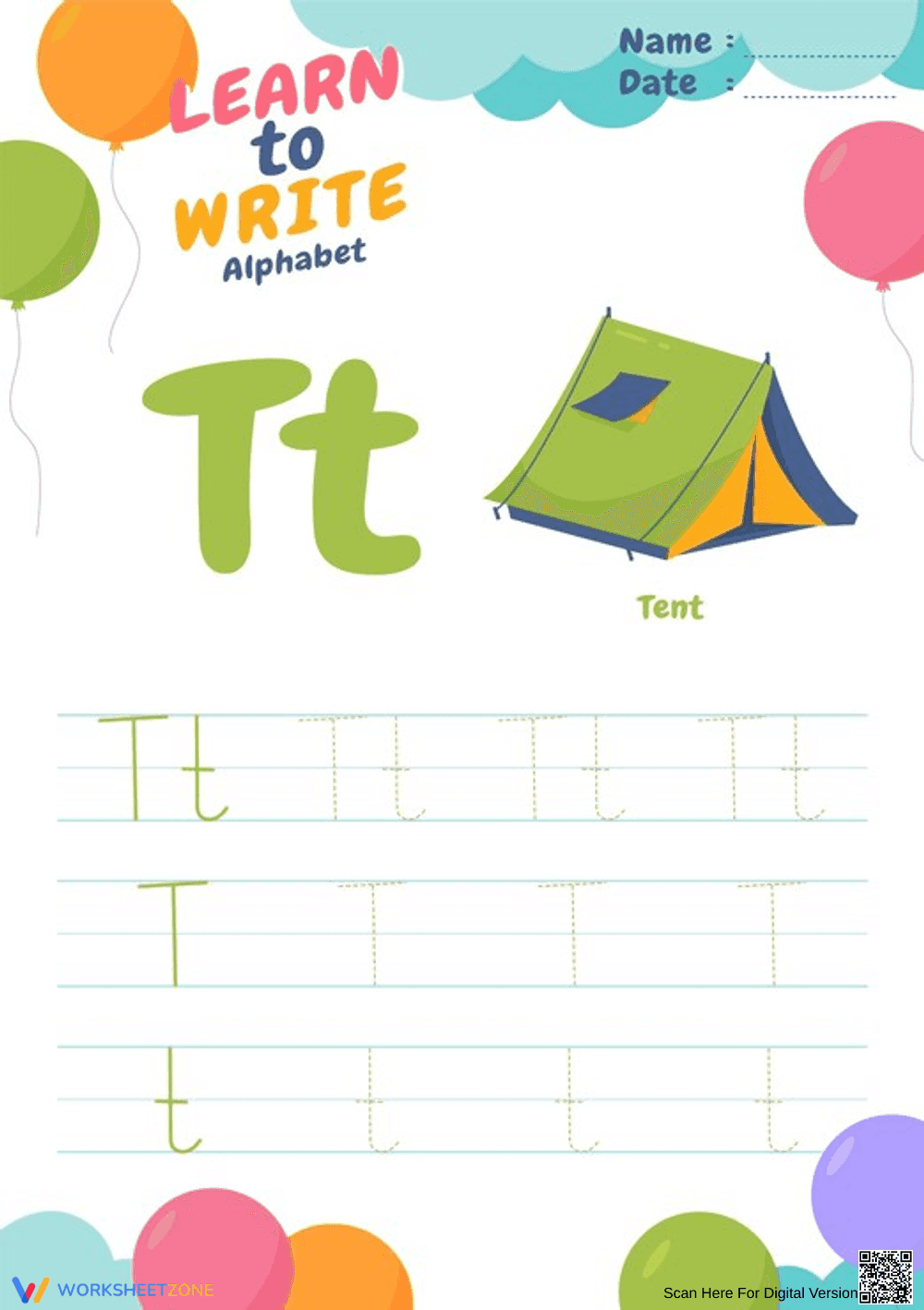
This Kindergarten and Grade 1 handwriting worksheet provides structured practice for mastering the letter T. Students engage in repetitive tracing of both uppercase and lowercase forms to build muscle memory and letter recognition. By connecting the letter sound to the "Tent" illustration, learners reinforce phonemic awareness while developing the fine motor control necessary for legible writing.
At a Glance
- Grade: Kindergarten · Subject: English
- Standard:
CCSS.ELA-LITERACY.L.K.1.A— Print many upper- and lowercase letters correctly during independent writing tasks- Skill Focus: Letter T formation
- Format: 1 page · 12 problems · Answer key included · PDF
- Best For: Morning work and literacy centers
- Time: 5–10 minutes
This single-page PDF features a clear, distraction-free layout designed for early learners. It includes a large visual example of the letter Tt alongside a colorful "Tent" graphic to provide phonics context. The worksheet is divided into three distinct tracing rows: one row for combined uppercase and lowercase pairs, one dedicated row for uppercase T, and one dedicated row for lowercase t, ensuring comprehensive practice.
The zero-prep workflow for this resource is designed for maximum efficiency in busy classrooms. Teachers can print the single-page PDF in less than 30 seconds. Distribution takes approximately 1 minute during transition periods. Reviewing student work is instantaneous, as the tracing lines provide immediate visual feedback on stroke accuracy. This makes it an ideal choice for emergency sub plans or quiet independent work.
This resource is specifically aligned with CCSS.ELA-LITERACY.L.K.1.A, which requires students to print many upper- and lowercase letters. It also supports the foundational writing skills described in Grade 1 standards. This standard code can be copied directly into lesson plans, IEP goals, or district curriculum mapping tools to ensure compliance with state and national frameworks.
Use this worksheet during the "You Do" phase of a direct instruction lesson on the letter T. It serves as an excellent formative assessment tool; observe students as they trace to ensure they are following the correct top-to-bottom and left-to-right stroke order. Expect students to complete the 12 tracing tasks within a 5 to 10 minute window during literacy rotations.
This worksheet is designed for Kindergarten students and Grade 1 learners who need additional handwriting support. It is also highly effective for English Language Learners (ELLs) and students receiving occupational therapy for fine motor delays. Pair this resource with a letter T anchor chart or a phonics reader focusing on the /t/ sound for a complete instructional experience.
Research from Fisher & Frey (2014) emphasizes the importance of guided practice in the gradual release of responsibility model, particularly for foundational skills like letter formation. Handwriting remains a critical component of early literacy, as the physical act of writing letters by hand is linked to stronger letter recognition and reading fluency. According to the NAEP, early mastery of handwriting allows students to focus cognitive resources on higher-level composition tasks later in their academic careers. This worksheet provides the high-frequency, low-stakes repetition required to move letter formation from conscious effort to automaticity. By utilizing the CCSS.ELA-LITERACY.L.K.1.A standard, educators ensure that students are meeting national benchmarks for print concepts. This structured approach to the letter T supports the development of the 26 essential characters needed for communicative competence in the English language.


