


























Views
Downloads
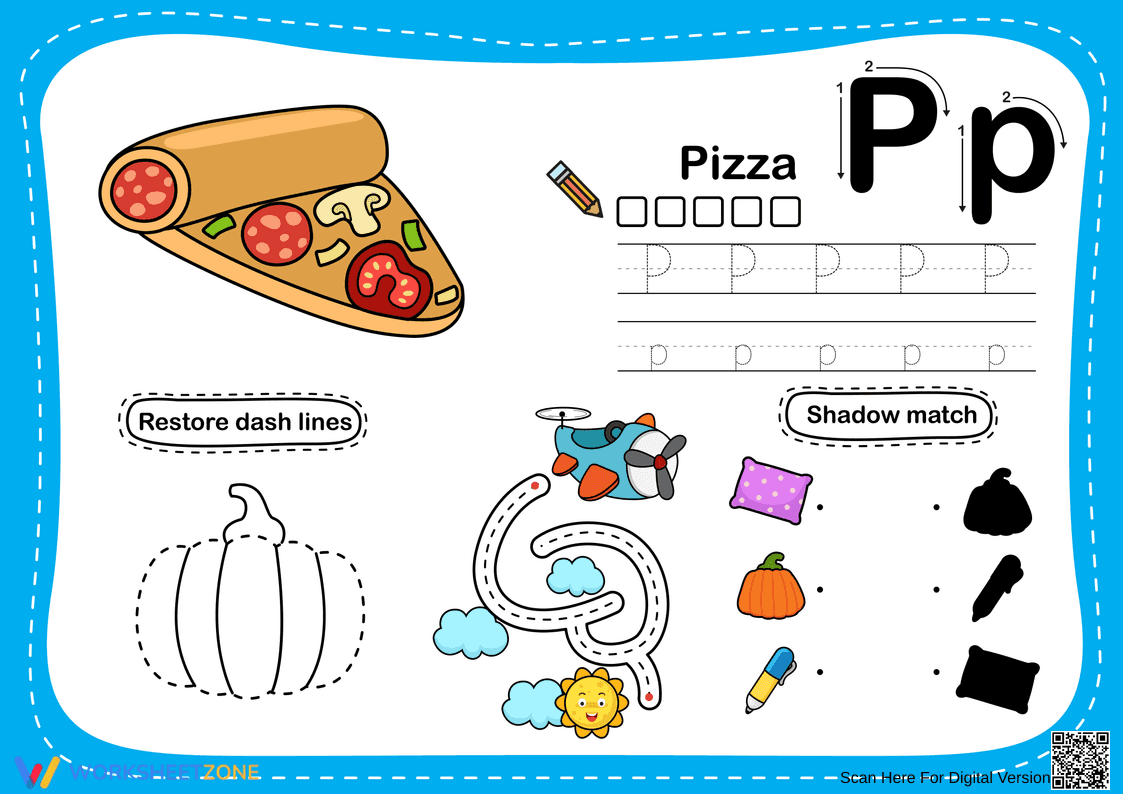

Printable Letter P Tracing Worksheet | Kindergarten ELA
Paste this activity's link or code into your existing LMS (Google Classroom, Canvas, Teams, Schoology, Moodle, etc.).
Students can open and work on the activity right away, with no student login required.
You'll still be able to track student progress and results from your teacher account.
This foundational Letter P worksheet helps early learners develop essential handwriting and fine motor skills. Students practice proper letter formation, trace dashed lines, and complete visual matching exercises. By combining letter recognition with engaging activities, this resource ensures young students build the physical control needed for fluent writing.
At a Glance
- Grade: Kindergarten · Subject: ELA
- Standard:
CCSS.ELA-LITERACY.L.K.1.A— Print many upper- and lowercase letters- Skill Focus: Letter P tracing and fine motor control
- Format: 1 page · 4 tasks · No answer key · PDF
- Best For: Independent morning work
- Time: 10–15 minutes
This single-page printable features four distinct activity zones designed to keep young learners engaged. At the top, students find large, guided models of uppercase and lowercase P with directional arrows, followed by standard tracing lines. The bottom half includes a "restore dash lines" section where children trace a pumpkin and a curved path to build pencil control. Finally, a shadow match activity challenges students to connect colorful objects to their corresponding silhouettes.
This resource is designed for immediate classroom implementation.
- Print (1 min): Download the PDF and print a class set.
- Distribute (1 min): Hand out the worksheets with pencils. Visual instructions make tasks self-evident.
- Review (1 min): Scan completed pages to check letter formation and pencil grip.
With under two minutes of prep, this is ideal for sub plans or morning routines.
This worksheet is directly aligned to CCSS.ELA-LITERACY.L.K.1.A: Print many upper- and lowercase letters. It also supports early visual discrimination and fine motor development necessary for writing readiness. Both standard codes can be copied directly into lesson plans, IEP goals, or district curriculum mapping tools.
Deploy this worksheet during morning work or literacy centers to give students focused, independent practice. Before direct instruction, it serves as a gentle warm-up for small group handwriting sessions. During independent center time, students can complete the tracing and matching tasks while the teacher works with other groups. As a formative assessment tip, observe students while they trace the large "Pp" at the top; watch to ensure they are following the directional arrows rather than drawing the letter from bottom to top. Expected completion time is 10 to 15 minutes.
This resource is primarily designed for Kindergarten students, though it serves as excellent review for first graders or an introductory challenge for preschool learners. For students needing extra support, provide a tactile letter P or a sand tray for sensory practice before they attempt the pencil-and-paper tasks. It pairs perfectly with a read-aloud focused on words starting with the letter P or a classroom anchor chart displaying alphabet formation.
Developing automaticity in letter formation is a critical precursor to expressive writing and reading fluency. When students practice printing many upper- and lowercase letters, as outlined in CCSS.ELA-LITERACY.L.K.1.A, they reduce the cognitive load required for physical handwriting. According to Fisher & Frey (2014), explicit instruction and repeated, guided practice in foundational skills like handwriting are essential for long-term literacy success. Worksheets that combine direct tracing with engaging visual-motor tasks, such as shadow matching and path tracing, provide the varied repetition necessary to solidify these neural pathways. By integrating these fine motor exercises, educators ensure early learners build the stamina required for future academic tasks.


