


























Views
Downloads
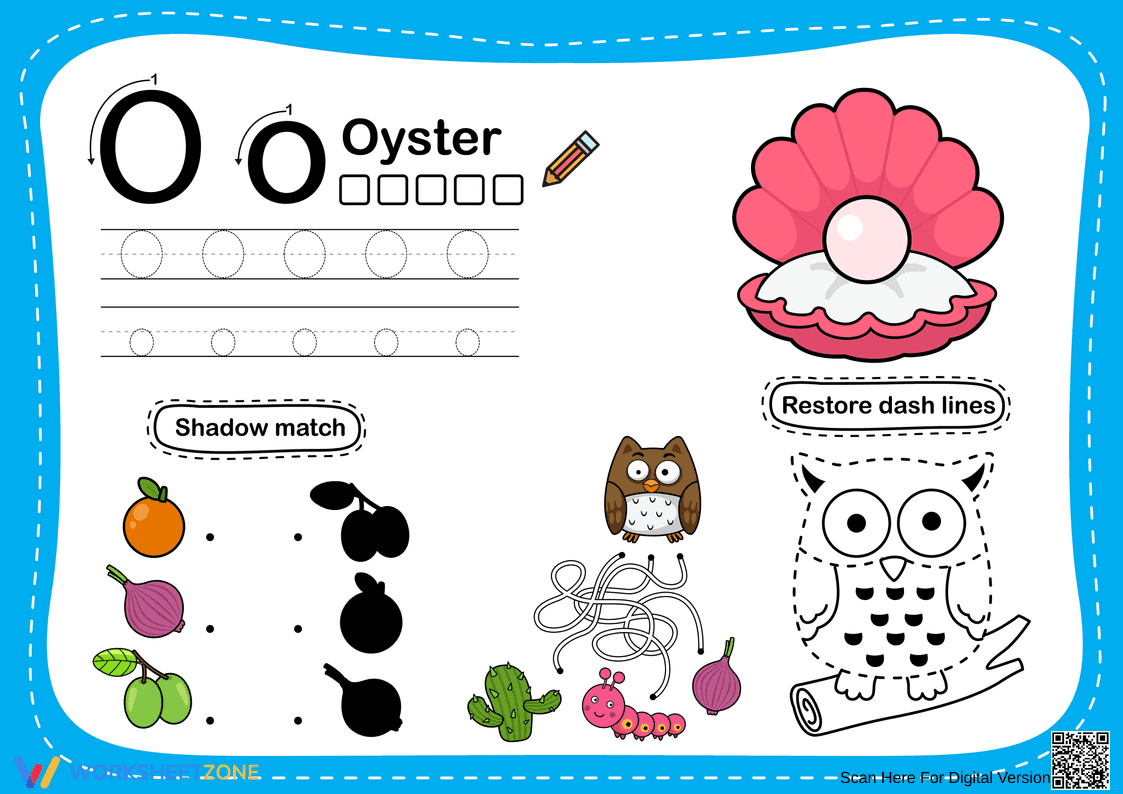

Essential Letter O Tracing Worksheet | Kindergarten
Paste this activity's link or code into your existing LMS (Google Classroom, Canvas, Teams, Schoology, Moodle, etc.).
Students can open and work on the activity right away, with no student login required.
You'll still be able to track student progress and results from your teacher account.
This essential Letter O worksheet helps early learners master uppercase and lowercase letter formation while building phonemic awareness. Students engage with multiple modalities, including tracing, visual discrimination through shadow matching, and fine motor coordination via a themed maze. It provides a comprehensive introduction to the letter O in a single, printable page.
At a Glance
- Grade: Kindergarten · Subject: ELA
- Standard:
CCSS.ELA-LITERACY.RF.K.1.D— Recognize and name all upper- and lowercase letters of the alphabet- Skill Focus: Letter O formation and recognition
- Format: 1 page · 5 activities · Answer key included · PDF
- Best For: Independent morning work or literacy centers
- Time: 15–20 minutes
The worksheet features a structured layout starting with directional tracing guides for both "O" and "o." Below the tracing lines, students find a "Shadow Match" activity with 3 items to sharpen visual processing. A "Restore dash lines" section features an owl illustration to strengthen grip, while a small maze and "Oyster" letter boxes reinforce the initial vowel sound.
This resource is designed for a zero-prep classroom environment. 1. Print: Select the single-page PDF and print enough copies for your group (30 seconds). 2. Distribute: Hand out the sheets during your phonics block or as a transition activity (1 minute). 3. Review: Use the completed shadow matches and tracing lines for a quick formative check (1 minute). Total teacher prep is under 3 minutes.
Aligned to `CCSS.ELA-LITERACY.RF.K.1.D`, this resource focuses on the identification and production of the letter O. It also supports `CCSS.ELA-LITERACY.L.K.1.A` by encouraging the print of many upper- and lowercase letters. Both standard codes can be copied directly into lesson plans, IEP goals, or district curriculum mapping tools.
Use this worksheet during the "You Do" phase of a gradual release model after demonstrating the circular motion of the letter O on an anchor chart. It also serves as an excellent formative assessment tool; observe students during the shadow match to ensure they are identifying the distinct shapes of O-themed objects like oranges and onions.
This is ideal for preschool, kindergarten, and first-grade students who need tactile reinforcement of alphabet shapes. It is particularly helpful for English Language Learners (ELLs) who benefit from the visual cues of the oyster, owl, and orange. Pair this with a physical alphabet manipulative or a letter-sound song for a multi-sensory experience.
Research from the RAND AIRS 2024 report emphasizes that multi-modal alphabet instruction—combining tracing with visual discrimination—significantly accelerates letter-name knowledge in early childhood settings. This worksheet applies these findings by integrating fine motor "dash line" restoration with standard letter formation tasks. By engaging students in 5 distinct cognitive tasks related to the letter O, the resource ensures that recognition moves from short-term memory to long-term mastery. According to Fisher & Frey (2014), providing varied entry points for a single skill, such as the maze and shadow matching included here, supports diverse learners in reaching the CCSS.ELA-LITERACY.RF.K.1.D benchmark. This structured approach reduces cognitive load while maintaining high engagement, making it a reliable tool for foundational literacy development in any early elementary classroom or home-schooling environment.


