


























Views
Downloads
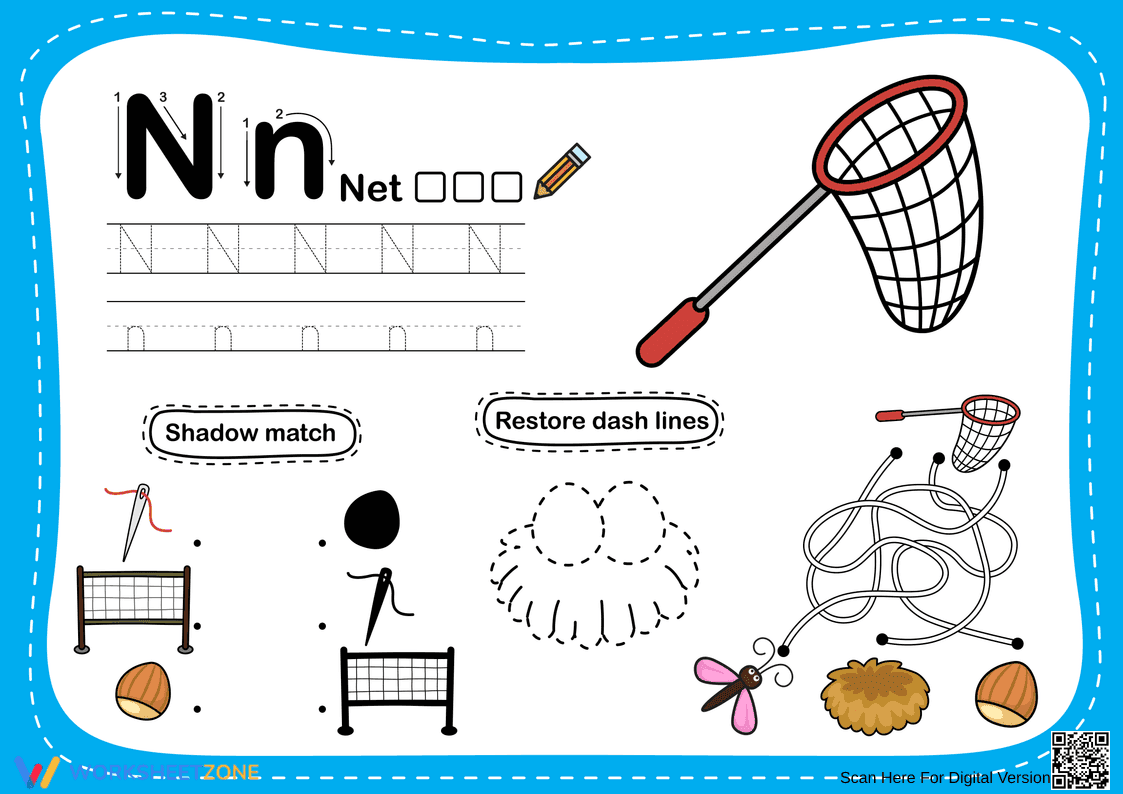

Letter N Tracing Printable | Kindergarten ELA
Paste this activity's link or code into your existing LMS (Google Classroom, Canvas, Teams, Schoology, Moodle, etc.).
Students can open and work on the activity right away, with no student login required.
You'll still be able to track student progress and results from your teacher account.
This foundational worksheet introduces early learners to the letter N, combining essential handwriting practice with engaging fine motor activities. Students develop letter recognition and pencil control as they trace uppercase and lowercase forms, match shadows, and complete simple line paths to reinforce visual-spatial skills.
At a Glance
- Grade: Kindergarten · Subject: ELA
- Standard:
CCSS.ELA-LITERACY.L.K.1.A— Print many upper- and lowercase letters- Skill Focus: Letter N recognition and tracing
- Format: 1 page · 5 problems · No answer key · PDF
- Best For: Morning work or centers
- Time: 10–15 minutes
This single-page resource features five distinct activity zones designed to maintain student engagement. The top section provides guided directional arrows for tracing uppercase and lowercase N, alongside a vocabulary word box for "Net." The bottom half includes a shadow matching game, a dashed-line tracing exercise featuring a bird's nest, and a short path-following maze connecting an insect to a net. The varied task types ensure comprehensive fine motor development without requiring an answer key.
Zero-Prep Workflow
This resource allows for immediate classroom implementation.
- Print (1 minute): Print copies for literacy centers directly from the PDF.
- Distribute (1 minute): Distribute sheets and pencils. Visual instructions make tasks self-explanatory.
- Review (1 minute): Quickly check student progress by observing their pencil grip and stroke direction during the tracing segments.
With a total prep time of under two minutes, this worksheet serves as an excellent emergency sub plan or a quick transition activity between larger lessons.
Standards Alignment
This activity aligns directly with CCSS.ELA-LITERACY.L.K.1.A, requiring students to print many upper- and lowercase letters. By providing guided tracing paths with numbered directional arrows, the worksheet ensures students practice correct letter formation from the start. It also supports early visual discrimination skills necessary for reading readiness. Both standard codes can be copied directly into lesson plans, IEP goals, or district curriculum mapping tools.
How to Use It
Use this worksheet during morning work to establish a focused routine. Alternatively, place it in an independent literacy center where students can practice letter formation while the teacher conducts small group reading instruction. While students work, observe their pencil grip and ensure they follow the numbered arrows for correct stroke order, providing immediate corrective feedback if they start letters from the bottom. Most kindergarten students will complete the activities within a 10 to 15-minute timeframe.
Who It's For
This resource targets preschool and kindergarten students learning the alphabet. It serves as an excellent intervention tool for first graders who need additional support with letter formation or visual-motor integration. Pair this worksheet with a read-aloud book featuring words that start with the letter N, or use it alongside a classroom alphabet anchor chart to reinforce letter-sound correspondence.
Effective handwriting instruction requires explicit modeling and guided practice to establish automaticity in letter formation. According to Fisher & Frey (2014), providing structured opportunities for students to practice foundational skills is critical for long-term literacy success. This worksheet supports that framework by targeting CCSS.ELA-LITERACY.L.K.1.A, which asks students to print many upper- and lowercase letters. By combining direct tracing exercises with engaging visual-motor tasks like shadow matching and path following, the resource addresses multiple facets of early childhood cognitive development. Research indicates that integrating fine motor activities with letter recognition strengthens neural pathways associated with reading and writing. Educators can utilize this targeted practice to ensure young learners develop the necessary pencil control, visual discrimination, and spatial awareness required for more advanced composition tasks in later grades.


