


























Views
Downloads
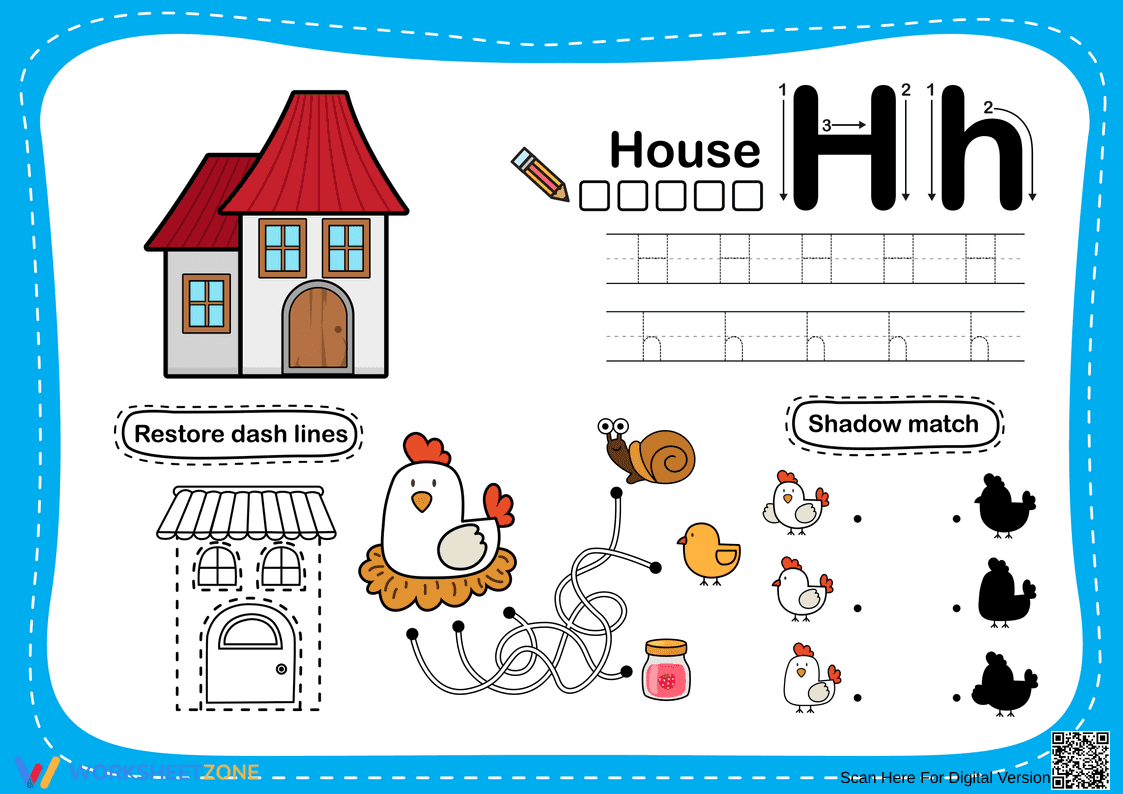

Printable Letter H Tracing Worksheet | Kindergarten ELA
Paste this activity's link or code into your existing LMS (Google Classroom, Canvas, Teams, Schoology, Moodle, etc.).
Students can open and work on the activity right away, with no student login required.
You'll still be able to track student progress and results from your teacher account.
This foundational letter H worksheet helps early learners master alphabet recognition and handwriting. By combining uppercase and lowercase tracing with engaging fine motor activities, students develop the pencil control necessary for fluent writing. The varied tasks keep young minds focused while building essential literacy skills.
At a Glance
- Grade: Kindergarten · Subject: ELA
- Standard:
CCSS.ELA-LITERACY.L.K.1.A— Print upper- and lowercase letters- Skill Focus: Letter tracing and fine motor control
- Format: 1 page · 5 activities · No answer key needed · PDF
- Best For: Morning work or literacy centers
- Time: 10–15 minutes
This single-page resource features five activities to reinforce letter H recognition and fine motor development. Students begin with guided directional tracing for both uppercase and lowercase H, followed by tracing the word "House." The page also includes a dashed-line drawing activity to practice pencil control, a short path-tracing maze, and a visual discrimination shadow-matching task featuring chickens. The layout is highly visual and intuitive for non-readers.
This resource is designed for immediate classroom implementation with a streamlined workflow:
- Print (1 minute): Generate enough copies for your small group or entire class directly from the PDF.
- Distribute (1 minute): Hand out the sheets along with pencils or crayons. The visual instructions make it easy for students to begin independently.
- Review (1 minute): Quickly scan completed pages to check for proper letter formation and pencil grip.
With under two minutes of prep time, this worksheet is an excellent addition to sub plans or literacy centers.
This activity is directly aligned to CCSS.ELA-LITERACY.L.K.1.A, which requires students to print many upper- and lowercase letters. It also supports early visual discrimination and fine motor skills critical for writing readiness. Both standard codes can be copied directly into lesson plans, IEP goals, or district curriculum mapping tools.
Use this worksheet in your morning routine as a soft-start activity. As students arrive, they can immediately begin tracing and matching, providing a calm transition into the academic day. Alternatively, use it during small group literacy centers after a direct instruction lesson on the letter H. While students work independently, teachers can conduct formative assessments by observing pencil grip and stroke direction. Expect students to complete the page in 10 to 15 minutes.
Designed for Kindergarten, this resource also serves as remediation for first graders struggling with letter formation or enrichment for preschoolers. The heavy reliance on visual cues makes it highly accessible for English Language Learners and students receiving occupational therapy support for fine motor delays. Pair this worksheet with a tactile activity, such as forming the letter H with playdough or an alphabet anchor chart, to reinforce the concepts.
Developing automaticity in letter formation is a critical precursor to expressive writing and reading fluency in early childhood education. According to Fisher & Frey (2014), providing students with targeted, repetitive practice in foundational skills significantly reduces cognitive load, allowing them to focus on higher-order comprehension and composition tasks later in their academic journey. This worksheet specifically targets CCSS.ELA-LITERACY.L.K.1.A, ensuring students can accurately print upper- and lowercase letters. By integrating engaging fine motor exercises like short mazes and dashed-line tracing alongside traditional letter formation, the activity strengthens the specific hand muscles required for sustained writing. Early intervention and consistent, daily practice in these fine motor skills have been shown to correlate strongly with later literacy achievement and reading proficiency. This resource provides the structured, multimodal practice necessary to build these essential early literacy pathways effectively and efficiently.


