


























Views
Downloads

Printable Letter D Tracing Worksheet | Grade K
Paste this activity's link or code into your existing LMS (Google Classroom, Canvas, Teams, Schoology, Moodle, etc.).
Students can open and work on the activity right away, with no student login required.
You'll still be able to track student progress and results from your teacher account.
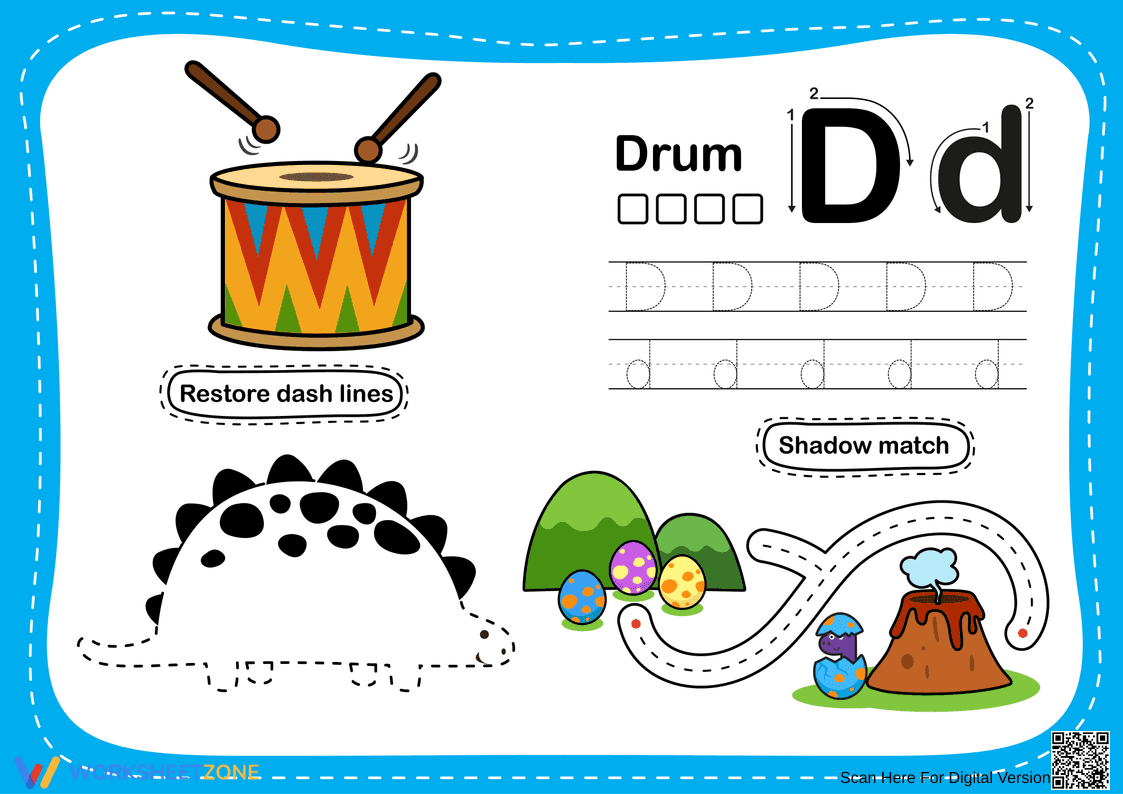
This foundational Letter D tracing worksheet helps early learners develop essential fine motor skills and letter recognition. Students practice forming uppercase and lowercase D while engaging with fun, thematic illustrations like a drum and dinosaur. This single-page resource builds handwriting confidence and reinforces early phonics connections.
At a Glance
- Grade: K · Subject: ELA
- Standard:
CCSS.ELA-LITERACY.L.K.1.A— Print many upper- and lowercase letters- Skill Focus: Letter D formation and fine motor tracing
- Format: 1 page · 4 tasks · No answer key needed · PDF
- Best For: Morning work and literacy centers
- Time: 10–15 minutes
This single-page printable features four activities. At the top, students find guided directional arrows for tracing uppercase and lowercase letter D, alongside a drum illustration. Below, dashed handwriting lines provide structured practice for independent letter formation. The bottom half includes two fine motor exercises: restoring dashed lines on a dinosaur and completing a curved path to match a baby dinosaur to its mother.
Zero-Prep Workflow
This resource requires zero teacher preparation.
- Print (1 minute): Download the PDF and print. The black-and-white design ensures crisp copies.
- Distribute (1 minute): Hand out with pencils. Visual instructions make tasks clear to early readers.
- Review (1 minute): Quickly scan student work to ensure proper pencil grip and correct stroke direction on the letter D.
With a total prep time of under two minutes, this worksheet is an ideal addition to any emergency sub plan or last-minute literacy center rotation.
Standards Alignment
This worksheet aligns directly with CCSS.ELA-LITERACY.L.K.1.A: Print many upper- and lowercase letters. It also supports early reading foundations by associating the letter D with corresponding phonetic images. Both standard codes can be copied directly into lesson plans, IEP goals, or district curriculum mapping tools.
How to Use It
Integrate this worksheet into your morning routine as a quiet "do now" activity. It serves as an excellent warm-up before direct alphabet instruction. Alternatively, place it in a literacy center. As a formative assessment tip, observe students tracing the directional arrows; ensure they start at the top line and pull down. Expected completion time is 10 to 15 minutes.
Who It's For
This resource is primarily designed for preschool and kindergarten students mastering their alphabet and fine motor control. It is also highly effective for first-grade students who need targeted intervention or occupational therapy support for handwriting. For differentiation, provide students who struggle with pencil grip a thicker crayon or marker. Pair this worksheet with a read-aloud book featuring strong "D" vocabulary or a classroom alphabet anchor chart.
Developing automaticity in letter formation is a critical precursor to fluent writing and reading comprehension in early childhood education. According to Fisher & Frey (2014), explicit instruction in handwriting and fine motor skills significantly reduces the cognitive load required for early composition, allowing young students to focus on meaning and phonics rather than the physical mechanics of writing. This specific worksheet directly supports CCSS.ELA-LITERACY.L.K.1.A by requiring students to print many upper- and lowercase letters with guided precision and directional arrows. By combining structured letter tracing with engaging, thematic fine motor tasks like the dinosaur dashed-line restoration, the resource provides the repeated, targeted practice necessary for neurological pathway development in early literacy. Mastery of these foundational strokes ensures that young learners can efficiently translate their spoken ideas into written text as they progress through the primary grades, building a strong foundation for future academic success.


