


























Views
Downloads
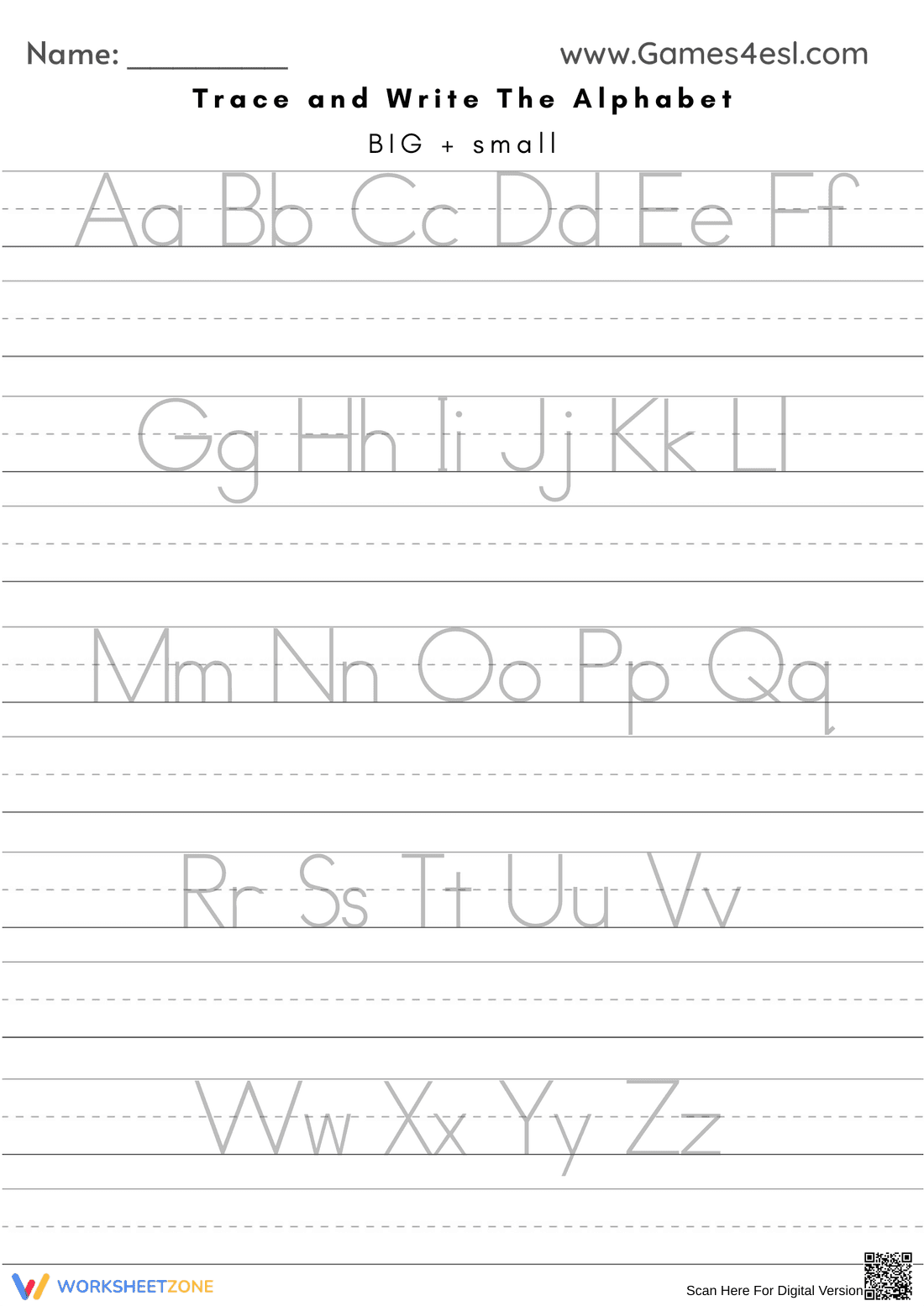

Alphabet Tracing Worksheet | Grade 1 Printable
Paste this activity's link or code into your existing LMS (Google Classroom, Canvas, Teams, Schoology, Moodle, etc.).
Students can open and work on the activity right away, with no student login required.
You'll still be able to track student progress and results from your teacher account.
This Grade 1 alphabet tracing worksheet provides a structured environment for students to master letter formation. By tracing both uppercase and lowercase pairs, learners develop the fine motor control and visual recognition necessary for fluent writing. It offers a clear path from recognition to production, ensuring students build a solid foundation in literacy.
At a Glance
- Grade: 1 · Subject: English
- Standard:
CCSS.ELA-LITERACY.L.1.1.A— Print all upper- and lowercase letters correctly and legibly- Skill Focus: Letter formation and handwriting
- Format: 1 page · 52 letters · Model letters included · PDF
- Best For: Morning work or handwriting centers
- Time: 15–20 minutes
What's Inside
The worksheet features a clean, distraction-free layout with primary ruled lines. It includes all 26 letters of the English alphabet, presented as "BIG + small" pairs. Each letter pair is provided in a light grey dashed font, allowing students to trace directly over the models. The 1-page design ensures that the entire alphabet is visible at once, helping students understand the sequence and relationship between different characters.
Zero-Prep Workflow
- Print: Open the PDF and print the single-page sheet in seconds.
- Distribute: Hand out the worksheets with sharpened pencils for immediate use.
- Review: Quickly scan completed tracings for proper stroke order and line placement.
The total teacher preparation time is under 2 minutes, making it an ideal choice for emergency sub plans or transition periods.
Standards Alignment
The primary focus is `CCSS.ELA-LITERACY.L.1.1.A`, which requires students to print all upper- and lowercase letters. By providing a complete set of A-Z pairs, the worksheet ensures comprehensive coverage of this foundational requirement. Additionally, it supports fine motor development essential for later writing standards. Both standard codes can be copied directly into lesson plans, IEP goals, or district curriculum mapping tools.
How to Use It
Use this worksheet during the independent practice phase of a handwriting lesson. After demonstrating the correct stroke order for a specific group of letters, assign the sheet for students to practice the entire alphabet. It also serves as an excellent formative assessment tool; observe students as they work to identify those struggling with pencil grip or spatial awareness. Completion typically takes 15 to 20 minutes depending on the student's motor skill level.
Who It's For
This resource is tailored for Grade 1 students who need to solidify their handwriting skills, though it is also appropriate for Kindergarteners or English Language Learners (ELLs) beginning their literacy journey. It pairs naturally with alphabet anchor charts or letter-sound flashcards to reinforce the connection between the written symbol and its phonetic value.
Research from Fisher & Frey (2014) emphasizes the importance of guided practice in the gradual release of responsibility model, particularly for foundational skills like handwriting. This worksheet aligns with that evidence-based approach by providing clear models for students to follow. According to the CCSS.ELA-LITERACY.L.1.1.A standard, the ability to print all upper- and lowercase letters is a critical milestone for early elementary students. Mastery of letter formation is not merely a mechanical task but a prerequisite for cognitive fluency in composition. Studies such as the RAND AIRS 2024 report suggest that consistent, low-stakes practice with handwriting improves overall literacy outcomes by reducing the cognitive load during the writing process. This 1-page resource provides the 52 specific tasks required to meet these benchmarks effectively. By integrating this tool into daily routines, educators ensure that students develop the legibility and speed necessary for academic success in later grades.


