


























Views
Downloads
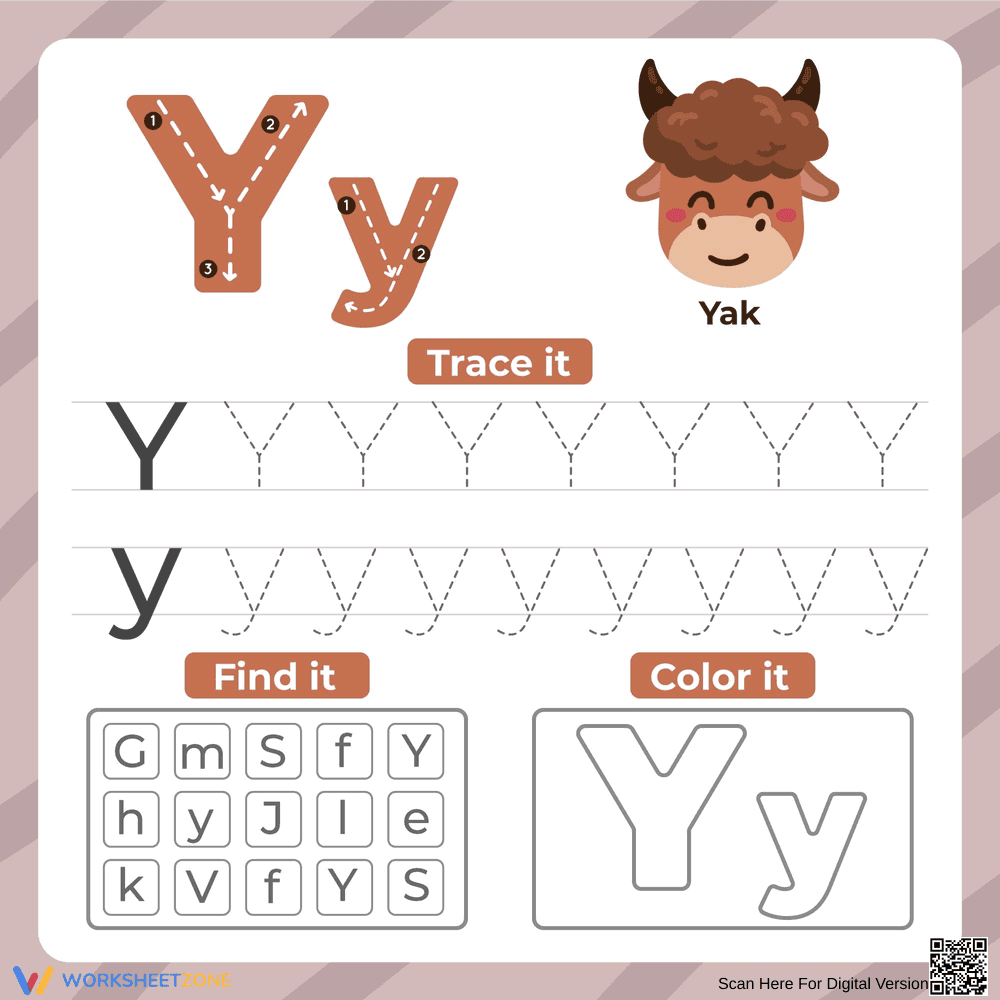

Letter Y Worksheet — Printable Grade K Practice
Paste this activity's link or code into your existing LMS (Google Classroom, Canvas, Teams, Schoology, Moodle, etc.).
Students can open and work on the activity right away, with no student login required.
You'll still be able to track student progress and results from your teacher account.
This printable letter Y worksheet helps early learners master alphabet recognition and handwriting fundamentals. Students practice identifying, tracing, and coloring both uppercase and lowercase Y, building essential fine motor skills. The engaging format ensures young readers develop confidence in their foundational literacy abilities right from the start.
At a Glance
- Grade: K · Subject: English
- Standard:
CCSS.ELA-LITERACY.L.K.1.a— Print many upper- and lowercase letters.- Skill Focus: Letter Y recognition and tracing
- Format: 1 page · 3 task types · No answer key needed · PDF
- Best For: Morning work or literacy centers
- Time: 10–15 minutes
This single-page resource features three activity zones to reinforce letter familiarity. The top section provides guided directional arrows for proper stroke order, followed by two rows of dotted letters for tracing practice. A "Find it" word search grid challenges students to visually discriminate the target letter among distractors, while a "Color it" block offers a creative outlet to reinforce letter shapes. A friendly yak illustration anchors the page to build phonetic association.
- Print (1 minute): Simply download the PDF and print class sets. The high-contrast black-and-white design ensures crisp copies while saving ink.
- Distribute (1 minute): Hand out the sheets along with pencils and crayons. The visual instructions make the tasks immediately clear to early readers.
- Review (0 minutes): The self-explanatory nature of the tracing and coloring tasks requires no formal grading, making it an ideal independent activity.
Teacher preparation time is under two minutes. This makes the resource highly suitable for emergency sub plans, quick morning work, or spontaneous literacy center rotations.
This resource is directly aligned to CCSS.ELA-LITERACY.L.K.1.a: Print many upper- and lowercase letters. It also supports foundational reading skills by requiring students to recognize and name letters of the alphabet. Both standard codes can be copied directly into lesson plans, IEP goals, or district curriculum mapping tools.
Deploy this worksheet during morning arrival to establish a calm routine before direct instruction begins. Alternatively, place it in a literacy center alongside tactile letter manipulatives for independent practice. While students work, teachers can conduct quick formative assessments by observing pencil grip and stroke direction during the tracing portion. Expected completion time ranges from 10 to 15 minutes, depending on the child's fine motor development.
This material is designed for Kindergarten students, though it serves as excellent remedial practice for first graders needing handwriting reinforcement. The clear, uncluttered layout provides built-in differentiation for students who become easily overwhelmed by busy pages. Pair this activity with a read-aloud book featuring "Y" vocabulary or an anchor chart displaying common yak, yarn, and yellow items.
Developing automaticity in letter formation is a critical precursor to fluent writing and reading comprehension. According to Fisher & Frey (2014), providing students with targeted, repetitive practice in foundational skills reduces cognitive load, allowing young learners to eventually focus on meaning-making rather than basic mechanics. This targeted practice sheet directly addresses CCSS.ELA-LITERACY.L.K.1.a by requiring students to print many upper- and lowercase letters accurately and consistently. By combining visual discrimination tasks—such as locating specific characters in a mixed grid—with kinesthetic tracing exercises, the worksheet engages multiple learning pathways simultaneously. Early intervention in handwriting and letter recognition has been shown to significantly impact later literacy outcomes. Educators utilizing this comprehensive resource can ensure their students receive the structured, evidence-based repetition necessary to solidify these essential early literacy milestones and build lasting academic confidence.


