


























Views
Downloads
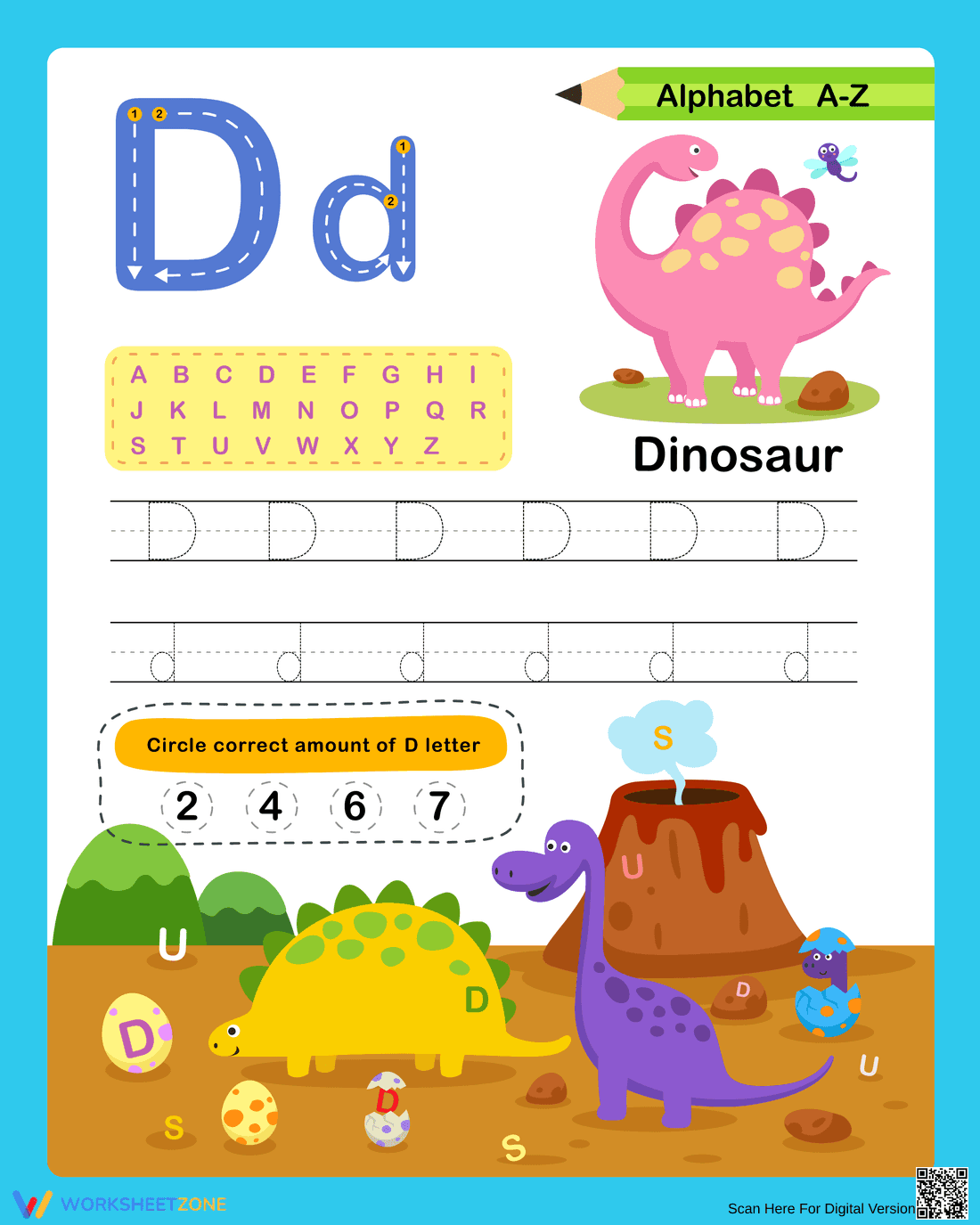

Letter D Alphabet Worksheet | Essential Kindergarten Ready
Paste this activity's link or code into your existing LMS (Google Classroom, Canvas, Teams, Schoology, Moodle, etc.).
Students can open and work on the activity right away, with no student login required.
You'll still be able to track student progress and results from your teacher account.
This Grade K Letter D worksheet helps early learners master alphabet recognition and formation through structured tracing and visual identification. Students practice writing uppercase and lowercase letters while engaging with a dinosaur-themed counting activity to reinforce letter-sound associations. It provides a clear path toward foundational literacy and handwriting proficiency.
At a Glance
- Grade: Kindergarten · Subject: ELA
- Standard:
CCSS.ELA-LITERACY.RF.K.1.D— Recognize and name all upper- and lowercase letters of the alphabet- Skill Focus: Letter D formation and recognition
- Format: 1 page · 13 problems · Answer key included · PDF
- Best For: Morning work or literacy centers
- Time: 10–15 minutes
This single-page PDF features a comprehensive layout for the letter D. It includes large directional stroke guides for initial modeling, 6 uppercase tracing opportunities, and 6 lowercase tracing opportunities on primary-ruled lines. The bottom section contains a "find and count" visual search task set in a prehistoric scene, requiring students to identify the letter D among distractors.
The resource is designed for immediate classroom implementation with three simple steps. First, print the single-page PDF (30 seconds). Second, distribute the sheets to students for independent or guided practice (1 minute). Finally, review the counting activity as a whole group to check for visual discrimination accuracy (1 minute). This workflow ensures total teacher prep time remains under 2 minutes.
The primary focus is CCSS.ELA-LITERACY.RF.K.1.D, which requires students to recognize and name all upper- and lowercase letters of the alphabet. By combining tactile tracing with visual identification, the worksheet supports the development of orthographic mapping. Both standard codes can be copied directly into lesson plans, IEP goals, or district curriculum mapping tools.
Use this worksheet during the "You Do" phase of a gradual release lesson after introducing the letter D sound and shape. It serves as an excellent formative assessment tool; observe student grip and stroke direction during the tracing portion to identify those needing fine motor intervention. Expect completion within 10 to 15 minutes.
This resource is ideal for preschool, kindergarten, and first-grade students beginning their literacy journey. It is particularly effective for English Language Learners (ELLs) who benefit from the visual dinosaur anchor. Pair this worksheet with a letter D anchor chart or a phonics reader for a complete instructional block.
According to the RAND AIRS 2024 report, consistent exposure to multisensory alphabet activities is a critical predictor of early reading success. This worksheet targets CCSS.ELA-LITERACY.RF.K.1.D by integrating handwriting practice with visual discrimination, ensuring students can distinguish the letter D from similar characters. Research from Fisher & Frey (2014) emphasizes that structured tracing provides the necessary scaffolding for fine motor development in early childhood settings. By providing 13 distinct tasks, this resource offers the repetition required for letter-shape mastery without overwhelming the learner. The inclusion of both uppercase and lowercase forms aligns with evidence-based practices for comprehensive alphabet instruction. Educators can utilize this printable to bridge the gap between letter recognition and independent writing, providing a reliable tool for daily literacy routines and progress monitoring in the primary classroom.


