


























Views
Downloads

Printable Alliteration Worksheet | Grade 3 ELA
Paste this activity's link or code into your existing LMS (Google Classroom, Canvas, Teams, Schoology, Moodle, etc.).
Students can open and work on the activity right away, with no student login required.
You'll still be able to track student progress and results from your teacher account.
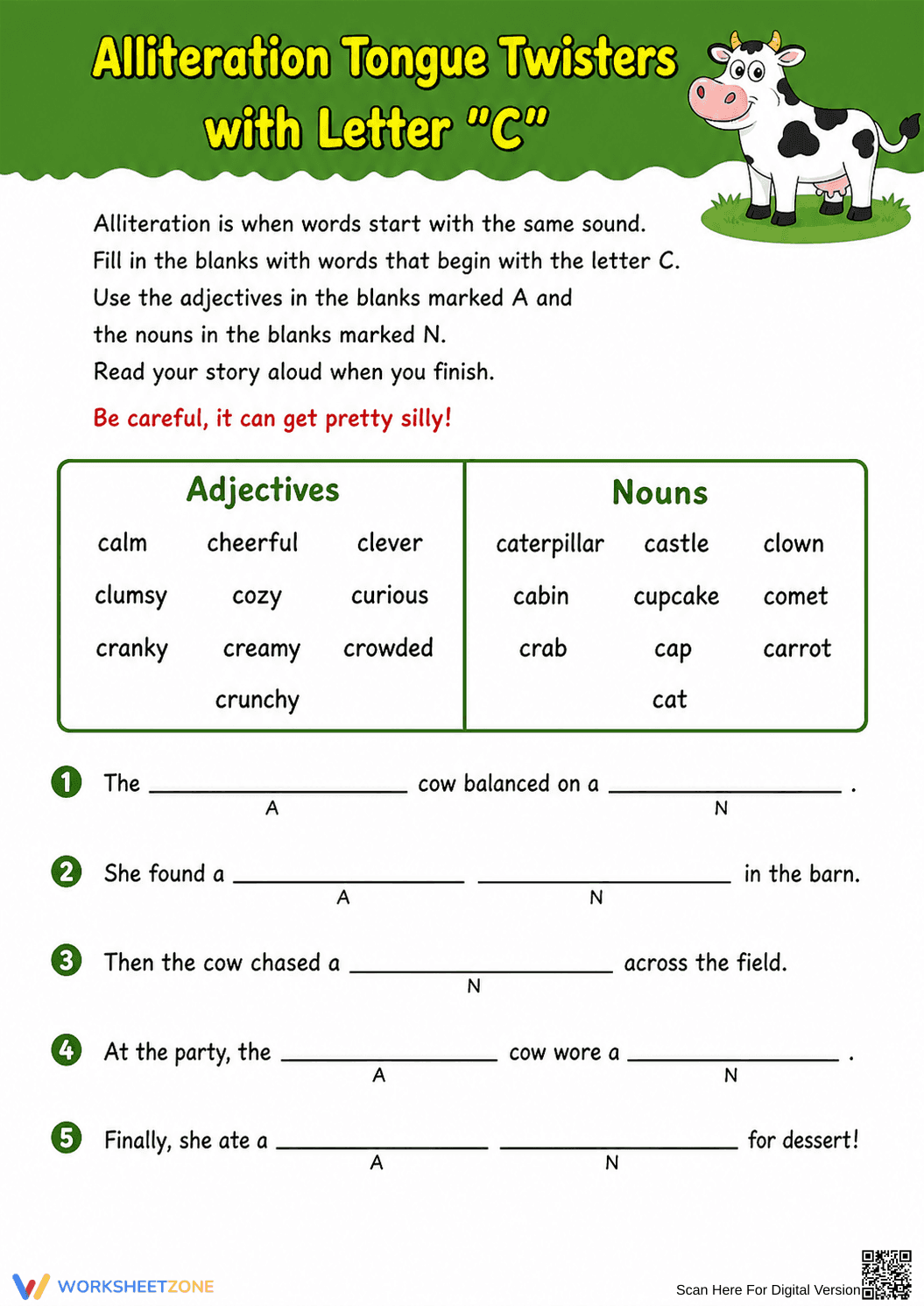
This Grade 3 English Language Arts worksheet helps students master alliteration and parts of speech by creating silly tongue twisters. By selecting specific adjectives and nouns starting with the letter C, learners practice identifying word functions while exploring how sound devices create rhythm and humor in writing.
At a Glance
- Grade: 3 · Subject: English Language Arts
- Standard:
CCSS.ELA-LITERACY.L.3.3.A— Choose words and phrases for effect.- Skill Focus: Alliteration and Parts of Speech
- Format: 1 page · 5 problems · Answer key included · PDF
- Best For: Independent practice
- Time: 10–15 minutes
Inside this single-page resource, students will find a clear definition of alliteration alongside two categorized word banks featuring letter C adjectives and nouns. The worksheet provides five fill-in-the-blank sentences where students must strategically place the correct part of speech to complete a humorous story about a cow. A complete answer key is included to ensure accurate grading and quick review.
This resource is designed for immediate classroom implementation.
- Print (1 minute): Simply download the PDF and print a class set. The layout ensures crisp copies.
- Distribute (1 minute): Hand out the worksheets during your literacy block. The instructions are self-explanatory, allowing students to begin working immediately.
- Review (3 minutes): Use the provided answer key to quickly check student responses or conduct a whole-class read-aloud of the silly sentences.
With a total prep time of under two minutes, this activity is an ideal addition to any emergency sub plan or independent literacy center.
This worksheet is directly aligned to CCSS.ELA-LITERACY.L.3.3.A, requiring students to choose words and phrases for effect. By selecting specific adjectives and nouns to create alliteration, learners demonstrate an understanding of how language choices impact the tone and rhythm of a sentence. It also reinforces the distinct roles of nouns and adjectives. Both standard codes can be copied directly into lesson plans or IEP goals.
This versatile worksheet serves as an excellent independent practice activity following direct instruction on figurative language or parts of speech. Assign it during literacy centers for individual or paired work to construct the funniest sentences. Alternatively, it functions perfectly as a quick formative assessment. While students work, teachers can circulate and observe whether learners correctly distinguish between the adjective and noun word banks when filling the designated A and N blanks. Expect students to complete this activity within 10 to 15 minutes.
This resource is primarily designed for third-grade students developing their creative writing and grammar skills. The categorized word banks provide built-in scaffolding, making it accessible for English Language Learners and students who need additional vocabulary support. It pairs naturally with a read-aloud of a classic alliterative picture book or a direct instruction lesson on identifying adjectives and nouns in context.
Integrating sound devices like alliteration into early elementary grammar instruction significantly enhances both phonetic awareness and vocabulary retention. According to Fisher & Frey (2014), providing students with structured, playful language tasks increases engagement and promotes deeper understanding of complex grammatical concepts. This worksheet directly targets CCSS.ELA-LITERACY.L.3.3.A, asking students to choose words and phrases for effect. By requiring learners to select specific adjectives and nouns to complete a humorous narrative, the activity bridges the gap between mechanical grammar practice and creative expression. The use of targeted word banks reduces cognitive overload, allowing students to focus entirely on the rhythmic and structural elements of the sentences. This evidence-based approach ensures that learners not only memorize the definitions of parts of speech but actively apply them to construct meaningful, engaging text in the classroom.


