


























Views
Downloads

Printable Alliteration Worksheet | Grade 3-9 ELA Practice
Paste this activity's link or code into your existing LMS (Google Classroom, Canvas, Teams, Schoology, Moodle, etc.).
Students can open and work on the activity right away, with no student login required.
You'll still be able to track student progress and results from your teacher account.
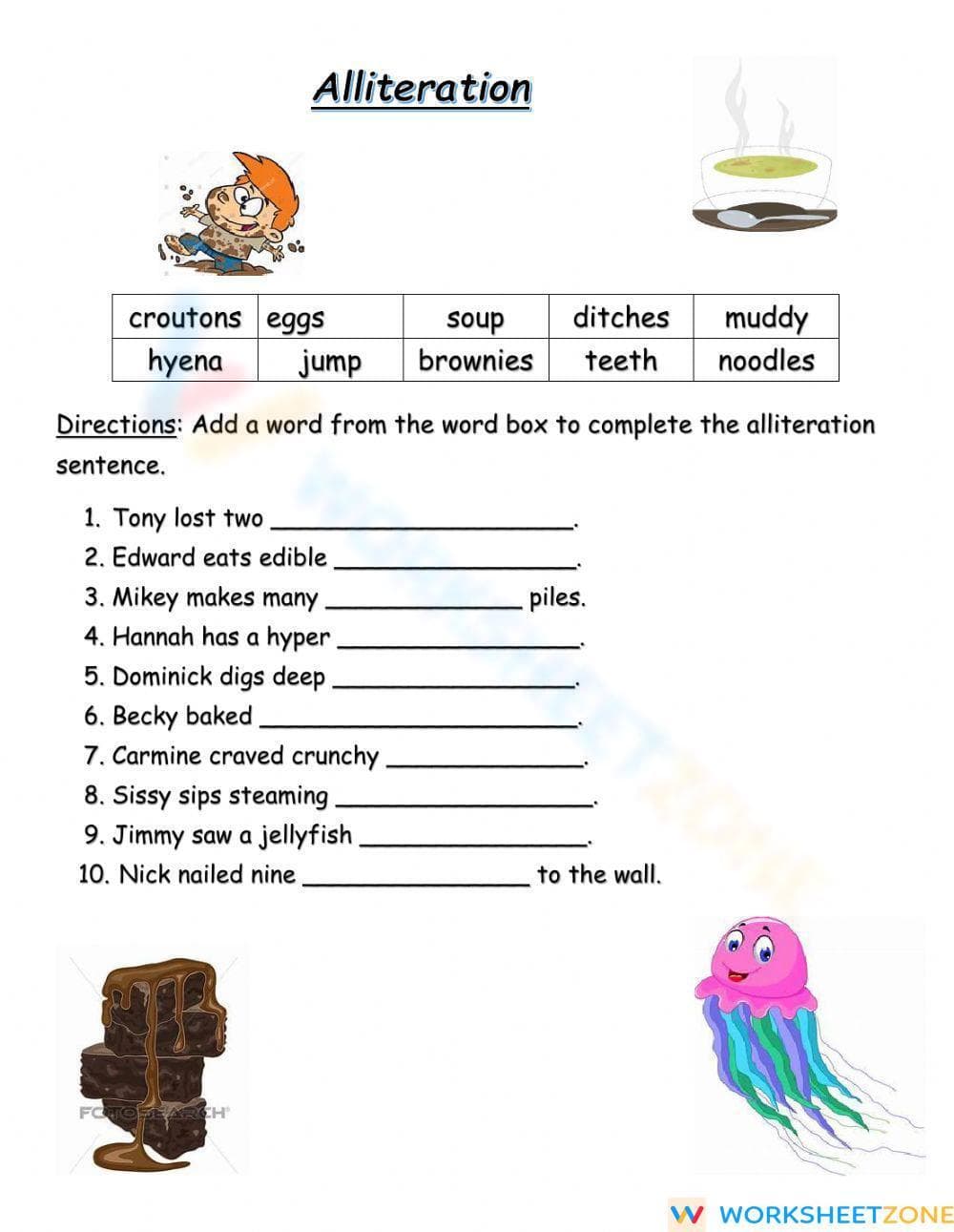
This alliteration worksheet provides a focused way for students to master figurative language. By completing ten sentences with a provided word bank, learners develop a practical understanding of how repeated initial consonant sounds create rhythm. This essential ELA resource ensures students can identify and apply alliteration effectively across multiple grade levels.
At a Glance
- Grade: 3-9 · Subject: ELA
- Standard:
CCSS.ELA-LITERACY.L.5.5— Identify and complete alliteration sentences to enhance writing rhythm, phonemic awareness, and figurative meaning.- Skill Focus: Alliteration identification and completion
- Format: 1 comprehensive page · 10 targeted problems · Full answer key included · PDF
- Best For: Literacy centers, independent practice, and quick figurative language assessments
- Time: 15–20 minutes
What's Inside
This single-page PDF features ten sentences missing a key word that completes an alliteration pattern. A word box containing terms like "brownies" and "hyena" allows students to match sounds to sentence starters. The worksheet includes playful illustrations to provide visual context for the exercises. A full answer key is included to facilitate quick grading or self-checking.
Skill Progression
The worksheet follows a structured progression toward mastery. In guided practice, students analyze initial sounds (e.g., "Tony lost two...") and scan for a matching phoneme ("teeth"). Supported practice continues with more complex sentences and varied vocabulary. Finally, independent practice is achieved as students complete the set, solidifying their ability to recognize and produce alliteration. This gradual-release approach ensures foundational success.
Standards Alignment
This resource aligns to CCSS.ELA-LITERACY.L.5.5: "Demonstrate understanding of figurative language, word relationships, and nuances in word meanings." It targets the ability to utilize sound-based devices to enhance writing. It also supports CCSS.ELA-LITERACY.RL.4.4 regarding figurative language in text. Both standard codes can be copied directly into lesson plans, IEP goals, or curriculum mapping tools.
How to Use It
Use this worksheet after direct instruction on figurative language to reinforce alliteration. It works well as a formative assessment; observe if students match words based on phonemes or meaning alone. Have students read completed sentences aloud to hear the rhythmic effect. The expected completion time is 15 to 20 minutes, making it an ideal bell-ringer or exit ticket.
Who It's For
This worksheet is designed for students in grades 3-9, with accessible yet challenging vocabulary. It is effective for English Language Learners developing phonemic awareness and students requiring scaffolded literacy support. Pair this resource with a mentor text rich in figurative language or an anchor chart displaying common alliteration examples to deepen the learning experience.
Research by Fisher & Frey (2014) emphasizes that the gradual release of responsibility is critical for students to master complex literary devices like alliteration. This Grade 3-9 worksheet applies these principles by providing a structured word bank that reduces cognitive load, allowing students to focus on phonemic patterns. Aligned to the CCSS.ELA-LITERACY.L.5.5 standard, the resource requires students to demonstrate a nuanced understanding of how sounds interact to create meaning within a sentence. Studies in the ScienceDirect TpT Analysis suggest that isolated skill practice, when paired with visual cues and immediate feedback through answer keys, significantly improves retention of figurative language concepts among diverse learners. By engaging with these ten targeted tasks, students build the foundational phonological awareness and rhythmic sensitivity necessary for advanced poetic analysis, nuanced reading comprehension, and creative writing mastery.


