


























Views
Downloads


Printable Alliteration Adjectives Worksheet | Grade 3-9 ELA
Paste this activity's link or code into your existing LMS (Google Classroom, Canvas, Teams, Schoology, Moodle, etc.).
Students can open and work on the activity right away, with no student login required.
You'll still be able to track student progress and results from your teacher account.
Master alliteration with this adjectives worksheet for grades 3-9. Students pair descriptive adjectives with nouns to create rhythmic phrases that enhance creative writing and vocabulary. This resource focuses on the practical application of sound devices to produce evocative and memorable language in student compositions.
At a Glance
- Grade: 3–9 · Subject: English Language Arts (ELA)
- Standard:
CCSS.ELA-LITERACY.RL.3.4— Determine the meaning of words and phrases as they are used in a text- Skill Focus: Alliteration and Adjectives
- Format: 2 pages · 14 problems · Answer key included · PDF
- Best For: Creative writing workshops and bell-ringers
- Time: 15–20 minutes
What's Inside
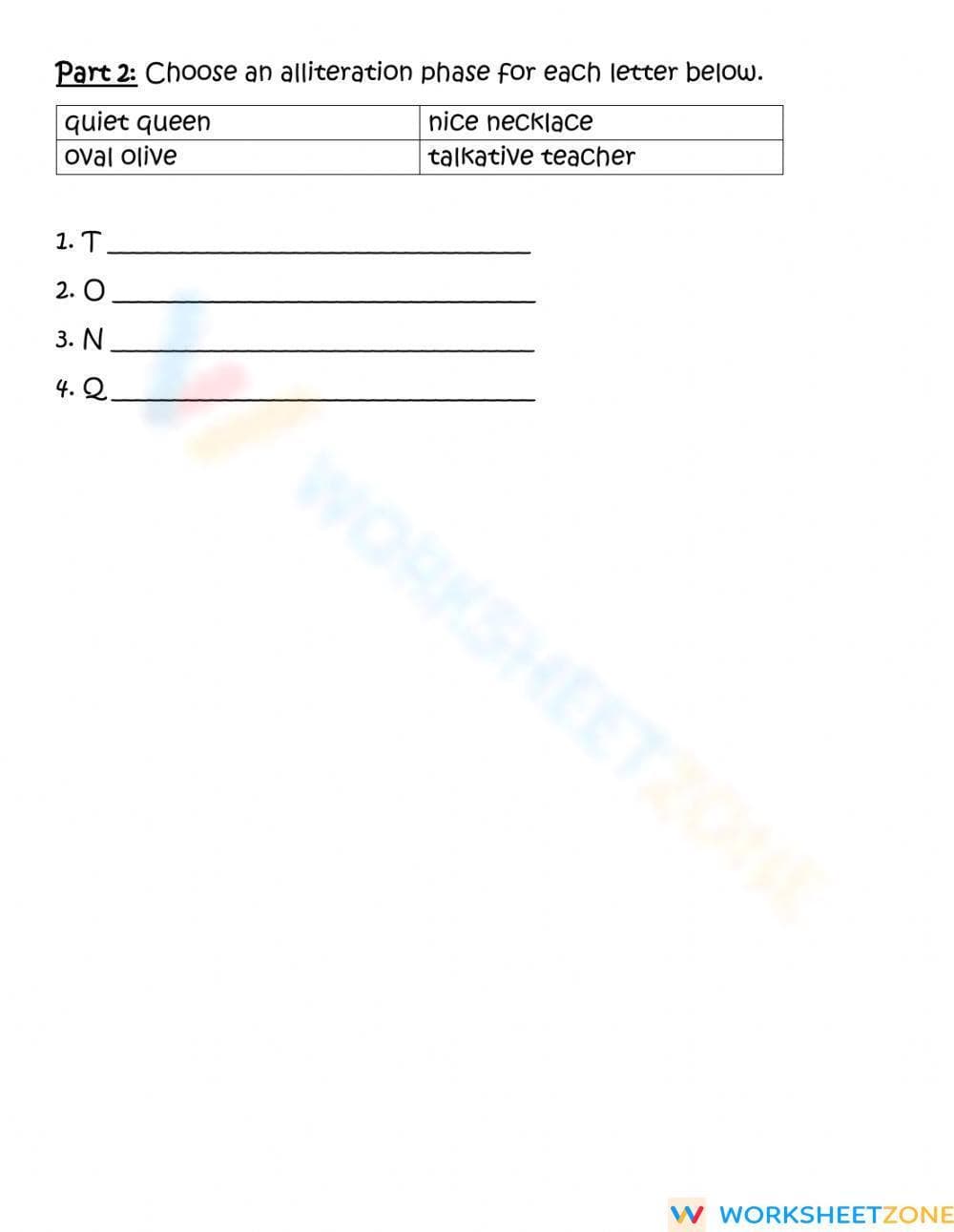
This two-page PDF features a structured approach to alliteration. It includes a clear definition alongside a word bank to support student choices. Part 1 challenges students to match ten adjectives to alliterative nouns, while Part 2 encourages independent creation with letter-based prompts. A complete answer key is provided for efficient grading and student feedback.
Skill Progression
- Guided Practice: Students match adjectives to a specific word bank of nouns, ensuring foundational sound-matching mastery (10 problems).
- Supported Practice: Example phrases like "quiet queen" provide scaffolding for the transition to independent generation.
- Independent Practice: Students generate original alliterative phrases based on initial letters (4 problems).
This gradual-release approach ensures students build confidence before creating original figurative content.
Standards Alignment
Aligned to CCSS.ELA-LITERACY.RL.3.4, this resource helps students determine the meaning of figurative language. By practicing alliteration, students understand how authors use sound devices to create impact. These standard codes can be copied directly into lesson plans, IEP goals, or district curriculum mapping tools for easy documentation and tracking.
How to Use It
Use this as a mini-lesson during creative writing or as a bell-ringer for figurative language. For formative assessment, observe students during Part 2 to identify those struggling with phoneme identification. Most students complete the exercise in 15-20 minutes, making it ideal for any ELA period or a quick substitute plan activity.
Who It's For
Tailored for upper elementary and middle school students refining descriptive writing. It is effective for students needing support with phonics or those ready for sophisticated literary devices. Pair this with a poetry analysis or figurative language anchor chart to maximize the instructional impact in your classroom.
According to the RAND AIRS 2024 report on literacy instructional materials, the use of structured, skill-focused worksheets significantly improves student retention of linguistic devices. By providing students with 14 targeted opportunities to practice alliteration and adjective pairing, this resource aligns with the phonological and vocabulary demands of CCSS.ELA-LITERACY.RL.3.4. Research from Fisher & Frey (2014) emphasizes that gradual release models are essential for moving students toward independent mastery of complex figurative language skills. This worksheet provides the necessary scaffolding to bridge the gap between recognizing sound patterns and actively utilizing them in original composition. As a printable resource, it meets the high-quality instructional criteria cited in EdReports for standard-aligned ELA materials. Teachers can integrate this tool into their curriculum to ensure students meet state-mandated literacy benchmarks while fostering interest in the musicality of the English language.


