

































Aligned Test Points & Styles Worksheet | Grade 9 Algebra I

Paste this activity's link or code into your existing LMS (Google Classroom, Canvas, Teams, Schoology, Moodle, etc.).
Students can open and work on the activity right away, with no student login required.
You'll still be able to track student progress and results from your teacher account.
Mastering two-variable linear inequalities requires students to connect boundary styles with half-plane solution sets. This 4-page worksheet guides Grade 9 Algebra I students through evaluating dashed versus solid lines and verifying shaded regions using algebraic test points across 12 targeted mathematical exercises.
At a Glance
- Grade: 9 · Subject: Algebra I
- Standard:
HSA-REI.D.12— Graph linear inequality solutions as half-planes- Skill Focus: Connect Test Points and Boundary Styles
- Format: 4 pages · 12 problems · Answer key included · PDF
- Best For: Guided practice and error analysis
- Time: 35–45 minutes
What's Inside
This resource opens with a core principles box detailing boundary styles and test-point guidelines, followed by 12 sequentially structured problems across 4 pages. Students interpret coordinate graphs, rewrite linear inequalities, analyze budget constraints, and solve systems. Part C delivers higher-order error analysis tasks. A complete 2-page answer key provides graphed solutions and step-by-step verification.
Skill Progression
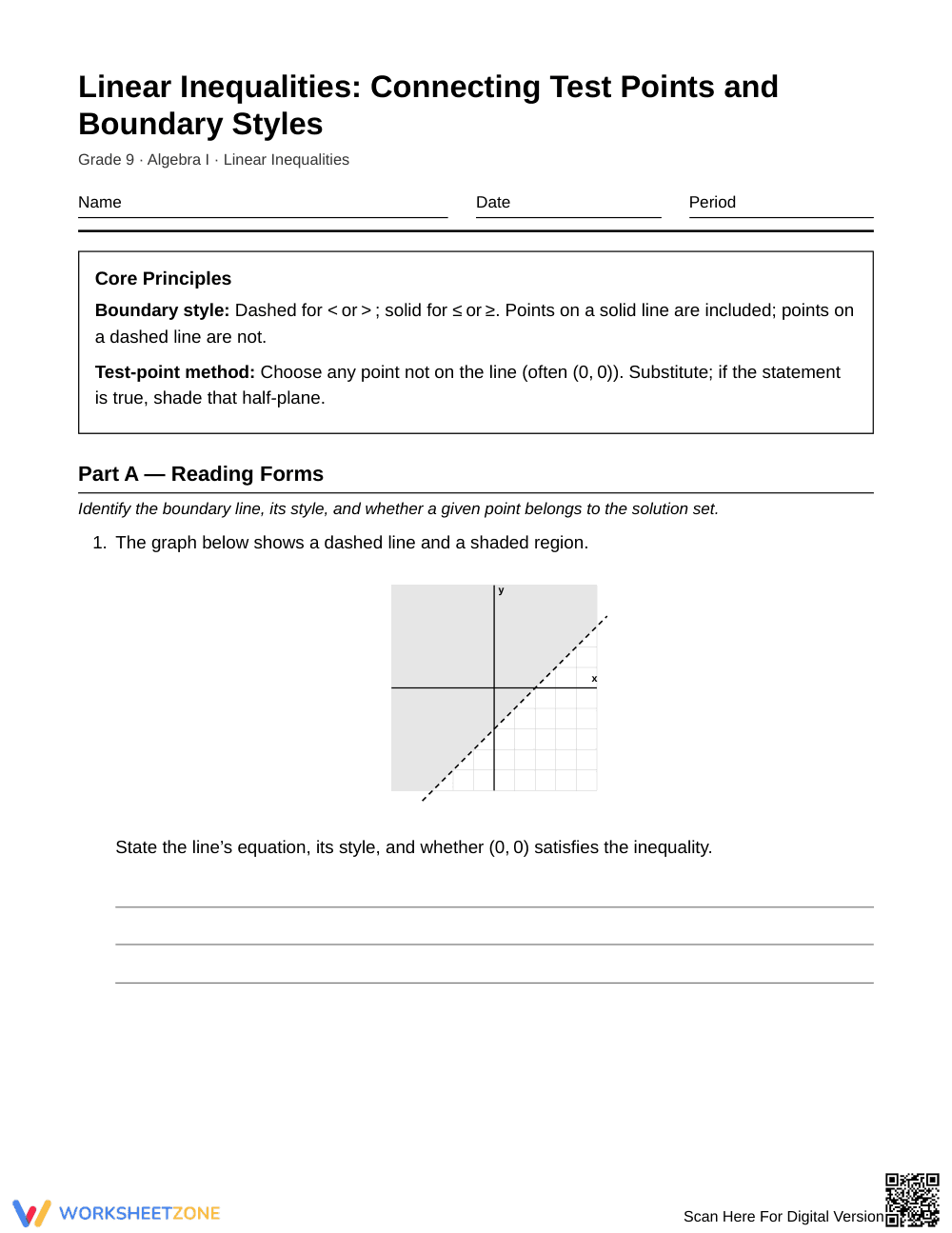
- Guided Practice (Part A, Problems 1–3): Students read graphs and basic equations, identifying boundary line styles and testing points like the origin.
- Supported Practice (Part B, Problems 4–9): Learners convert standard-form inequalities, compare strict versus non-strict boundaries, model budget limits, and test points in systems.
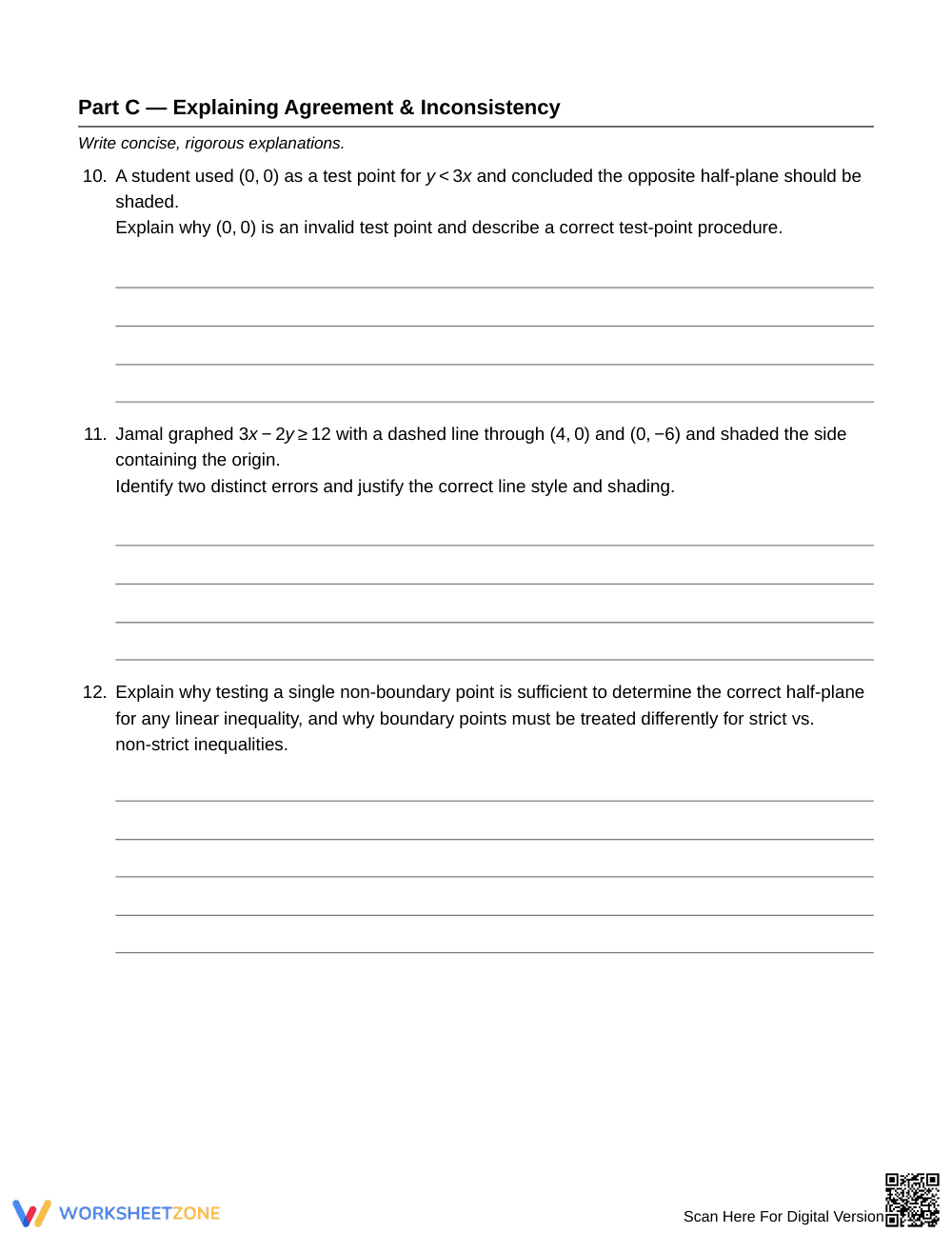
- Independent Practice (Part C, Problems 10–12): Students analyze graphing errors, explain invalid test points on boundary lines, and justify half-plane properties.
This gradual-release structure moves learners smoothly from visual recognition to independent mathematical justification.
Standards Alignment
This worksheet aligns directly with `HSA-REI.D.12`: Graph the solutions to a linear inequality in two variables as a half-plane, excluding dashed boundaries and including solid boundaries. A word problem also supports `HSA-CED.A.3` by representing practical constraints. Both standard codes can be copied directly into lesson plans, IEP goals, or district curriculum mapping tools.
How to Use It
Use this worksheet during the active practice phase following direct instruction on graphing linear inequalities. Dedicate 35 to 45 minutes for student completion, utilizing Part A as an initial check for understanding. As a formative assessment observation tip, monitor whether students select test points that fall off the boundary line before shading.
Who It's For
This activity supports Grade 9 Algebra I students and secondary learners needing targeted algebra review. Visual learners benefit from explicit graphical representations, while the reference box aids students needing procedural reminders. Pair this assignment with a graphing calculator demonstration or a classroom anchor chart on inequality symbols.
Under standard HSA-REI.D.12, Grade 9 Algebra I students learn to graph solutions to two-variable linear inequalities as half-planes, distinguishing dashed boundaries for strict inequalities from solid boundaries for non-strict relationships. Research documented by Fisher & Frey (2014) shows that structured gradual-release frameworks—advancing from guided graphical reading to independent error analysis—substantially improve conceptual retention and procedural fluency. By requiring learners to verify solution sets using algebraic test points, this 12-task worksheet prevents rote memorization of shading rules. Students discover why points lying directly on dashed lines cannot be included in solution sets and construct written arguments defending proper graphing methods. Addressing common algebraic mistakes through error analysis prepares students for advanced modeling and systems of inequalities. This standards-aligned resource provides educators with verified instructional materials that ensure measurable mastery of linear inequality graphing on the coordinate plane.


