


























Views
Downloads


Aligned Logarithmic Scales Worksheet | Grade 11 Algebra II
Paste this activity's link or code into your existing LMS (Google Classroom, Canvas, Teams, Schoology, Moodle, etc.).
Students can open and work on the activity right away, with no student login required.
You'll still be able to track student progress and results from your teacher account.
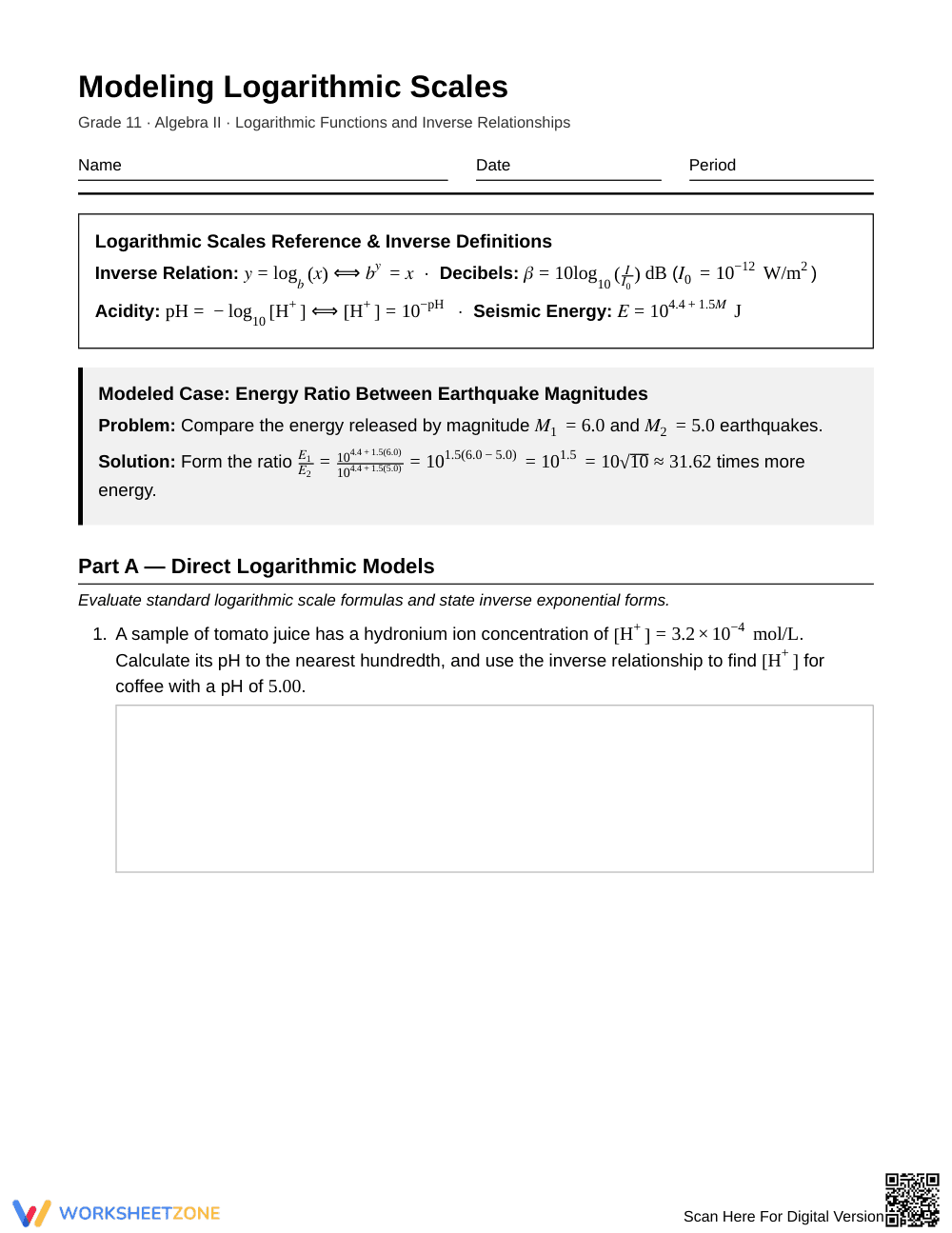
This Grade 11 Algebra II worksheet trains students to model real-world phenomena using logarithmic scales and inverse exponential relationships. Learners calculate values for pH, decibels, seismic energy, and stellar brightness while analyzing threshold constraints. By translating between logarithmic formulas and exponential forms, students build fluency with non-linear scale comparisons across STEM contexts.
At a Glance
- Grade: 11 · Subject: Algebra II
- Standard:
HSF-BF.B.5— Apply inverse relationships between exponents and logarithms to model scale data- Skill Focus: Model a Logarithmic Scale
- Format: 4 pages · 10 problems · Answer key included · PDF
- Best For: Algebra II application and modeling practice
- Time: 45–60 minutes
What's Inside
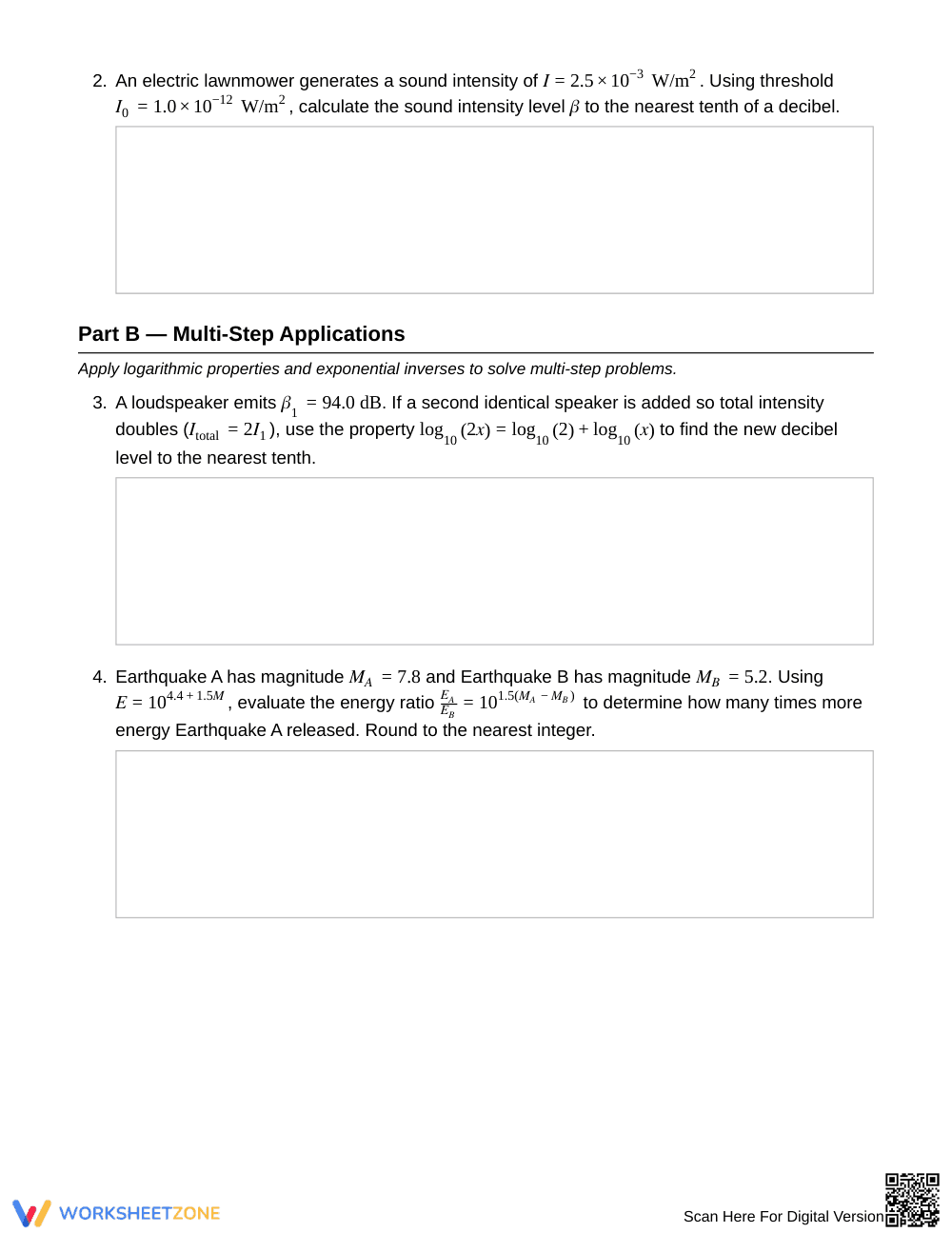
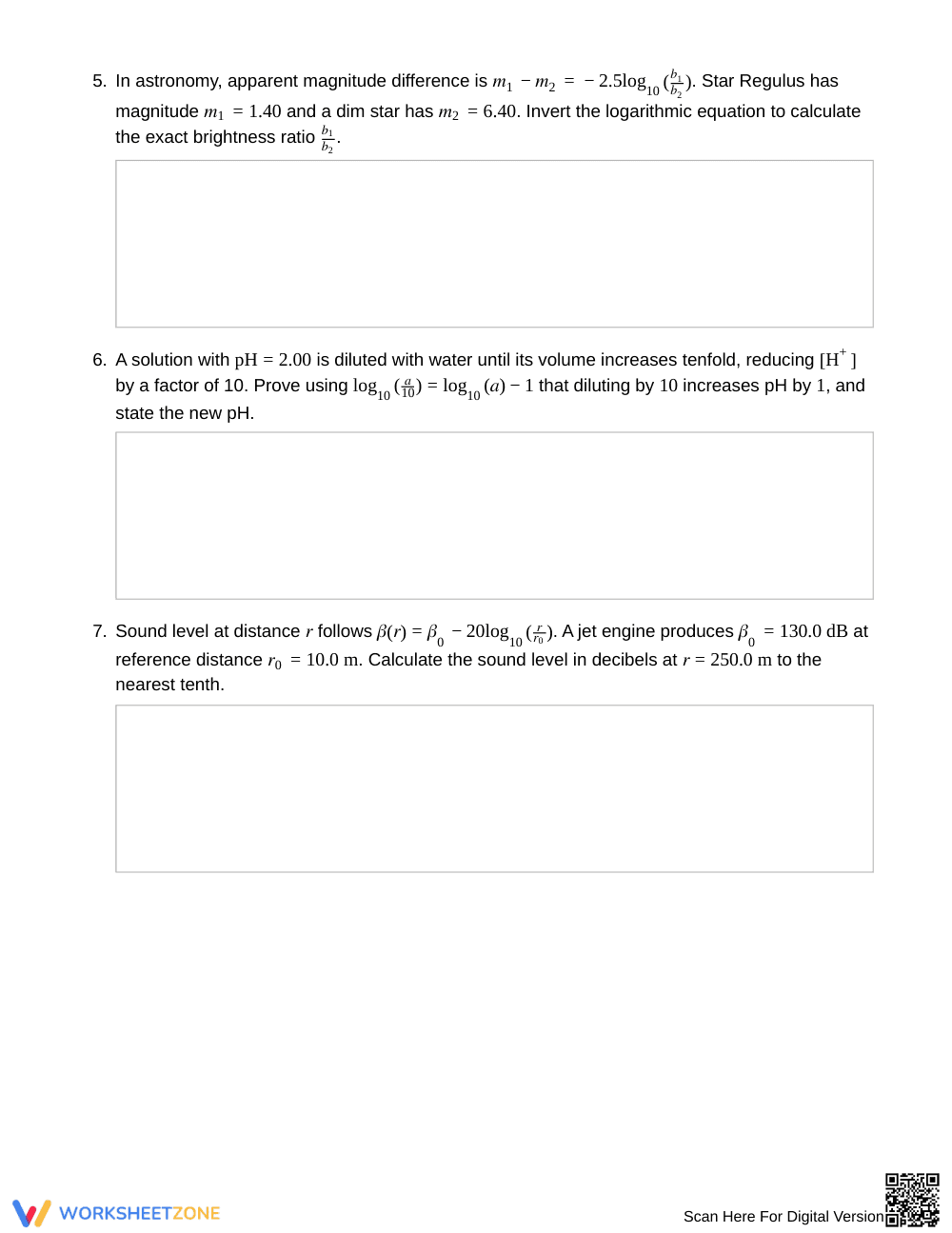
This 4-page resource includes a reference box of scientific formulas, inverse exponential definitions, and a modeled earthquake energy ratio problem. Across 10 multi-step exercises, students work with hydronium concentrations, acoustic levels, stellar magnitudes, and information capacity. A complete 2-page answer key provides step-by-step solutions and rounded values.
Skill Progression
- Guided Practice (Part A, 2 problems): Direct logarithmic evaluation where students calculate pH and decibels using provided formulas and inverse exponential relationships.
- Supported Practice (Part B, 6 problems): Multi-step modeling applications requiring logarithmic properties, distance attenuation functions, astronomical magnitude differences, and bit capacity comparisons.
- Independent Practice (Part C, 2 problems): Constraint-based modeling where students invert logarithmic formulas to solve real-world municipal noise and wastewater inequalities.
This sequence follows a gradual-release model transitioning learners from formula evaluation to multi-step reasoning.
Standards Alignment
This worksheet aligns directly to HSF-BF.B.5: understand the inverse relationship between exponents and logarithms and use this relationship to solve problems. It also supports HSF-LE.A.4 by requiring students to solve exponential models using logarithms. Both standard codes can be copied directly into lesson plans, IEP goals, or district curriculum mapping tools.
How to Use It
Assign this worksheet after direct instruction on logarithms and inverse functions. It works well during collaborative partner practice or as an independent summative assignment. During work time, check whether students mistakenly treat logarithmic differences linearly rather than exponentially when comparing Richter and decibel levels. Expect completion within 45 to 60 minutes.
Who It's For
This resource is designed for Grade 11 Algebra II and pre-calculus students studying logarithmic models. Scaffolds like reference boxes support struggling learners, while constraint tasks extend advanced students. Pair this worksheet with an anchor chart on logarithmic rules or an interactive graphing activity.
According to research highlighted by Fisher & Frey (2014) on purposeful instructional design, student mastery of non-linear algebraic models accelerates when classroom instruction pairs explicit mathematical reference frames with structured, contextual problem-solving progressions. This Grade 11 Algebra II worksheet targets standard HSF-BF.B.5 by guiding students through the inverse relationship between exponential and logarithmic expressions across 10 structured modeling problems. Students analyze real-world scientific scales, calculating exact hydrogen ion concentrations, acoustic decibels, and astronomical brightness ratios while formulating precise boundary solutions for municipal and environmental regulations. Structured reference formulas and worked examples scaffold direct formula evaluation before students tackle multi-step algebraic proofs, sound attenuation problems, and constraint-based inequalities. This rigorous alignment ensures that secondary students bridge conceptual understanding and procedural fluency, transforming abstract logarithmic properties into practical tools for quantitative decision-making across advanced STEM curricula.


