




























Views
Downloads



Aligned Evaluating Functions Worksheet | Grade 9 Algebra I

Paste this activity's link or code into your existing LMS (Google Classroom, Canvas, Teams, Schoology, Moodle, etc.).
Students can open and work on the activity right away, with no student login required.
You'll still be able to track student progress and results from your teacher account.
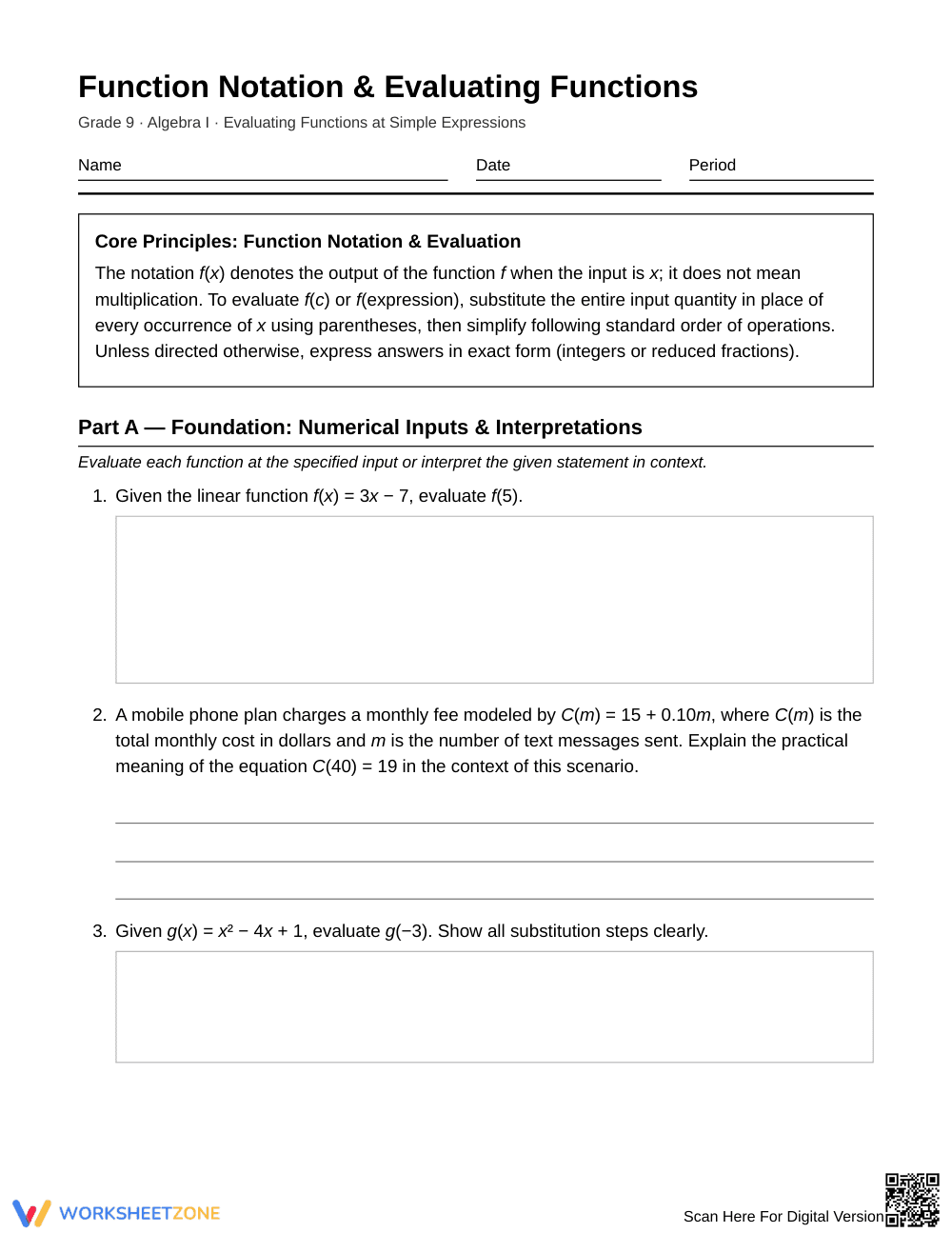
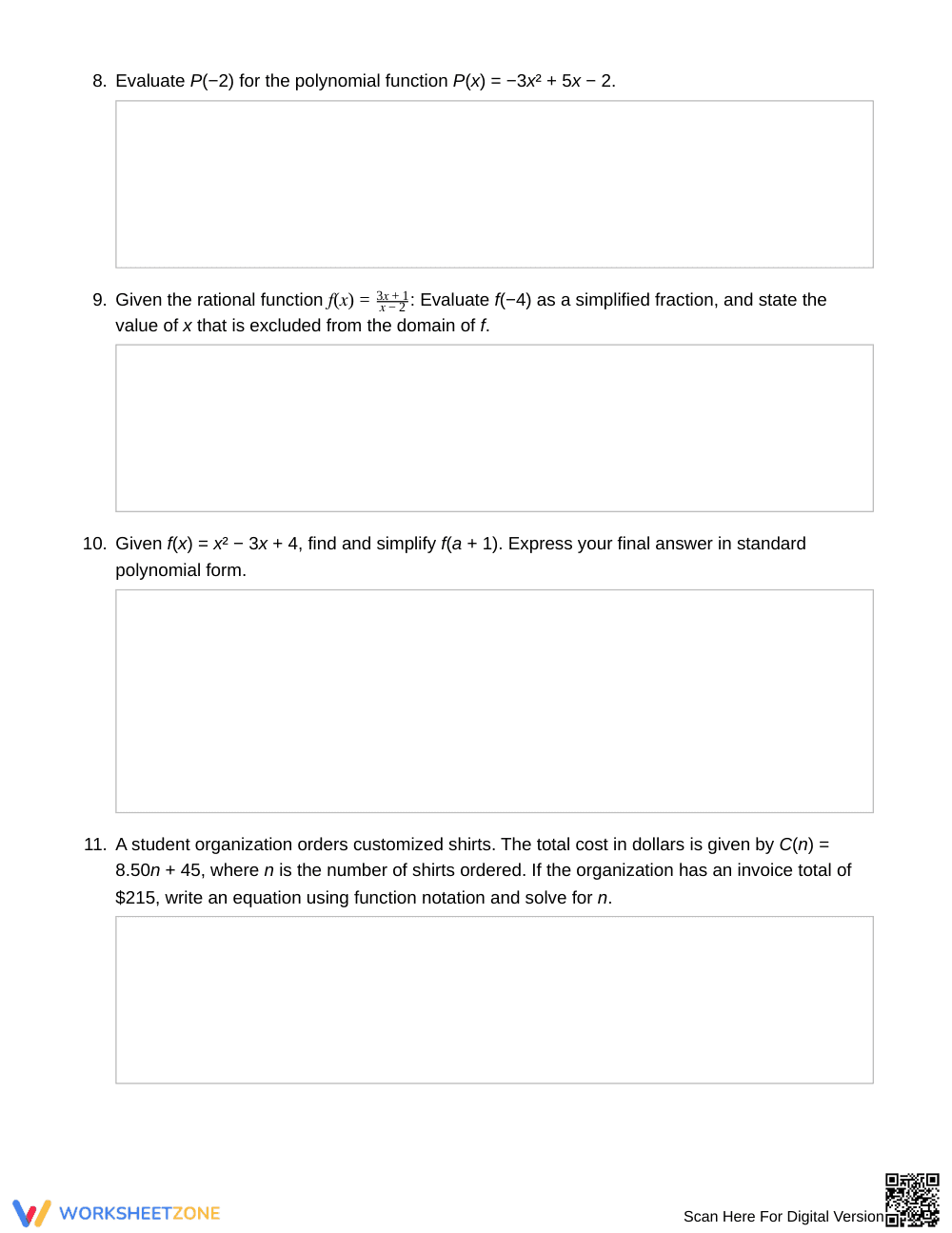
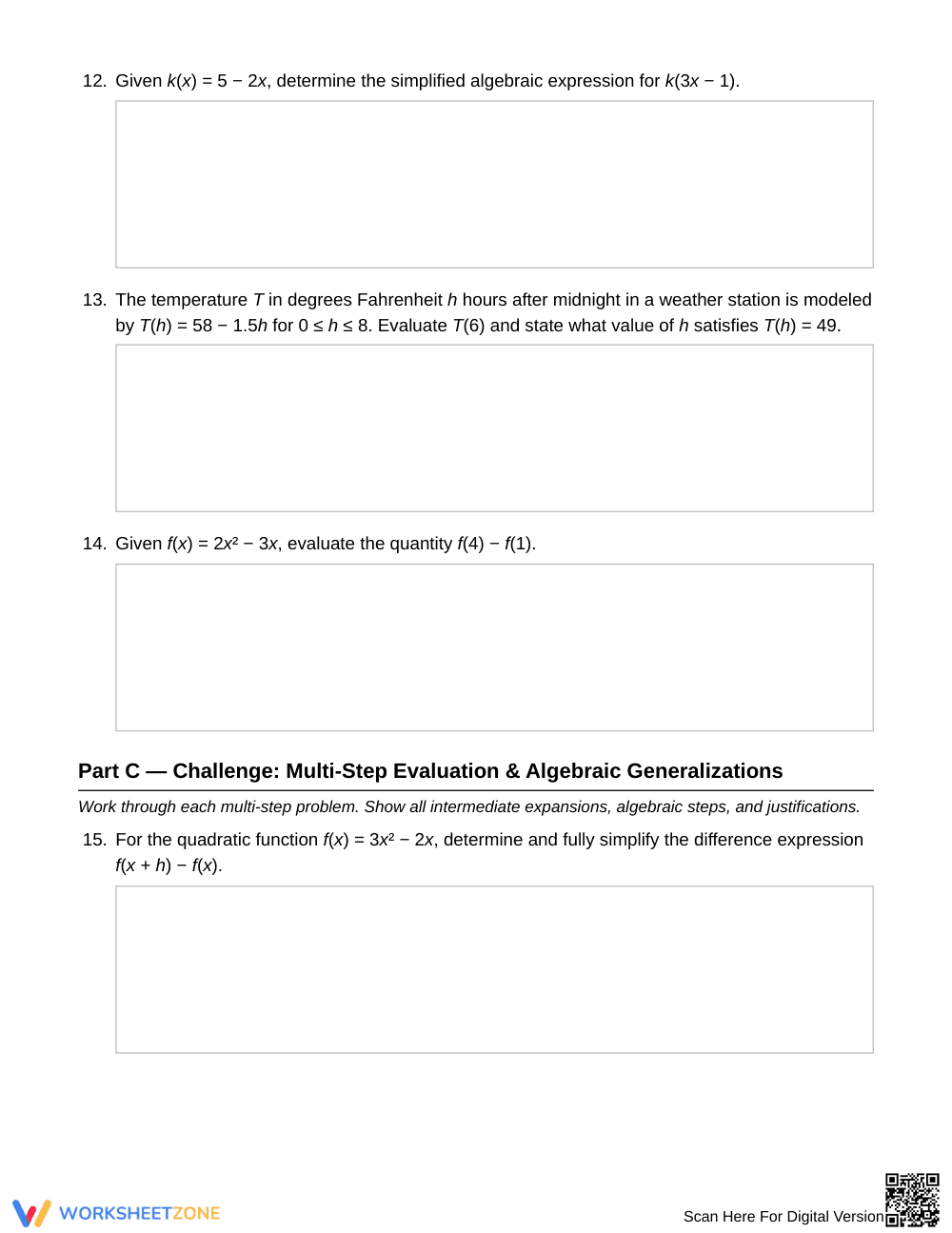
This Grade 9 Algebra I worksheet develops student mastery in evaluating functions using numerical inputs and algebraic expressions. Students calculate outputs, substitute binomials, interpret contextual models, and simplify multi-step expressions. Designed for high school algebra learners, this resource reinforces function notation conventions while eliminating algebraic substitution errors.
At a Glance
- Grade: 9 · Subject: Algebra I
- Standard:
HSF-IF.A.2— Evaluate functions for domain inputs and interpret statements in context.- Skill Focus: Evaluate Functions at Simple Expressions
- Format: 5 pages · 18 problems · Answer key included · PDF
- Best For: Skills practice and review
- Time: 45–60 minutes
Across five pages, this resource delivers 18 structured problems across three sections, paired with a 3-page worked answer key. A foundational Core Principles box reminds students to use parentheses during substitution. The worksheet features tables, quadratic formulas, contextual models, and difference quotient preparation.
Skill Progression
- Guided practice (Part A, 4 problems): Focuses on numerical substitution and tabular data with minimal manipulation to build notation confidence.
- Supported practice (Part B, 10 problems): Introduces binomial inputs, rational functions, and quadratic models where students expand products and combine terms.
- Independent practice (Part C, 4 problems): Challenges students with advanced functional equations and multi-step difference expressions.
This gradual-release sequence guides students from procedural evaluation toward autonomous symbolic reasoning.
Standards Alignment
This worksheet aligns with primary standard `HSF-IF.A.2`: evaluate functions for inputs in their domains and interpret statements in context. It also supports `HSA-APR.A.1` through polynomial operations. Both standard codes can be copied directly into lesson plans, IEP goals, or district curriculum mapping tools.
How to Use It
Assign this worksheet after direct instruction on function notation. Use Parts A and B for collaborative classwork, reserving Part C for extension. For formative assessment, check Problem 6 to ensure students distribute terms correctly when evaluating binomial inputs like (x + 3). Completion typically takes 45 to 60 minutes.
Who It's For
This resource serves Grade 9 Algebra I students mastering functions and Grade 10 students needing targeted intervention. The initial reference box supports striving learners, while Part C extends advanced thinkers. Pair this worksheet with a direct instruction lesson or a visual anchor chart on function machines.
According to research by Fisher & Frey (2014) on the gradual release of responsibility framework, structured instructional sequences that transition from guided numerical practice to independent abstract problem solving significantly improve high school students' retention of complex algebraic procedures. Standard HSF-IF.A.2 requires ninth-grade learners to evaluate functions accurately for inputs in their domains and interpret functional relationships in contextual scenarios. Beginning algebra students frequently misunderstand function notation, often mistaking it for multiplication or dropping negative signs during evaluation. By organizing 18 targeted tasks across three progressive stages—advancing from basic integer inputs to variable expressions and multi-step functional differences—this five-page resource reinforces sound mathematical practices. Accompanied by a complete 3-page worked solution key, the resource provides educators with valuable formative assessment insights while ensuring that secondary algebra students develop the procedural fluency and conceptual understanding essential for success in higher mathematics.


