































Aligned Equivalent Radicals Worksheet | Grade 11 Algebra II

Paste this activity's link or code into your existing LMS (Google Classroom, Canvas, Teams, Schoology, Moodle, etc.).
Students can open and work on the activity right away, with no student login required.
You'll still be able to track student progress and results from your teacher account.
This Grade 11 Algebra II worksheet trains students to evaluate, simplify, and prove equivalent radical and rational exponent expressions under strict real-number domain restrictions. Learners master absolute value conventions, principal root definitions, and domain constraints across 12 analytical problems to ensure algebraic precision.
At a Glance
- Grade: 11 · Subject: Algebra II
- Standard:
HSN-RN.A.2— Rewrite radical and rational exponent expressions using exponent properties- Skill Focus: Compare Equivalent Forms Under Domain Assumptions
- Format: 5 pages · 12 problems · Answer key included · PDF
- Best For: Domain mastery and honors practice
- Time: 45–60 minutes
The 5-page worksheet provides a reference box defining principal roots and rational exponents, followed by 12 multi-part tasks. Students complete interval domain tables, simplify nested radicals, verify algebraic identities requiring absolute value, and diagnose domain fallacies in student work. A 4-page answer key provides complete algebraic proofs.
Skill Progression
- Guided Practice (Part A, Problems 1–3): Students establish domain awareness by calculating interval domains, evaluating negative bases under even and odd roots, and simplifying $\sqrt[6]{x^6}$.
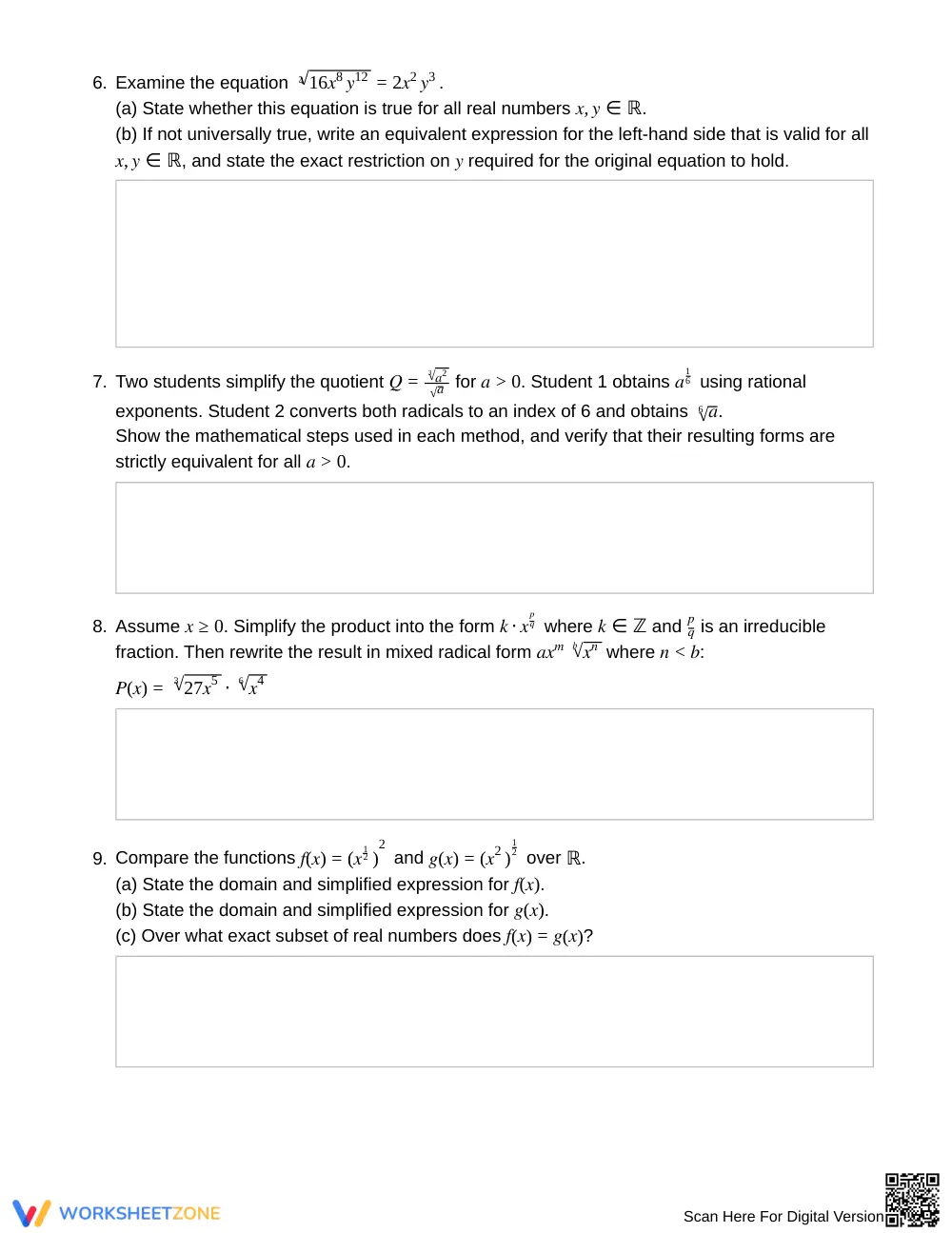
- Supported Practice (Part B, Problems 4–9): Learners apply exponent laws to simplify nested radicals and determine exact intervals where expressions like $(x^2)^{1/2}$ and $(x^{1/2})^2$ agree.
- Independent Practice (Part C, Problems 10–12): Students write formal mathematical explanations to diagnose domain errors, evaluate product rule boundaries, and justify absolute value notation in $\sqrt{x^2-6x+9}=|x-3|$.
This gradual release progression transitions students from identifying domain conventions to constructing rigorous mathematical arguments.
Standards Alignment
This resource aligns directly with HSN-RN.A.2: Rewrite expressions involving radicals and rational exponents using the properties of exponents. It also reinforces HSA-SSE.A.2 by requiring students to recognize equivalent expressions through structural analysis. Both standard codes can be copied directly into lesson plans, IEP goals, or district curriculum mapping tools.
How to Use It
Deploy this worksheet after direct instruction on rational exponents as an in-class problem-solving set or homework. For formative assessment, inspect student work on Part B Problem 6 to check whether students include absolute value notation on extracted variables. Expect completion within 45 to 60 minutes.
Who It's For
Designed for Grade 11 Algebra II, Integrated Math III, and honors classes preparing for Precalculus. Support struggling learners with the Part A reference box while prompting advanced students to complete Part C justifications. Pair this worksheet with graphing calculator comparisons of $f(x)=\sqrt{x^2}$ and $g(x)=x$.
According to EdReports 2024 instructional criteria, high school mathematics curricula must connect procedural manipulation directly to underlying algebraic structures rather than rote algorithmic rules. This 5-page Algebra II resource addresses standard HSN-RN.A.2 by prompting learners to rewrite expressions involving radicals and rational exponents while enforcing real-number domain restrictions. Instead of assuming all variables remain positive, students evaluate precise domain constraints, analyze even versus odd indices, and identify where radical expressions produce non-real values. Across 12 multi-part problems, students build procedural flexibility and conceptual reasoning as they resolve common student misconceptions and establish mathematically valid equivalences. Research summarized by EdReports 2024 confirms that analyzing algebraic equivalence across restricted domains prevents persistent misconceptions in advanced coursework, ensuring students establish the foundational rigor required for success with precalculus functions and analytic mathematical reasoning throughout their secondary education.


