


























Views
Downloads




Aligned Coordinate Proofs Worksheet | Grade 10 Geometry
Paste this activity's link or code into your existing LMS (Google Classroom, Canvas, Teams, Schoology, Moodle, etc.).
Students can open and work on the activity right away, with no student login required.
You'll still be able to track student progress and results from your teacher account.
This Grade 10 coordinate geometry worksheet strengthens students' proof skills by guiding them to identify and correct insufficient classification evidence. Students evaluate coordinate claims about polygons, diagnose logical gaps, and execute precise slope and distance calculations. Through structured error analysis, learners master establishing necessary and sufficient conditions for triangles, parallelograms, rectangles, and rhombi.
At a Glance
- Grade: 10 · Subject: Geometry
- Standard:
HSG-GPE.B.4— Use coordinate methods to prove simple geometric theorems algebraically- Skill Focus: Correcting Insufficient Classification Evidence
- Format: 5 pages · 10 proof repair tasks · Full answer key included · PDF
- Best For: Post-instruction coordinate proof practice and diagnostic error analysis
- Time: 45–60 minutes
What's Inside
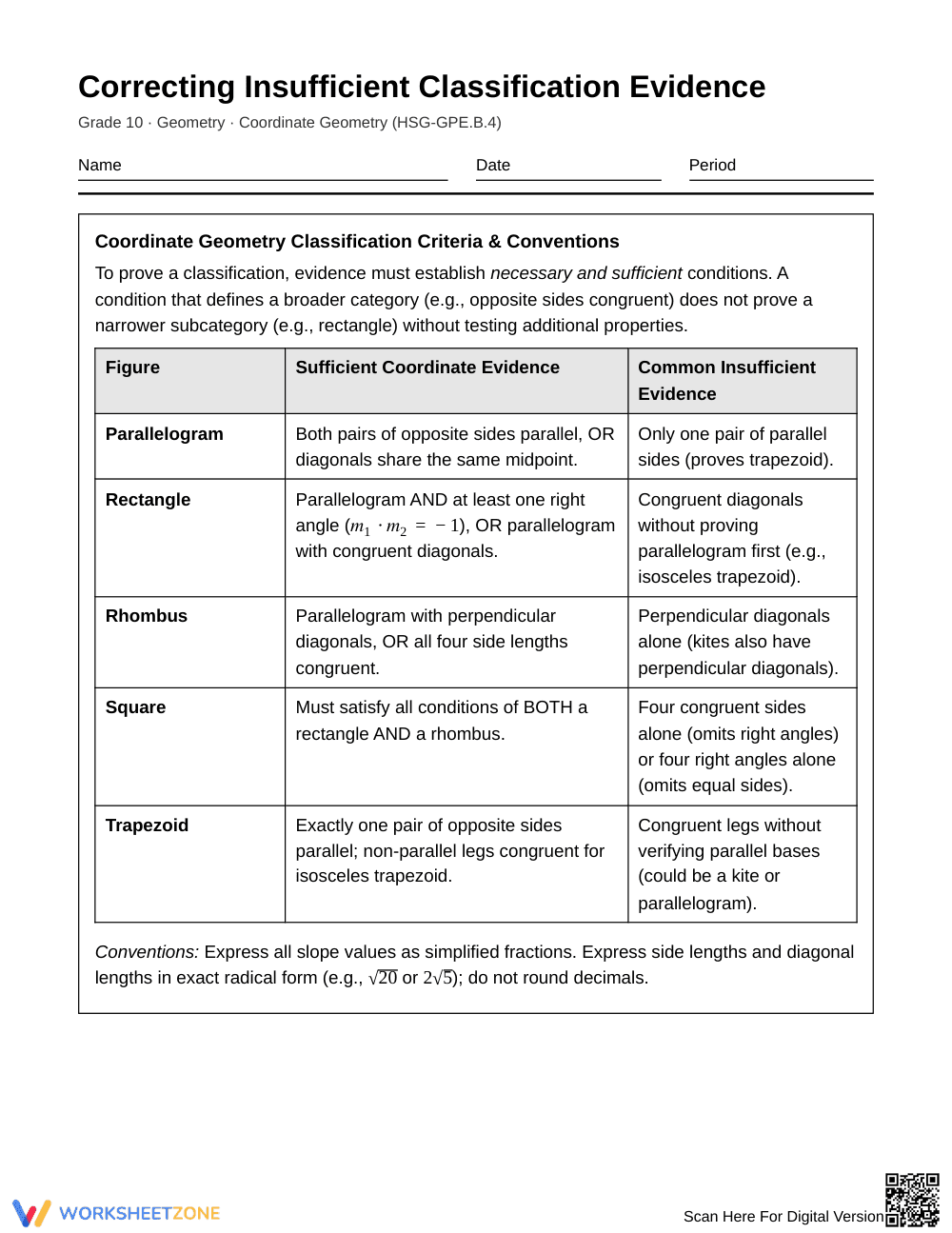
This 5-page worksheet includes a coordinate classification criteria reference table, a model error analysis, and 10 reconstruction tasks. The reference chart contrasts sufficient evidence with common incomplete claims across quadrilaterals. A 5-page answer key provides step-by-step diagnostic explanations, exact radical side lengths, simplified slopes, and reconstructed proofs.
Skill Progression
- Guided Practice: The reference chart and worked model demonstrate identifying sufficiency gaps, such as showing why congruent opposite sides prove a parallelogram but not a rectangle.
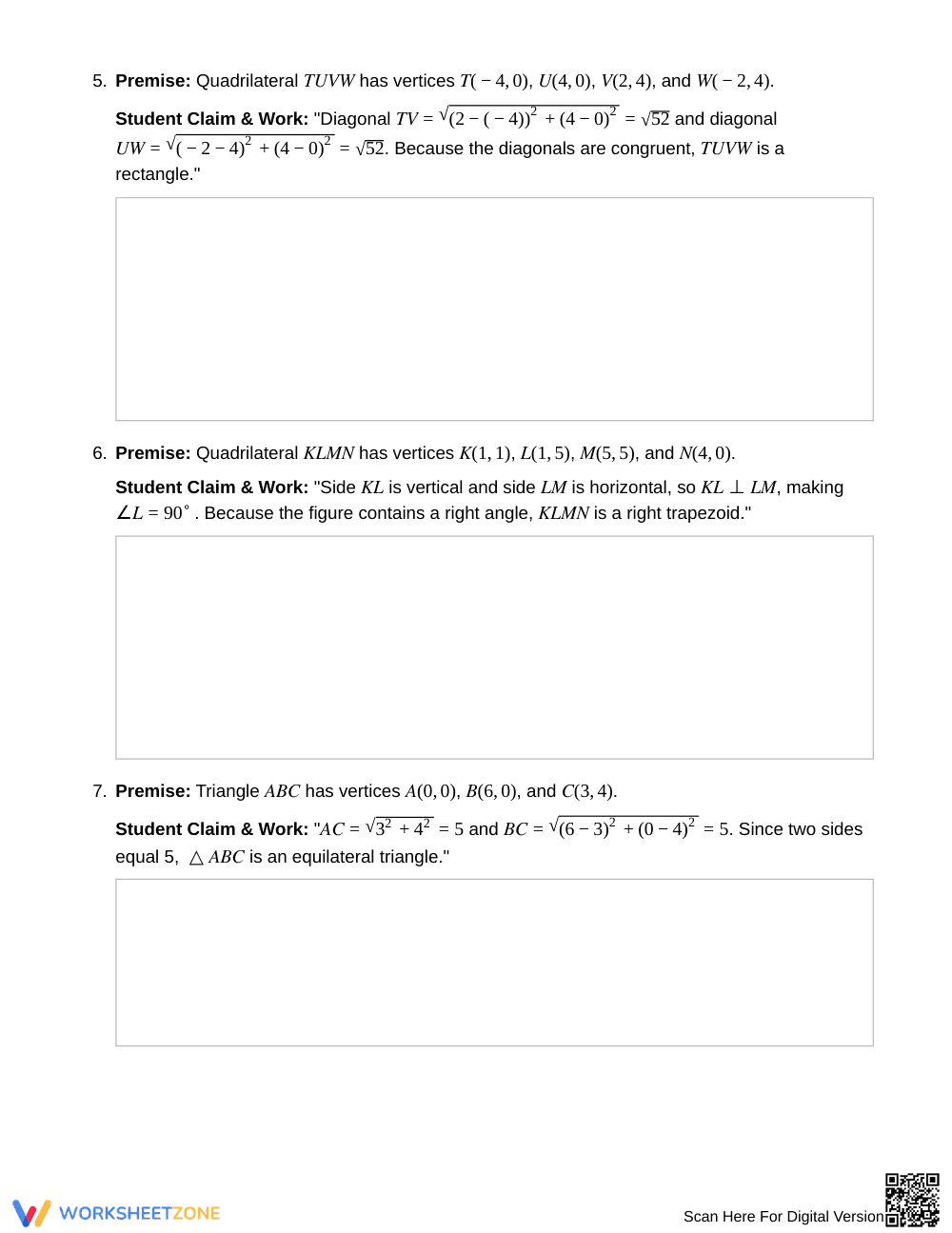
- Supported Practice: Problems 1–5 present flawed student proofs, prompting learners to name specific sufficiency errors before performing coordinate calculations.
- Independent Practice: Problems 6–10 require full proof reconstruction across trapezoids and oblique parallelograms using multi-step algebraic verification.
This progression uses a gradual-release model, moving students from guided error diagnosis to independent coordinate verification.
Standards Alignment
This resource directly aligns with `HSG-GPE.B.4`: Use coordinates to prove simple geometric theorems algebraically. Students apply slope and distance formulas to evaluate geometric properties and establish sufficient conditions for polygon classifications. The tasks also support `HSG-CO.C.11` by reinforcing parallelogram theorems. Both standard codes can be copied directly into lesson plans, IEP goals, or district curriculum mapping tools.
How to Use It
Use this worksheet after direct instruction on coordinate proofs. In partner pairs, have students diagnose the logical flaw together before independently calculating side lengths and slopes. Alternatively, assign individual problems as formative warm-ups during review. Check whether students confuse necessary conditions with sufficient conditions, especially regarding perpendicular diagonals. Expected completion time is 45 to 60 minutes.
Who It's For
This packet is designed for Grade 10 Geometry students learning deductive coordinate proofs. Built-in reference charts support developing learners, while non-standard orientations challenge advanced students. Pair this activity with an interactive graphing tool or a coordinate geometry anchor chart to help students visually verify classifications.
According to Fisher & Frey (2014), engaging secondary students in structured error analysis substantially deepens conceptual understanding compared to repetitive procedural drills alone. This coordinate geometry resource aligns with standard HSG-GPE.B.4 by requiring Grade 10 students to correct insufficient classification evidence in coordinate proofs rather than merely computing distances and slopes in isolation. By evaluating authentic student misconceptions—such as confusing perpendicular diagonals as sufficient evidence for a rhombus without verifying bisecting midpoints—learners confront common logical pitfalls in deductive geometry. Reconstructing incomplete coordinate arguments forces students to articulate why a mathematical condition fails to justify a specific polygon classification. This deliberate analytical practice bridges algebraic computation and formal geometric deduction, reinforcing how coordinates prove geometric theorems algebraically. Consequently, students develop durable metacognitive auditing habits, enabling them to evaluate their own geometric justifications critically during formal assessments and advanced secondary mathematics coursework.


