




























Views
Downloads
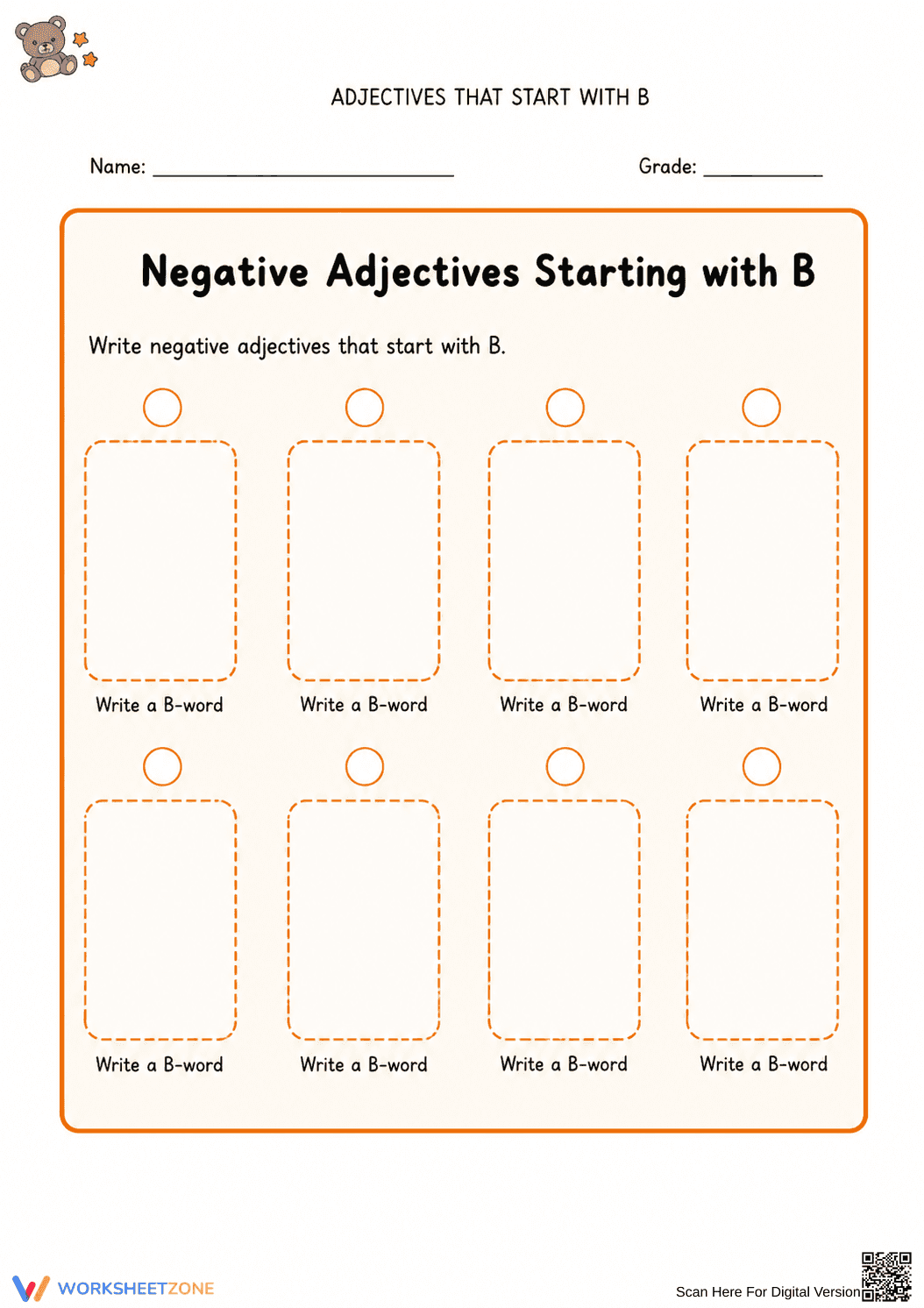

Grade 3 B-Word Adjectives — Printable No-Prep Worksheet

Paste this activity's link or code into your existing LMS (Google Classroom, Canvas, Teams, Schoology, Moodle, etc.).
Students can open and work on the activity right away, with no student login required.
You'll still be able to track student progress and results from your teacher account.
This vocabulary worksheet helps third and fourth-grade students expand their descriptive language by focusing on negative adjectives that begin with the letter B. Students practice recalling and writing specific vocabulary words, strengthening their ability to express precise meanings and emotions in their writing and daily communication.
At a Glance
- Grade: 3 · Subject: ELA
- Standard:
CCSS.ELA-LITERACY.L.3.6— Acquire and use grade-appropriate vocabulary words- Skill Focus: Negative Adjectives (Letter B)
- Format: 1 page · 8 problems · Answer key included · PDF
- Best For: Independent vocabulary practice
- Time: 10–15 minutes
Inside this resource, educators will find a single-page activity featuring eight distinct graphic organizer boxes. Each box prompts the student to write a unique negative adjective starting with the letter B. The visual layout includes dashed borders and small circles, providing a structured space that keeps handwriting neat. A complete answer key is provided, offering a list of potential correct responses such as "bad," "bitter," "boring," or "bossy" to assist with quick grading.
Zero-Prep Workflow
This resource is designed for immediate classroom implementation with minimal teacher effort.
- Print (1 minute): Simply download the PDF and print the required number of copies. The black-and-white design is ink-friendly.
- Distribute (1 minute): Hand out the sheets during morning work, literacy centers, or as a quick transition activity.
- Review (3 minutes): Use the included answer key to quickly check student responses or conduct a whole-class review where students share their chosen words.
Total teacher preparation time is under two minutes, making this an excellent option for emergency sub plans.
Standards Alignment
This activity aligns directly with CCSS.ELA-LITERACY.L.3.6: "Acquire and use accurately grade-appropriate conversational, general academic, and domain-specific words and phrases." It also supports foundational spelling and phonics skills by reinforcing the initial consonant sound of the letter B. Both standard codes can be copied directly into lesson plans, IEP goals, or district curriculum mapping tools.
How to Use It
Deploy this worksheet during the independent practice portion of a grammar or vocabulary lesson. After introducing the concept of positive and negative connotations, assign this task to see if students can independently generate appropriate examples. As a formative assessment tip, observe whether students struggle to differentiate between negative adjectives and negative verbs or nouns. The entire activity should take most students between 10 and 15 minutes to complete.
Who It's For
This material is primarily designed for third and fourth-grade students developing their descriptive writing skills. It serves as an excellent differentiation tool for early finishers who need an extra vocabulary challenge. Pair this worksheet with a short reading passage, asking students to identify the negative adjectives the author used, to reinforce the connection between reading comprehension and expressive vocabulary.
Developing a robust vocabulary is a critical component of reading comprehension and effective written communication. By focusing on specific categories, such as negative adjectives starting with a particular letter, educators can help students organize and retrieve words more efficiently. This targeted practice aligns with CCSS.ELA-LITERACY.L.3.6, requiring students to acquire and use grade-appropriate vocabulary words. According to Fisher & Frey (2014), explicit vocabulary instruction that encourages students to categorize and generate words based on specific constraints significantly improves their ability to select precise language during independent writing tasks. When students actively recall specific descriptive words rather than relying on generic terms, they demonstrate a deeper understanding of nuance and connotation. This structured approach ensures learners build the linguistic tools necessary for academic success.


