


























Views
Downloads
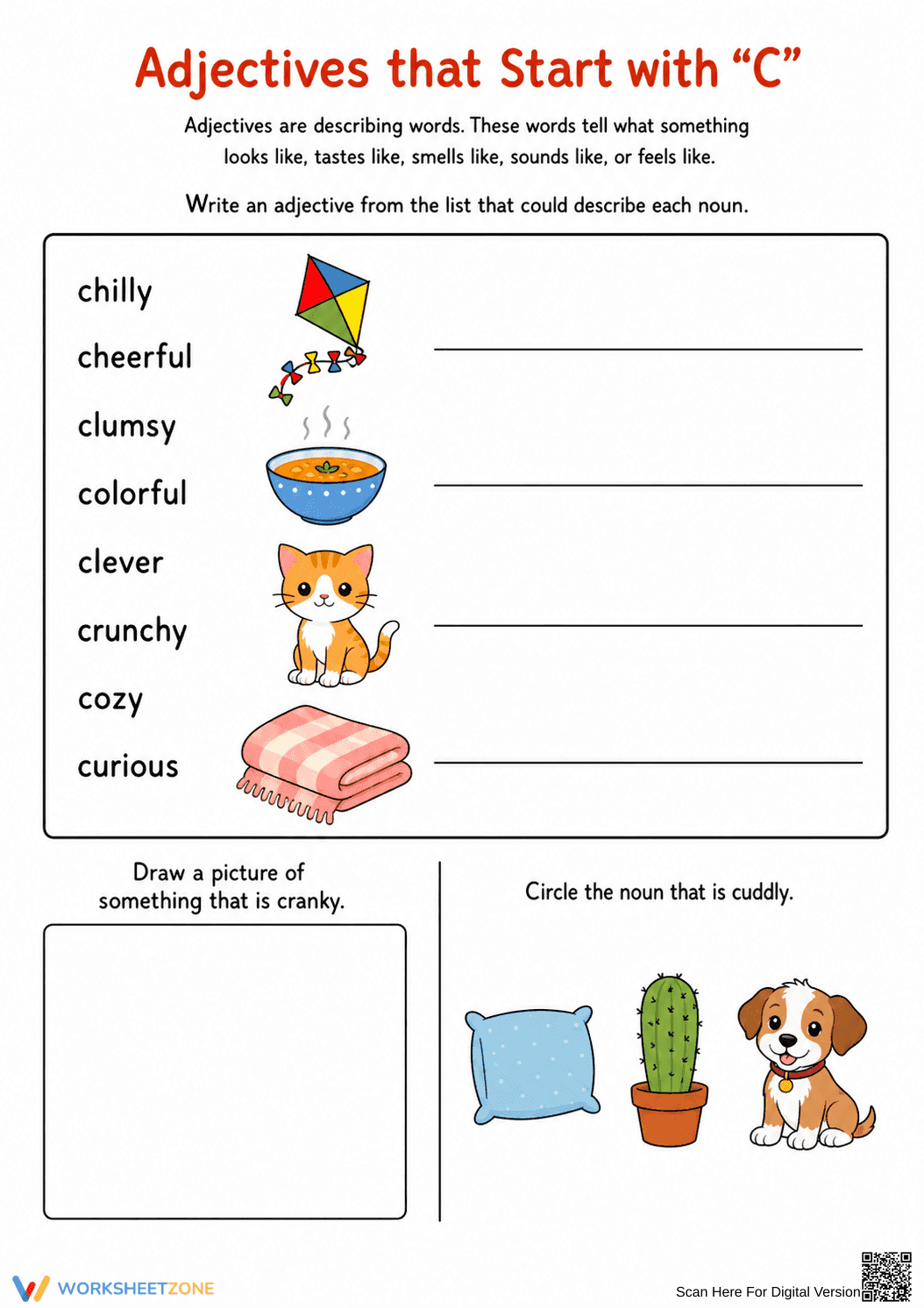

Essential Grade 2 Adjectives Starting With Letter C
Paste this activity's link or code into your existing LMS (Google Classroom, Canvas, Teams, Schoology, Moodle, etc.).
Students can open and work on the activity right away, with no student login required.
You'll still be able to track student progress and results from your teacher account.
This Grade 2 grammar worksheet helps students master descriptive language by focusing on adjectives that begin with the letter C. Students practice identifying, writing, and illustrating adjectives to deepen their understanding of how these words modify nouns. By connecting phonics with parts of speech, learners build a more robust vocabulary for both speaking and writing.
At a Glance
- Grade: 2 · Subject: ELA
- Standard:
CCSS.ELA-LITERACY.L.2.6— Use words and phrases acquired through reading, including adjectives to describe- Skill Focus: Adjectives starting with "C"
- Format: 1 page · 6 problems · Answer key included · PDF
- Best For: Independent grammar practice or morning work
- Time: 10–15 minutes
The resource features a word bank containing eight "C" adjectives such as "chilly," "clumsy," and "curious." It includes four primary writing prompts paired with colorful illustrations of a kite, soup, a cat, and a blanket. Additionally, a creative drawing space asks students to visualize the word "cranky," while a final task requires circling the correct noun to match the adjective "cuddly."
This resource is designed for a zero-prep classroom environment. Teachers can print the single-page PDF in less than 30 seconds. Distribution takes approximately 1 minute during a transition period. Reviewing the 6 tasks as a whole class or through peer-grading takes roughly 5 minutes. It is an ideal "grab-and-go" option for unexpected sub plans or literacy centers.
Aligned to `CCSS.ELA-LITERACY.L.2.6`, which requires students to "use words and phrases acquired through conversations, reading and being read to, and responding to texts, including using adjectives and adverbs to describe." This worksheet specifically targets the acquisition of descriptive adjectives. Both standard codes can be copied directly into lesson plans, IEP goals, or district curriculum mapping tools.
Use this as a formative assessment after a mini-lesson on adjectives. Observe if students can match the sensory adjectives like "crunchy" or "colorful" to the appropriate visual prompts. It also serves as an excellent literacy center activity where students can work independently for 10 to 15 minutes while the teacher conducts small-group reading instruction or individual conferencing.
This worksheet is perfect for second-grade students developing their grammar skills. It is also highly effective for English Language Learners (ELL) who benefit from the visual scaffolding provided by the illustrations. Pair this with a descriptive writing prompt or an anchor chart featuring common adjectives to extend the learning and encourage application in original sentences.
According to Fisher & Frey (2014), vocabulary development is most effective when students engage in word solving that combines visual cues with contextual application. This worksheet utilizes that principle by requiring students to map specific adjectives to representative images, reinforcing the semantic connection between the word and its meaning. By focusing on a specific starting letter, the activity also supports phonological awareness alongside grammatical mastery. Research from the NAEP suggests that students who possess a wider range of descriptive modifiers demonstrate higher proficiency in narrative writing tasks. This resource provides the structured repetition necessary for Grade 2 learners to move from simple word recognition to active usage in their own creative expressions. The drawing task further solidifies the mental model of the adjective, ensuring the vocabulary becomes a permanent part of the student's linguistic repertoire.


