


























Views
Downloads

Printable Adjectives of Comparison Worksheet | Grade 3 ELA
Paste this activity's link or code into your existing LMS (Google Classroom, Canvas, Teams, Schoology, Moodle, etc.).
Students can open and work on the activity right away, with no student login required.
You'll still be able to track student progress and results from your teacher account.
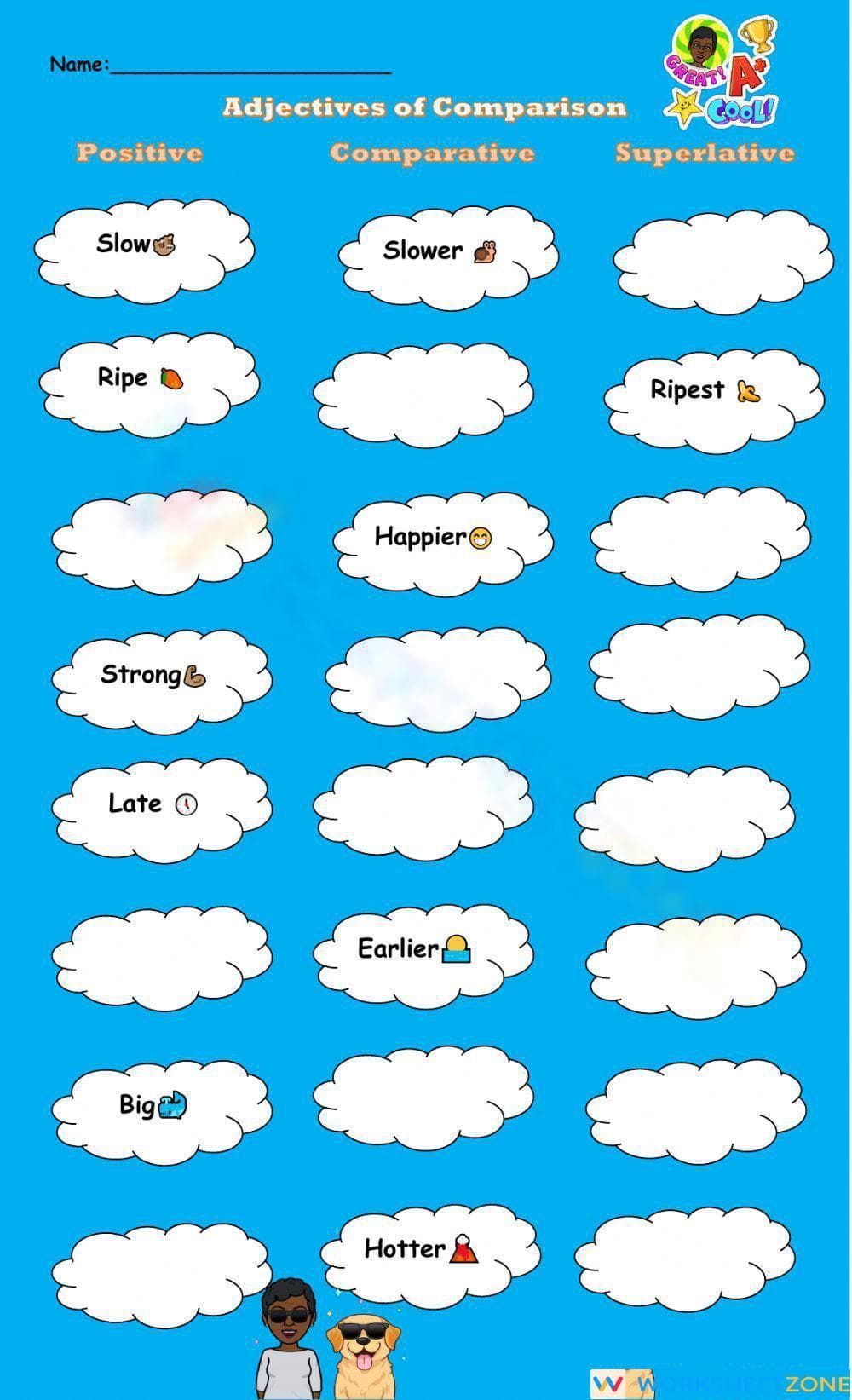
Help your students master the nuances of comparative and superlative adjectives with this focused practice worksheet. This resource specifically targets the spelling changes required when adding suffixes like -er and -est to base adjectives. By completing these 14 interactive tasks, learners build the linguistic accuracy needed for descriptive writing and clear communication in upper elementary ELA.
At a Glance
- Grade: 3 · Subject: English Language Arts (ELA)
- Standard:
CCSS.ELA-LITERACY.L.3.1.G— Form and use comparative and superlative adjectives and adverbs correctly- Skill Focus: Comparative and Superlative Adjectives
- Format: 1 page · 14 problems · Answer key included · PDF
- Best For: Independent grammar practice or sub plans
- Time: 15–20 minutes
This single-page PDF features a clean, cloud-themed table where students fill in missing positive, comparative, or superlative forms of common adjectives. The worksheet includes challenging examples that require spelling modifications, such as doubling final consonants (big/bigger/biggest) or changing 'y' to 'i' (early/earlier/earliest). A full answer key is provided to ensure quick grading and immediate feedback for student progress.
Implementing this resource into your daily routine is efficient and requires minimal teacher intervention. Follow these three simple steps for a smooth experience:
- Print: Download and print the required number of copies in less than 60 seconds.
- Distribute: Hand out the worksheets during your grammar block or as a transition activity (1 minute).
- Review: Use the included answer key to grade student work or facilitate a peer-review session in under 5 minutes.
The total teacher preparation time for this activity is under two minutes, making it an ideal choice for busy mornings or unexpected substitute situations.
This activity aligns with CCSS.ELA-LITERACY.L.3.1.G: "Form and use comparative and superlative adjectives and adverbs." It also supports CCSS.ELA-LITERACY.L.4.1 by reinforcing foundational spelling conventions during suffix addition.
Use this worksheet as a formative assessment during a unit on descriptive language. Observe how students handle the "y-to-i" change in words like "happy" and "early" to gauge their understanding of orthographic rules. Alternatively, assign it as a "bell-ringer" activity to reinforce previous direct instruction on adjectives. Most students will successfully complete the cloud-fill tasks within a 15-to-20-minute window.
This resource is designed for Grade 2, 3, and 4 students who are developing their command of English grammar. It is particularly beneficial for English Language Learners (ELLs) who need visual organizers to categorize word forms. Pair this worksheet with a short reading passage to have students identify comparatives and superlatives in a real-world text context.
Research indicates that explicit instruction in morphological rules, such as those found in this CCSS.ELA-LITERACY.L.3.1.G worksheet, significantly improves student writing accuracy. By focusing on the transformation of adjectives from their positive to comparative and superlative forms, students internalize spelling patterns that are often irregular. Fisher & Frey (2014) emphasize the importance of visual organizers, like the cloud-themed graphic organizer used here, to support the gradual release of responsibility. This worksheet provides the guided practice phase necessary for learners to move from teacher-led modeling to independent application of grammar rules. The 14 tasks are strategically sequenced to include both regular and irregular spelling changes, ensuring students encounter the specific hurdles found in Grade 3 and 4 standards. Utilizing this structured approach allows educators to collect clear evidence of student mastery for progress monitoring or reporting purposes. This resource serves as a foundational tool for developing sophisticated descriptive capabilities in elementary learners.


