




























Views
Downloads

Grade 3 Adjectives -ed and -ing Printable Worksheet

Paste this activity's link or code into your existing LMS (Google Classroom, Canvas, Teams, Schoology, Moodle, etc.).
Students can open and work on the activity right away, with no student login required.
You'll still be able to track student progress and results from your teacher account.
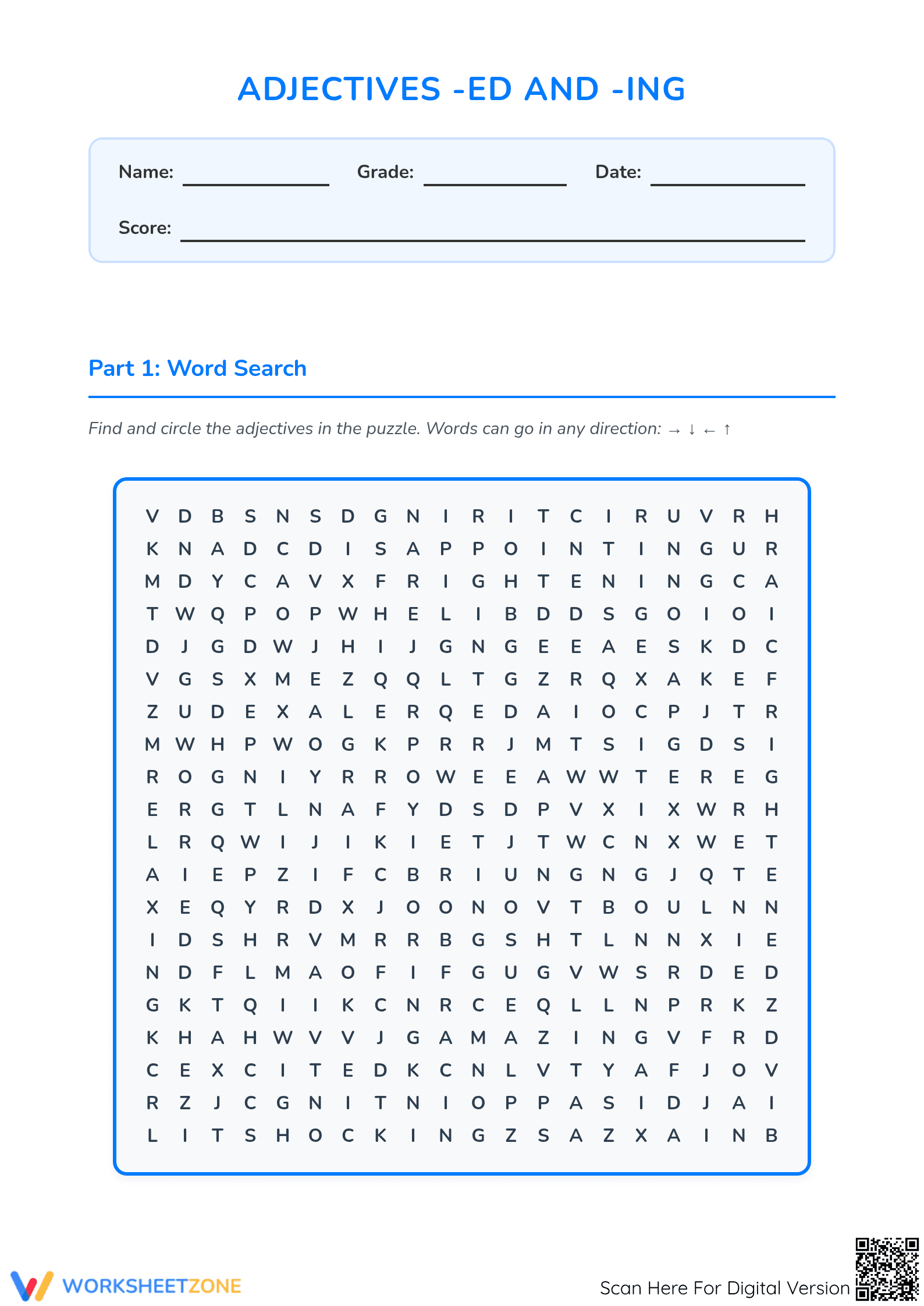
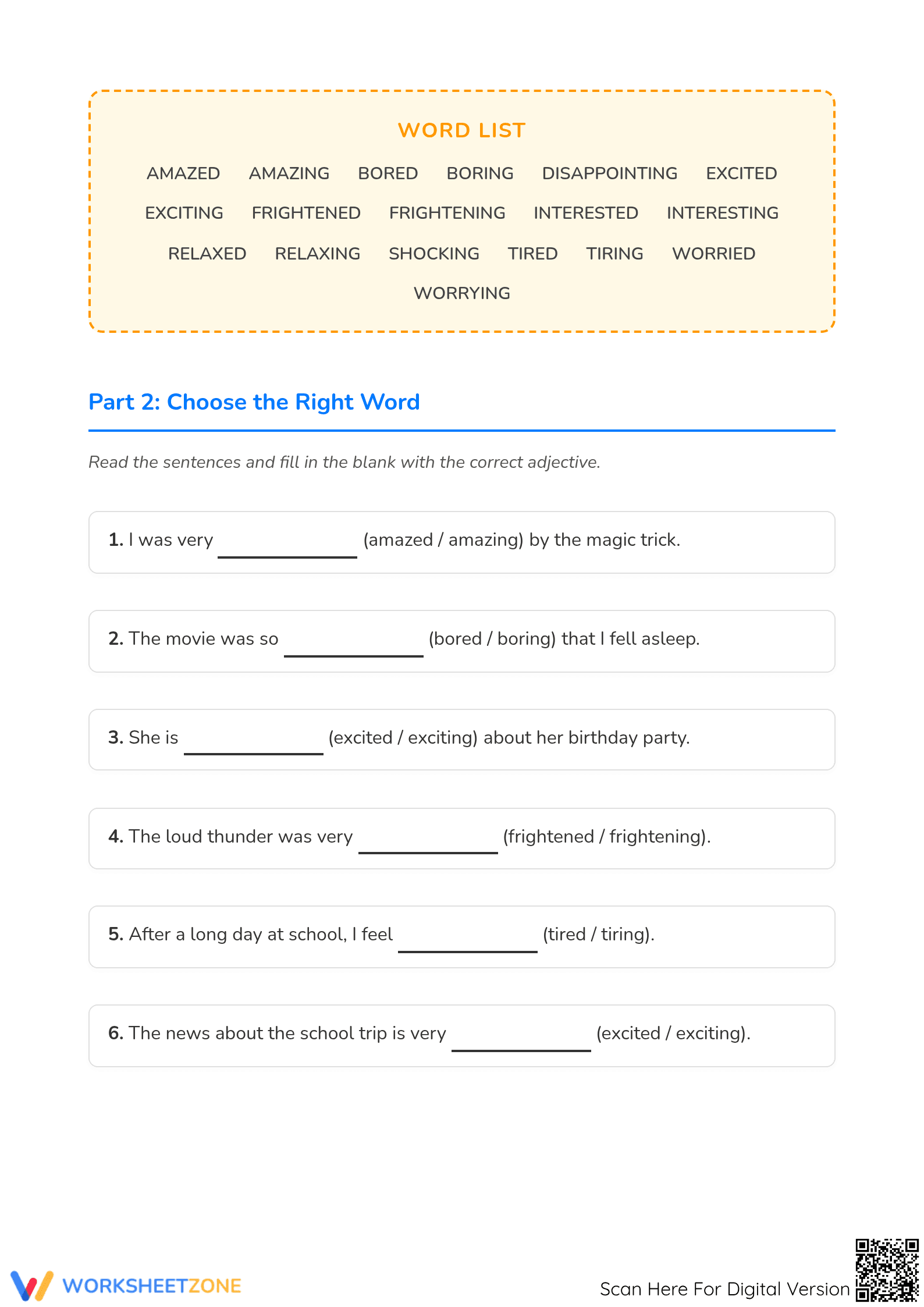
This Grade 3 grammar worksheet helps students master the distinction between -ed and -ing adjectives through engaging, structured activities. By identifying and applying these specific suffixes in context, learners improve their descriptive writing and reading comprehension. It provides a clear path for students to understand how word endings change the meaning of descriptive terms.
At a Glance
- Grade: 3 · Subject: ELA
- Standard:
CCSS.ELA-LITERACY.L.3.1— Demonstrate command of the conventions of standard English grammar and usage when writing- Skill Focus: Participial Adjectives (-ed vs -ing)
- Format: 2 pages · 26 problems · Answer key included · PDF
- Best For: Independent practice or morning work
- Time: 15–20 minutes
The resource contains two distinct pages designed for comprehensive skill reinforcement. Page one features a large word search puzzle containing 20 target adjectives like "disappointing," "excited," and "shocking." Page two provides a curated word list and six fill-in-the-blank sentences where students must choose the correct adjective form based on the sentence context. A full answer key is provided for quick grading.
Zero-Prep Workflow
This resource is designed for immediate classroom implementation with a three-step workflow. First, print the two-page PDF (30 seconds). Second, distribute the sheets to students for independent work or as a quiet sub-plan activity (1 minute). Finally, use the included answer key to review results or allow students to self-correct their work (2 minutes). Total teacher preparation time is under two minutes.
Standards Alignment
The primary focus is `CCSS.ELA-LITERACY.L.3.1`, which requires students to demonstrate command of the conventions of standard English grammar and usage. Specifically, it supports `CCSS.ELA-LITERACY.L.3.4.B` by having students determine the meaning of words formed when affixes are added to known roots. Both standard codes can be copied directly into lesson plans, IEP goals, or district curriculum mapping tools.
How to Use It
Assign this worksheet during the independent practice phase of a lesson on descriptive language to check for understanding. It works well as a formative assessment; observe if students can distinguish between the cause of a feeling (-ing) and the feeling itself (-ed). Expected completion time ranges from 15 to 20 minutes depending on student reading speed and familiarity with the vocabulary.
Who It's For
This is ideal for third-grade students mastering suffix rules, but it also serves as excellent remediation for fourth graders or enrichment for advanced second graders. It pairs naturally with a mentor text focusing on emotions or a direct instruction lesson using an anchor chart that explains the "person vs. thing" adjective rule for participial endings.
According to research by Fisher & Frey (2014), the gradual release of responsibility is most effective when students are provided with structured opportunities to apply linguistic rules independently. This worksheet facilitates that transition by moving from visual recognition to contextual application. By focusing on `CCSS.ELA-LITERACY.L.3.1`, the resource ensures students build foundational grammatical knowledge necessary for complex sentence construction. The inclusion of 26 total tasks provides sufficient repetition to move these adjective forms into long-term memory. Educators can rely on this structured approach to meet district requirements for evidence-based grammar instruction while maintaining student engagement through the puzzle-based format. This alignment with research-backed pedagogical strategies supports mastery of participial adjectives across diverse learning environments.


