




























Views
Downloads



Printable Adjectives and Nouns Worksheet | Grade 2-3 ELA

Paste this activity's link or code into your existing LMS (Google Classroom, Canvas, Teams, Schoology, Moodle, etc.).
Students can open and work on the activity right away, with no student login required.
You'll still be able to track student progress and results from your teacher account.
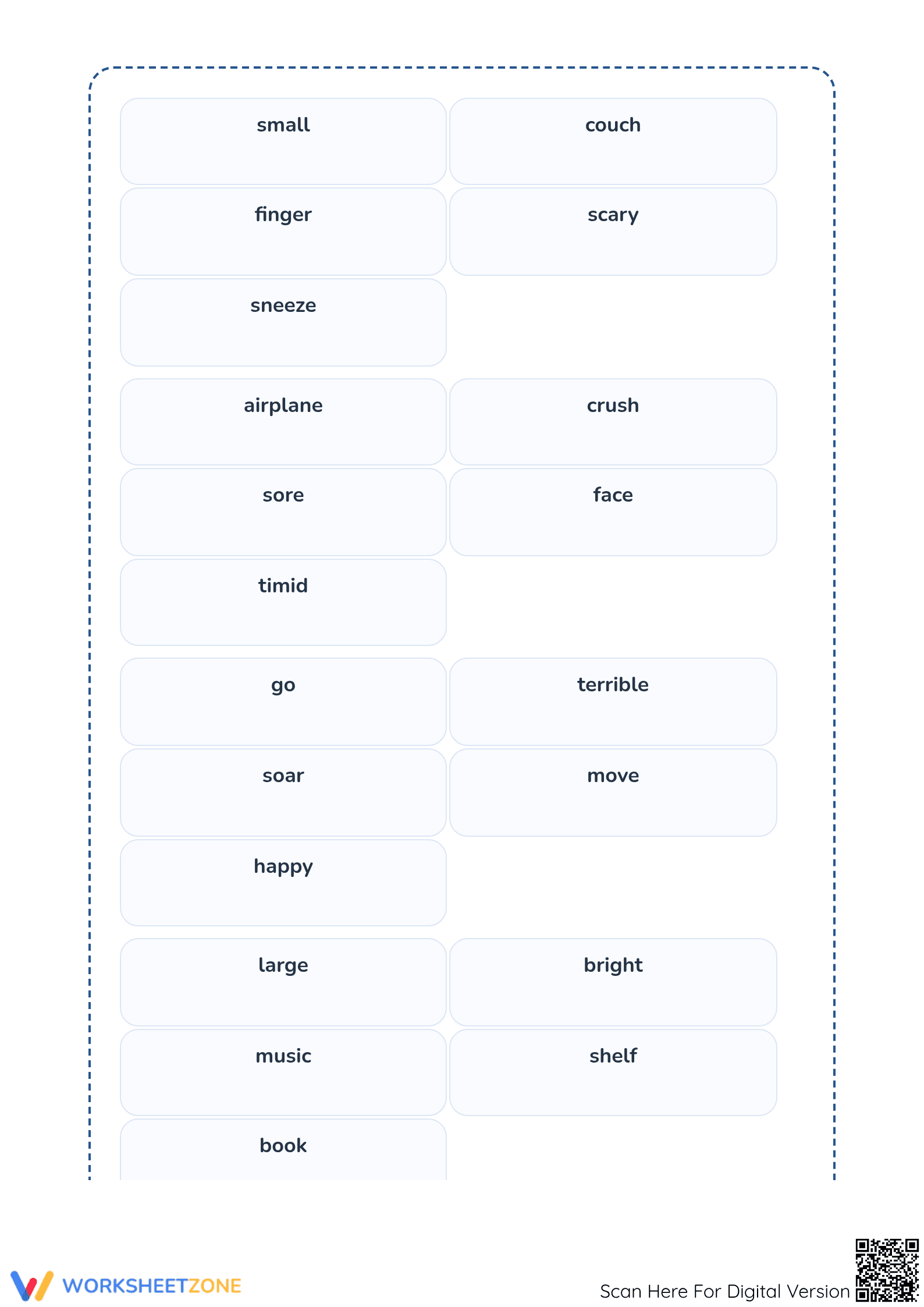
This worksheet helps Grade 2 and 3 students master parts of speech by distinguishing between adjectives, nouns, and verbs. By identifying "describing words" and "naming words" within a structured grid, learners build foundational grammar skills necessary for descriptive writing. The activity encourages active participation through circling and underlining tasks to ensure concept retention.
At a Glance
- Grade: 2-3 · Subject: ELA
- Standard:
CCSS.ELA-LITERACY.L.3.1.A— Explain the function of nouns and adjectives in word sets- Skill Focus: Parts of Speech Identification
- Format: 3 pages · 20 problems · Answer key included · PDF
- Best For: Literacy centers and independent word study
- Time: 15–20 minutes
This three-page PDF features a "Word Grid" with 20 curated words designed to challenge student recognition of descriptive and naming terms. It includes an instructional header with visual cues, a word identification page, and a full answer key for efficient grading or student self-correction. The layout is optimized for high-contrast printing and easy student navigation.
Skill Progression
- Guided practice: Students review the visual "How to check" guide which demonstrates marking adjectives and nouns using a model.
- Supported practice: The 20-word grid provides a controlled environment to apply knowledge across academic vocabulary like "airplane" and "timid."
- Independent practice: Learners complete the task by filtering out action words from the primary identification grid.
The lesson follows a gradual-release model, moving from explicit instructions to independent discrimination. This ensures students internalize word functions before applying them to writing.
Standards Alignment
This resource is primary aligned with `CCSS.ELA-LITERACY.L.3.1.A`, requiring students to explain word functions. It also supports `CCSS.ELA-LITERACY.L.2.1.E` through adjective selection for specific modification. Both standard codes can be copied directly into lesson plans, IEP goals, or district curriculum mapping tools.
How to Use It
Use this during independent practice after introducing nouns and adjectives. It serves as a formative-assessment tool; teachers should observe if students correctly ignore verbs to gauge understanding. Expected completion time for the 20-item grid is 15-20 minutes, making it an ideal exit ticket activity or literacy center task.
Who It's For
Designed for Grade 2 and 3 students, this activity also supports English Language Learners (ELLs) focusing on basic vocabulary and categorization. It pairs naturally with descriptive writing prompts or a classroom parts-of-speech anchor chart. Teachers can also use it as a quick review for Grade 4 students needing reinforcement.
According to research from Fisher & Frey (2014) on the gradual release of responsibility, structured word study activities are essential for developing linguistic precision in early elementary students. This printable worksheet targets `CCSS.ELA-LITERACY.L.3.1.A` by requiring students to distinguish the plain-English functions of describing words and naming words within a 20-item word grid. By filtering out distractors (verbs) and focusing on the relationship between adjectives and nouns, students develop the mental schemas necessary for more complex syntactical analysis. The inclusion of immediate feedback via the visual guide aligns with evidence-based practices for grammatical development as noted in recent NAEP literacy framework updates. This resource provides the repetition needed to move parts-of-speech identification from effortful decoding to automatic recognition during both reading and writing tasks.


