


























Views
Downloads



Adjectives Practice Worksheet | Grade 1 Essential
Paste this activity's link or code into your existing LMS (Google Classroom, Canvas, Teams, Schoology, Moodle, etc.).
Students can open and work on the activity right away, with no student login required.
You'll still be able to track student progress and results from your teacher account.
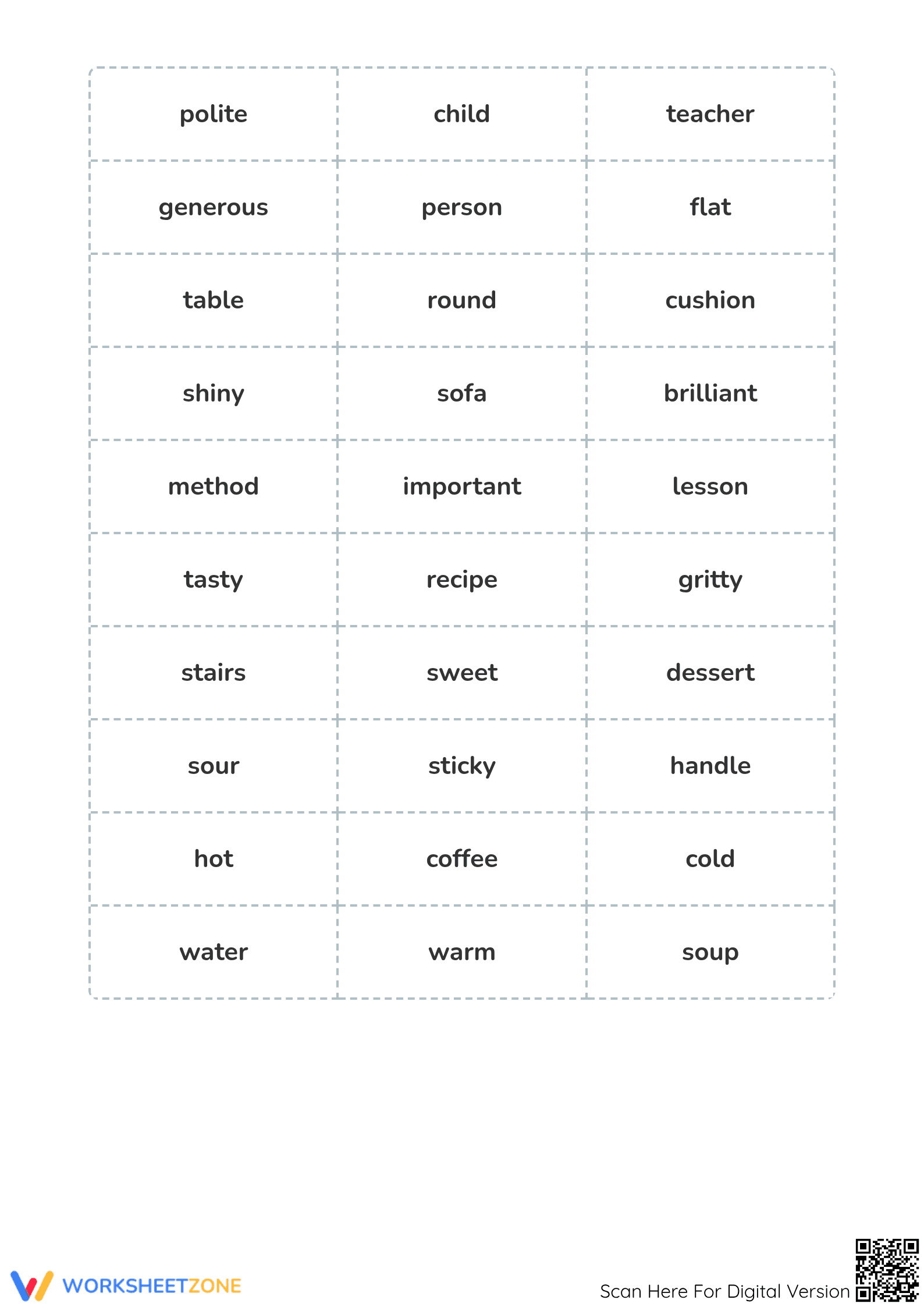
This Grade 1 adjectives worksheet helps young learners distinguish between descriptive words and nouns. By evaluating a curated list of 30 common vocabulary words, students develop the foundational grammar skills necessary for vivid writing and reading comprehension. It provides a clear, focused environment for mastering word classes in early elementary education.
At a Glance
- Grade: 1 · Subject: ELA
- Standard:
CCSS.ELA-LITERACY.L.1.1.F— Use frequently occurring adjectives to describe people, places, and things- Skill Focus: Adjective Identification
- Format: 3 pages · 30 problems · Answer key included · PDF
- Best For: Independent practice or morning work
- Time: 10–15 minutes
The resource includes a comprehensive 3-page PDF package. The primary task page features a 3x10 grid containing 30 distinct words, ranging from sensory descriptors like "sticky" and "sour" to character traits like "polite." A dedicated notes page allows for teacher-led examples, while the final page provides positive reinforcement. A full answer key is included for rapid grading.
Skill Progression
- Guided practice: The worksheet begins with a clear "Hint" box defining adjectives to anchor student understanding before they begin the task.
- Supported practice: Students navigate a mixed-word grid, requiring them to discriminate between concrete nouns (like "coffee") and the adjectives that describe them (like "hot").
- Independent practice: The 30-item task count ensures high-repetition exposure, allowing students to achieve fluency in identifying descriptive word classes without external prompting.
This gradual-release approach moves students from conceptual definition to confident, independent application during the grammar block.
Standards Alignment
This resource is specifically aligned to `CCSS.ELA-LITERACY.L.1.1.F`, which requires students to use frequently occurring adjectives. By identifying these words in isolation, students build the lexical bank needed to eventually produce descriptive sentences. Both standard codes can be copied directly into lesson plans, IEP goals, or district curriculum mapping tools.
How to Use It
Use this worksheet during the "You Do" phase of a grammar lesson after introducing adjectives through a mentor text. It also serves as an excellent formative assessment; observe if students struggle more with abstract adjectives (like "important") versus sensory ones (like "cold"). Expected completion time ranges from 10 to 15 minutes depending on reading level.
Who It's For
This is designed for first-grade students but works well for kindergarten enrichment or second-grade review. It is particularly helpful for English Language Learners (ELL) who need to categorize parts of speech. Pair this with a "Show and Tell" activity where students use the identified adjectives to describe classroom objects or personal belongings.
According to the RAND AIRS 2024 report on foundational literacy, explicit instruction in word classes like adjectives significantly improves a child's ability to decode complex texts and express specific ideas in writing. This worksheet targets CCSS.ELA-LITERACY.L.1.1.F by providing 30 opportunities for students to identify frequently occurring adjectives. By isolating the descriptive word from the noun it modifies, the activity reduces cognitive load, allowing Grade 1 learners to focus entirely on the linguistic function of the word. Research from Fisher & Frey (2014) emphasizes that high-repetition practice with immediate feedback—facilitated here by the included answer key—is vital for moving grammatical concepts into long-term memory. This printable resource offers a structured, evidence-based pathway for early elementary students to master descriptive language, ensuring they are prepared for more advanced sentence construction and narrative writing tasks in subsequent grades.


