


























Views
Downloads



Essential Addition Within 100 Puzzle Worksheet | Grade 2
Paste this activity's link or code into your existing LMS (Google Classroom, Canvas, Teams, Schoology, Moodle, etc.).
Students can open and work on the activity right away, with no student login required.
You'll still be able to track student progress and results from your teacher account.
Strengthen elementary arithmetic skills with this comprehensive four-page addition within 100 worksheet designed to build mathematical fluency and confidence. Students solve a variety of multi-digit problems to crack a hidden riddle, transforming routine calculation into an engaging problem-solving mission. This resource provides the structured repetition necessary for mastery while maintaining high student motivation through its interactive 'Crack the Code' format.
At a Glance
- Grade: 2 · Subject: Math
- Standard:
CCSS.MATH.CONTENT.2.NBT.B.5— Fluently add and subtract within 100 using strategies based on place value- Skill Focus: Multi-digit addition without regrouping
- Format: 4 pages · 24 problems · Answer key included · PDF
- Best For: Independent practice and math centers
- Time: 20–30 minutes
This four-page PDF includes 24 diverse math tasks organized into four logical parts to support progressive learning. The worksheet features vertical addition, horizontal equations, missing number challenges, and contextual word problems. A built-in riddle decoder at the top of the first page serves as a self-checking mechanism, while the included full answer key ensures teacher review is fast and accurate.
- Guided Practice: The first 9 vertical problems provide a clear visual structure for aligning tens and ones, helping students internalize place value columns.
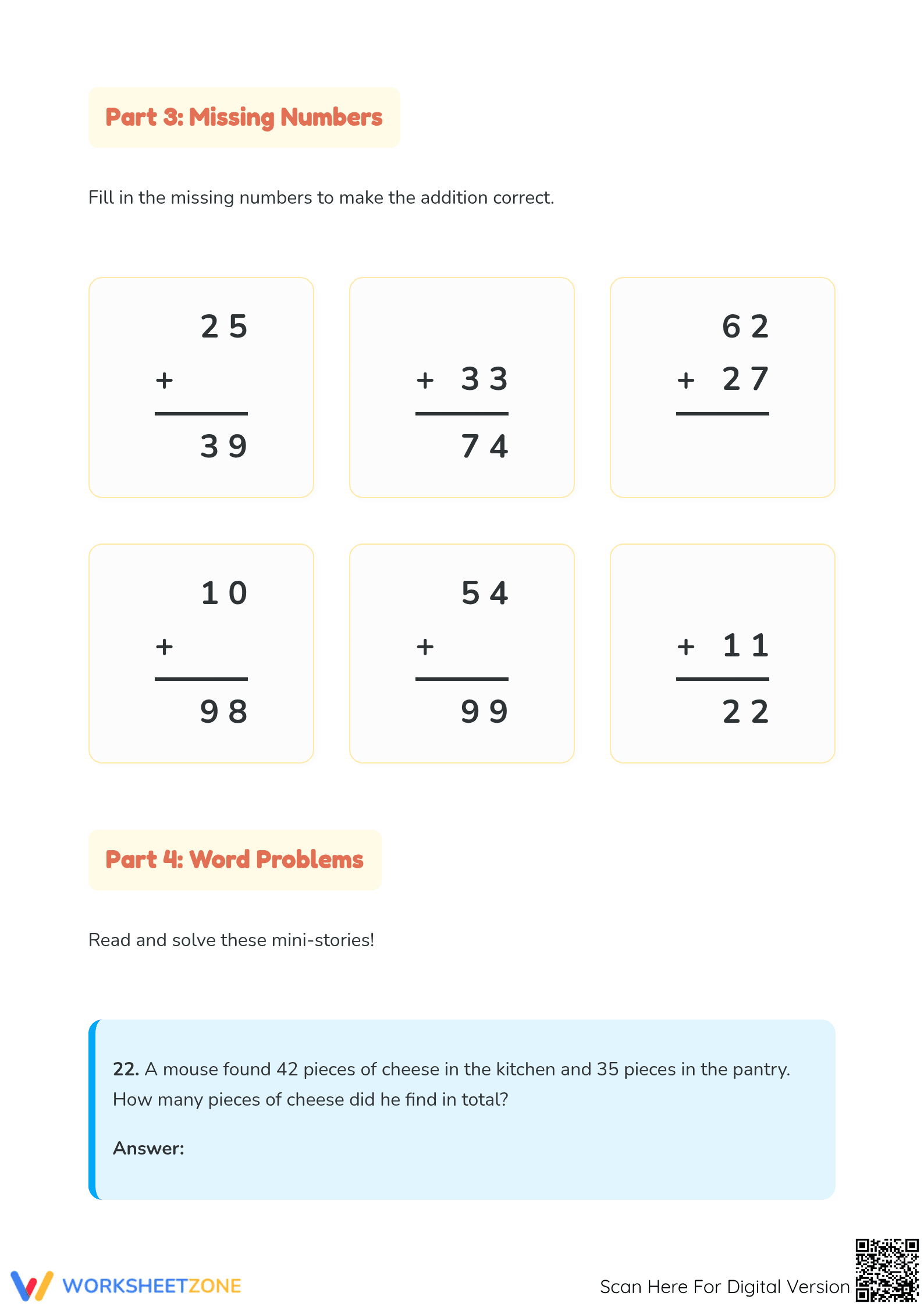
- Supported Practice: 6 horizontal problems and 6 missing-addend tasks require students to rewrite equations or apply inverse thinking to find unknown values.
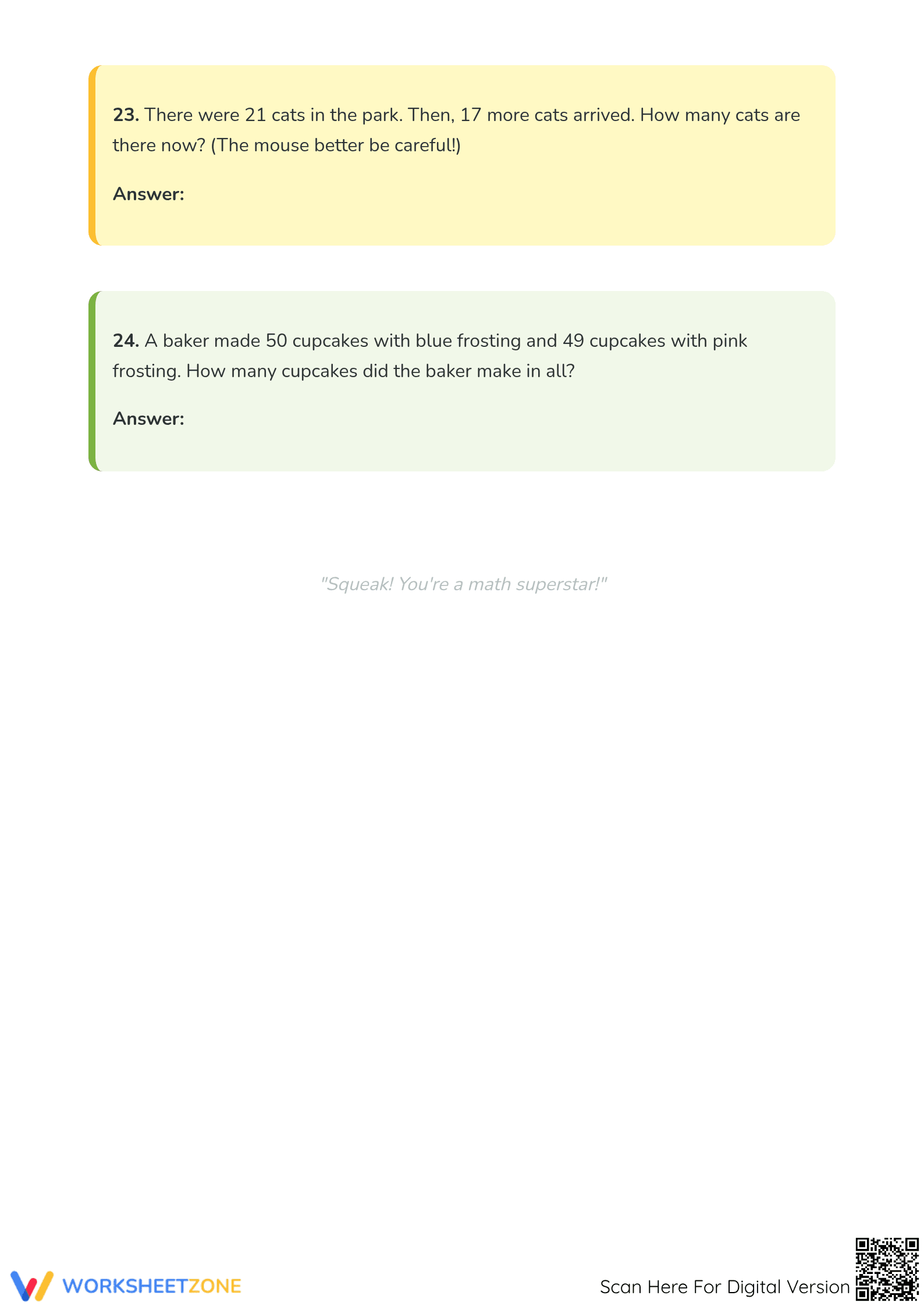
- Independent Practice: 3 final word problems challenge students to extract numerical data from short stories and apply their addition skills to real-world scenarios.
This resource is specifically aligned to CCSS.MATH.CONTENT.2.NBT.B.5, which requires students to fluently add within 100 using strategies based on place value and the properties of operations. The variety of problem types ensures that students are not just memorizing procedures but are developing a flexible understanding of how numbers interact. This standard code can be copied directly into lesson plans, IEP goals, or district curriculum mapping tools.
To maximize instructional impact, use this worksheet as a summative assessment after a unit on two-digit addition or as a high-interest activity for early finishers. Teachers should observe students during Part 3 (Missing Numbers) to identify those who may still struggle with the relationship between addition and subtraction. Most second-grade students will complete the full 24-task sequence within a single 30-minute instructional block.
This worksheet is ideal for Grade 2 students working toward fluency, though it serves as an excellent challenge for advanced Grade 1 learners. The clear font and spacious layout accommodate students with fine motor difficulties, and the 'Crack the Code' element makes it a perfect pairing for a classroom lesson on logical reasoning or as a reliable sub-plan activity.
Aligned to the CCSS.MATH.CONTENT.2.NBT.B.5 standard, this worksheet targets the essential skill of multi-digit addition within 100. By integrating vertical, horizontal, and missing number formats alongside contextual word problems, the resource ensures a comprehensive approach to arithmetic fluency. Educational research, such as the RAND AIRS 2024 study on mathematics instructional materials, highlights that varied problem presentation is a critical factor in developing flexible mathematical thinking. Furthermore, the inclusion of a riddle-based decoding task serves as a high-engagement 'hook' that sustains student focus during repetitive practice. This dual-purpose design—balancing rote calculation with logical reasoning—aligns with best practices for elementary math instruction. Teachers can use this tool to bridge the gap between basic facts and complex algorithms, providing a structured yet entertaining path toward mastery. The 24-task sequence allows for granular assessment of student understanding across different operational representations, making it an indispensable asset for second-grade classroom settings and targeted intervention programs alike.


