




























Views
Downloads



Grade 2 Adding Money — Essential No-Prep Worksheet

Paste this activity's link or code into your existing LMS (Google Classroom, Canvas, Teams, Schoology, Moodle, etc.).
Students can open and work on the activity right away, with no student login required.
You'll still be able to track student progress and results from your teacher account.
This worksheet provides targeted practice for Grade 2 students on adding money with decimals. Through a series of scaffolded tasks, from simple vertical addition to multi-step word problems, learners will build fluency and confidence in solving real-world financial calculations. The resource is designed for easy implementation.
At a Glance
- Grade: 2 · Subject: Math
- Standard:
CCSS.MATH.CONTENT.2.MD.C.8— Solve word problems involving dollar bills and coins, using $ and ¢ symbols.- Skill Focus: Adding money with decimals
- Format: 3 pages · 12 problems · Answer key included · PDF
- Best For: Independent practice or small group review
- Time: 20–30 minutes
What's Inside
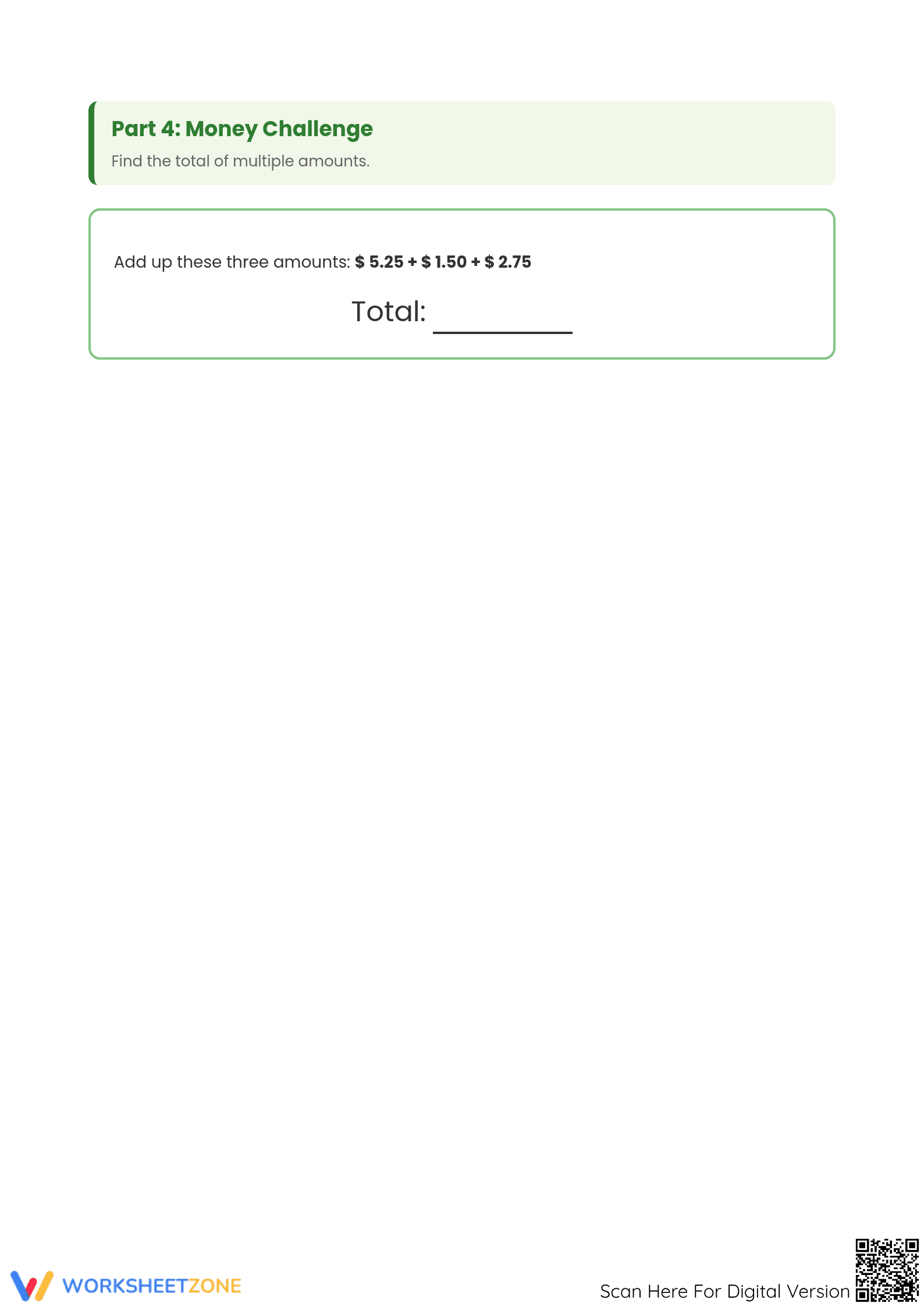
This three-page resource guides students through four distinct parts. It begins with vertical addition, moves to rewriting horizontal problems, and then presents practical shopping-themed word problems. The worksheet concludes with a multi-addend challenge. A complete answer key is provided for quick grading.
Zero-Prep Workflow
This worksheet is structured for maximum efficiency. The workflow is simple, letting you focus on instruction.
- Print (1 min): The packet is ready to print in under a minute. The clean layout is ink-friendly.
- Distribute (1 min): Hand out the worksheet to students. No cutting or extra materials are needed.
- Review (5 mins): Use the included answer key to review answers as a class or for self-checking.
With a total prep time under two minutes, this resource is an ideal tool for substitute plans, homework, or a last-minute review activity.
Standards Alignment
This worksheet directly aligns with Common Core standard CCSS.MATH.CONTENT.2.MD.C.8, which requires students to solve word problems involving money. The tasks give students direct practice with this essential real-world skill. It also supports foundational skills in multi-digit addition (CCSS.MATH.CONTENT.2.NBT.B.5). Both standard codes can be copied directly into lesson plans or curriculum maps.
How to Use It
Use this worksheet for independent practice after a lesson on adding money. The scaffolded sections build confidence before students tackle the word problems. For formative assessment, observe which part presents the most difficulty. For instance, struggles with Part 2 may indicate a need for more support on aligning decimals. The activity should take 20 to 30 minutes.
Who It's For
This resource is designed for second-grade students learning to add money. It can also serve as a review for third graders or as an intervention tool for older students struggling with decimals. For differentiation, pair this worksheet with play money to provide a hands-on manipulative for students who benefit from concrete aids.
This worksheet provides focused practice on CCSS.MATH.CONTENT.2.MD.C.8, a critical early financial literacy skill. By requiring students to add money with decimals in both procedural and applied contexts, the activity builds a foundation for more complex operations. Research underscores the importance of connecting mathematical concepts to real-world scenarios to improve student engagement and retention. According to a RAND AIRS 2024 analysis, instructional materials that incorporate practical applications, such as the shopping problems included here, show a measurable positive effect on student performance in mathematics. The 12 structured problems on this worksheet offer a concrete application of this principle, ensuring students not only compute correctly but also understand the context behind their calculations. This alignment of procedural fluency and conceptual understanding is a key marker of high-quality instructional materials.


