




























Views
Downloads

Kindergarten Addition Worksheet | Printable Math Ready

Paste this activity's link or code into your existing LMS (Google Classroom, Canvas, Teams, Schoology, Moodle, etc.).
Students can open and work on the activity right away, with no student login required.
You'll still be able to track student progress and results from your teacher account.
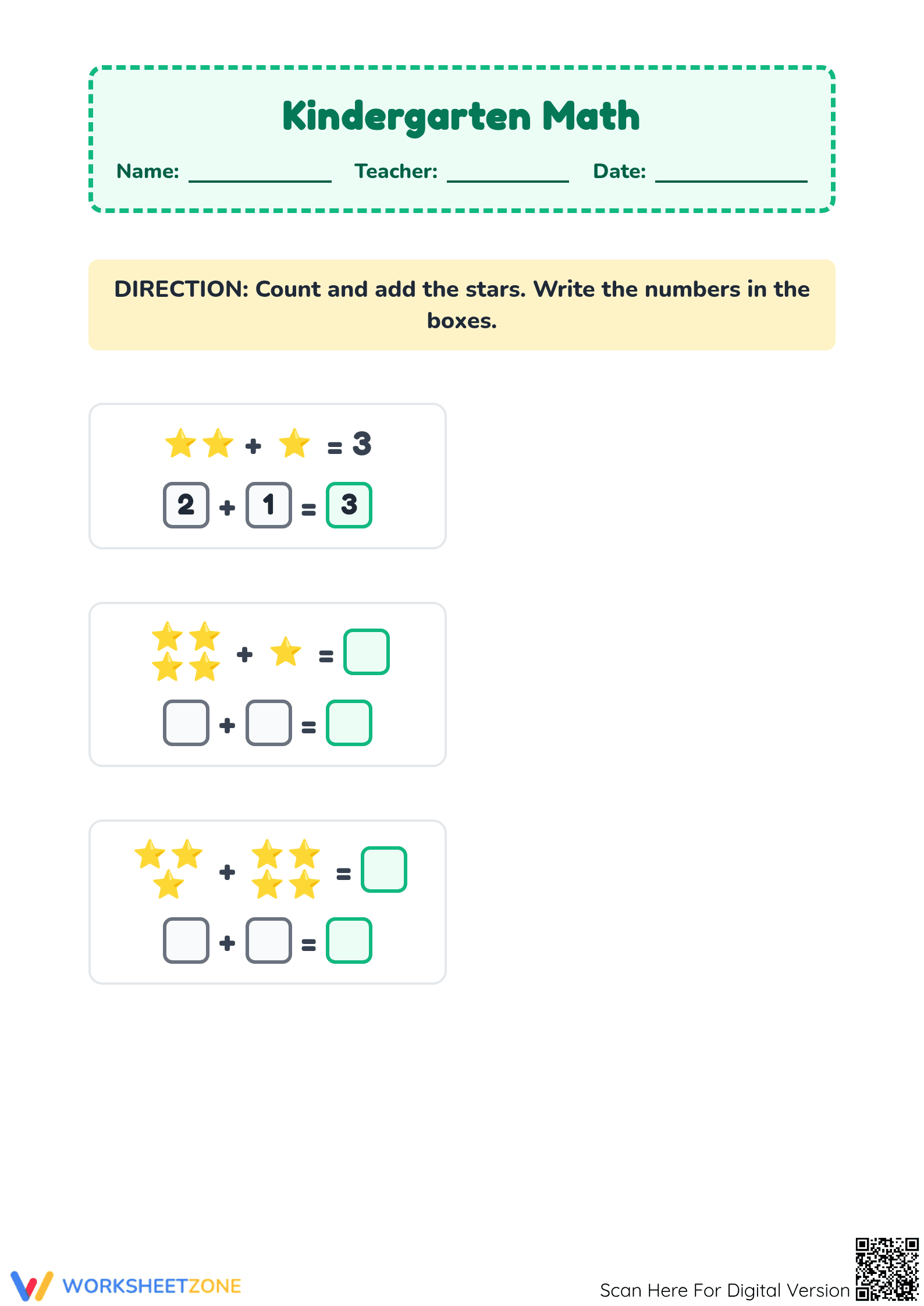
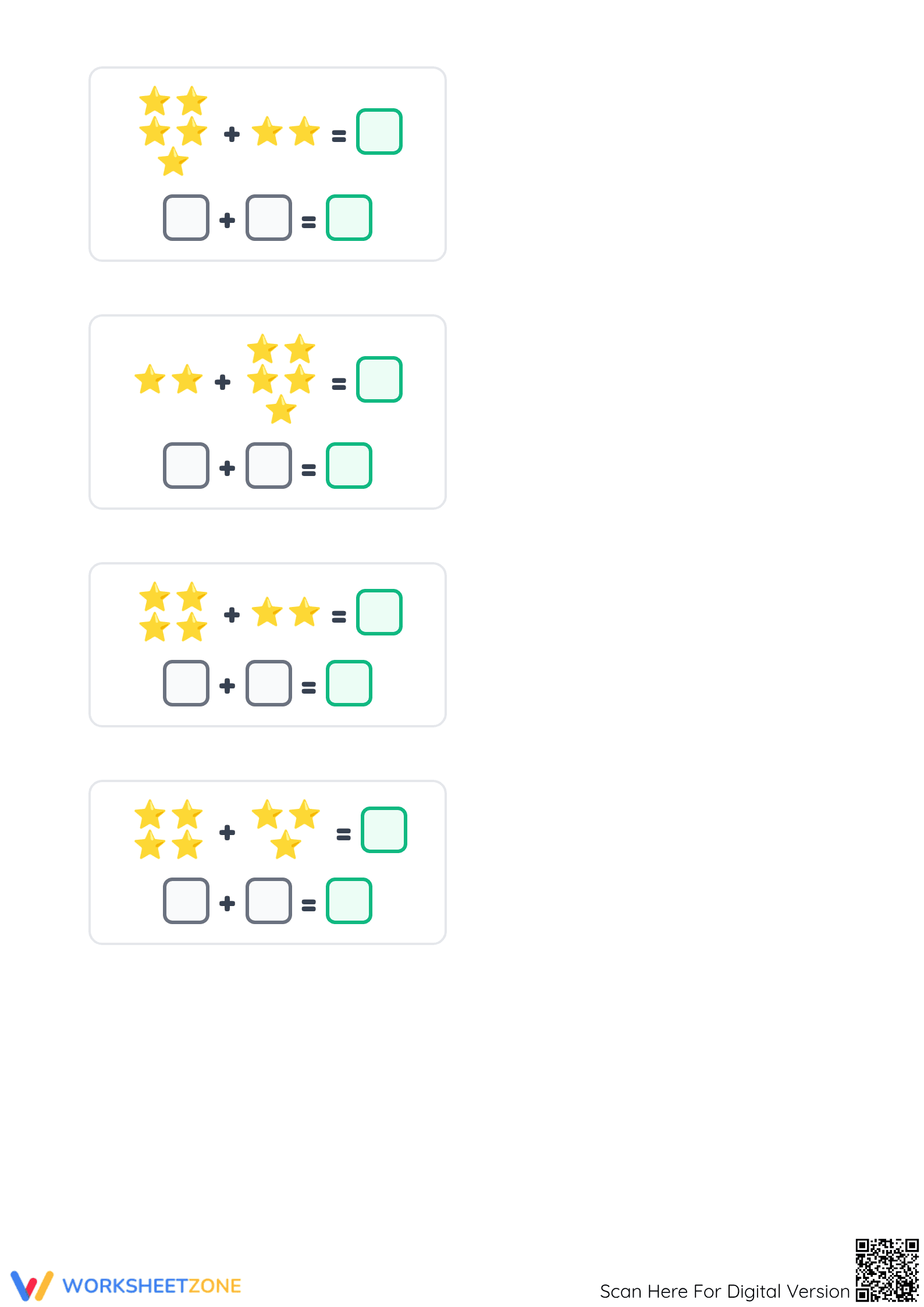
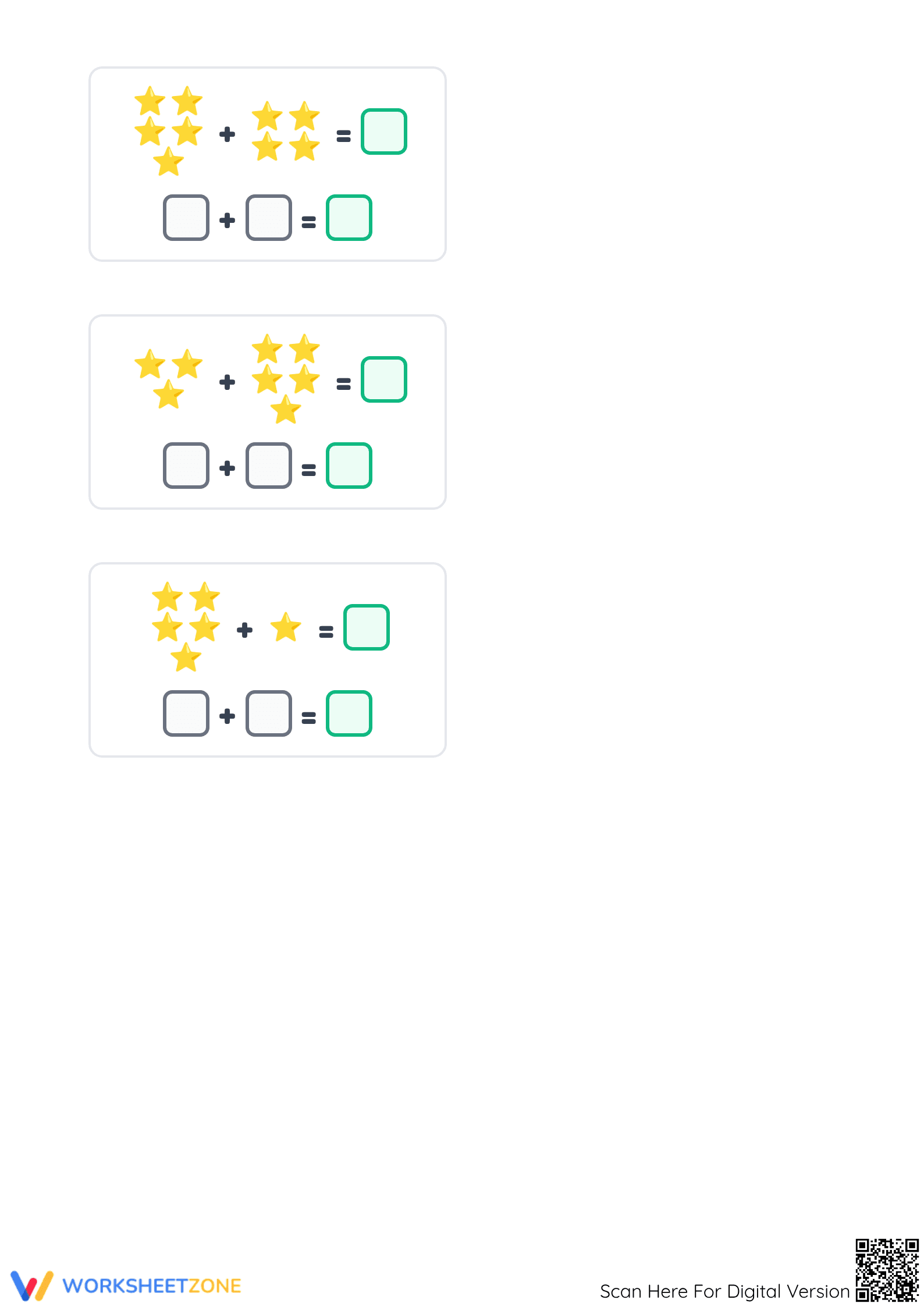
This Kindergarten addition worksheet provides a structured approach to early numeracy by using visual representations to bridge the gap between counting and arithmetic. Students use star icons to represent addends, allowing them to see the composition of numbers before writing digits. This method ensures a concrete understanding of the addition process and basic sums.
At a Glance
- Grade: Kindergarten · Subject: Math
- Standard:
CCSS.MATH.CONTENT.K.OA.A.1— Represent addition with objects, drawings, or sounds- Skill Focus: Visual Addition to 10
- Format: 3 pages · 10 problems · Answer key included · PDF
- Best For: Independent practice or morning work
- Time: 15–20 minutes
This 3-page PDF packet contains 10 distinct addition problems. Each task features a set of stars for students to count, followed by empty boxes to record the addends and the final sum. The first problem serves as a worked example to model the expected workflow. A comprehensive answer key is included to facilitate quick grading or student self-correction.
Zero-Prep Workflow
This resource is designed for immediate classroom implementation. Step 1: Print the three-page packet (20 seconds). Step 2: Distribute to students during your math block (30 seconds). Step 3: Review the visual counting method as a whole group using the provided example (1 minute). Total prep is under two minutes, making this ideal for sub plans.
Standards Alignment
The primary focus is `CCSS.MATH.CONTENT.K.OA.A.1`: "Represent addition and subtraction with objects, fingers, mental images, drawings, sounds, acting out situations, verbal explanations, expressions, or equations." By requiring students to translate visual stars into numerical equations, the worksheet also supports K.OA.A.2. Codes can be copied into lesson plans or IEP goals.
How to Use It
Use this worksheet as a formative assessment after a direct instruction lesson on "adding on." Observe students as they count the stars; if a student struggles to transition to writing the number, provide a number line for support. It also functions well as a quiet center activity, taking approximately 15 to 20 minutes for most Kindergarten learners to complete independently.
Who It's For
This resource is tailored for Kindergarten students beginning their journey with formal operations. It is also effective for Grade 1 students requiring intervention or English Language Learners who benefit from heavy visual scaffolding. Pair this worksheet with physical manipulatives like counting cubes or a printed anchor chart showing the plus and equal signs.
Research from the RAND AIRS 2024 report emphasizes that visual scaffolding in early mathematics is critical for developing long-term fluency in abstract operations. By utilizing the CCSS.MATH.CONTENT.K.OA.A.1 standard, this worksheet aligns with evidence-based practices that encourage students to represent addition through multiple modalities. The transition from counting objects to symbolic representation is a foundational milestone in the Concrete-Representational-Abstract instructional sequence. Studies indicate that students who master visual addition in Kindergarten demonstrate higher proficiency in multi-digit operations by the end of second grade. This resource provides the necessary repetition and clear visual cues required to solidify these early mental models. Educators can integrate this tool into their curriculum, knowing it meets rigorous alignment standards while reducing the cognitive load on emerging mathematicians through consistent formatting and clear instructional directions.


