


























Views
Downloads

Printable Tens and Ones Addition and Subtraction Worksheet
Paste this activity's link or code into your existing LMS (Google Classroom, Canvas, Teams, Schoology, Moodle, etc.).
Students can open and work on the activity right away, with no student login required.
You'll still be able to track student progress and results from your teacher account.
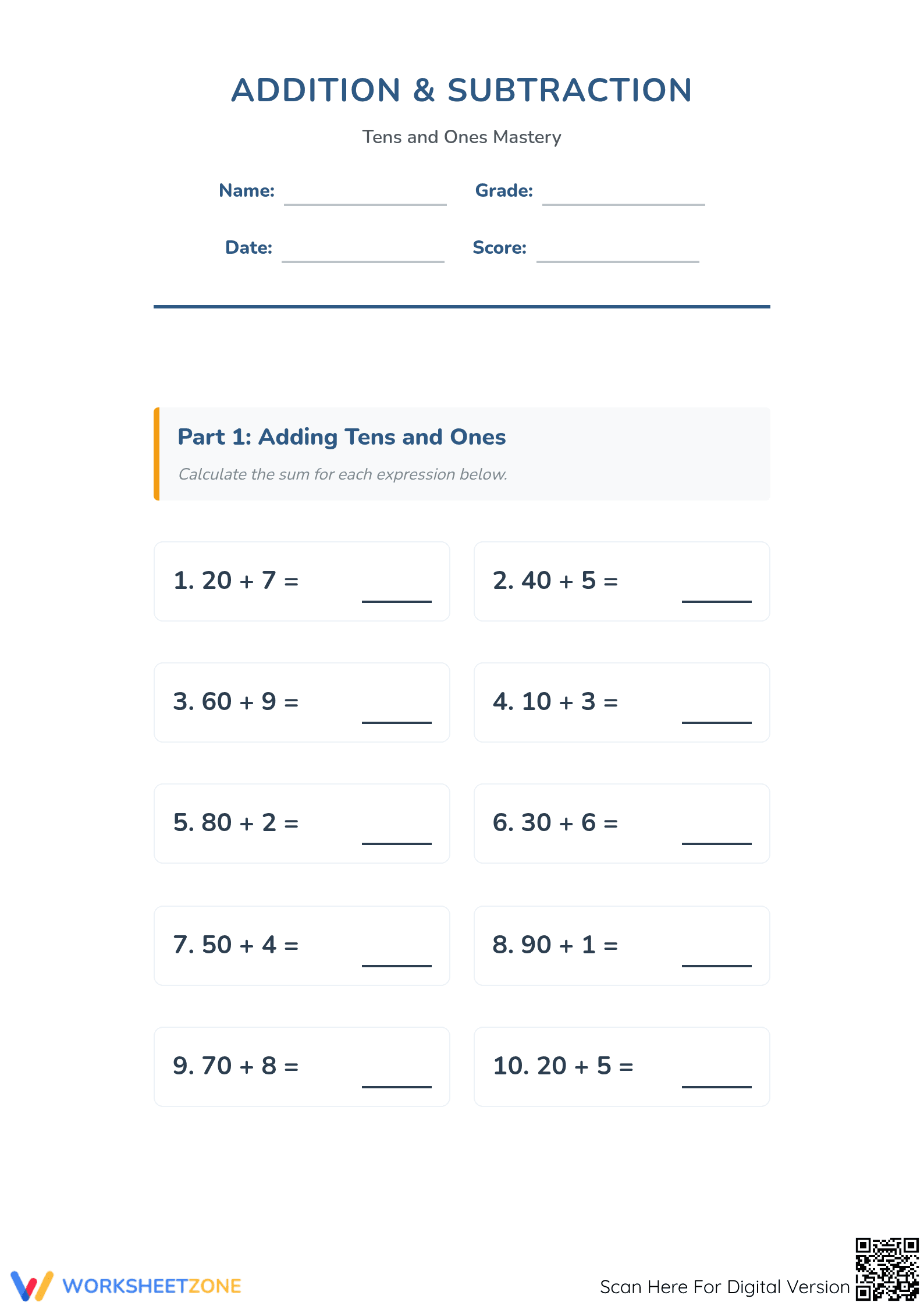
Strengthening foundational place value skills is essential for mathematical fluency. This four-page worksheet packet focuses on addition and subtraction with tens and ones, helping Grade 2 students transition from basic counting to strategic computation. By working through structured numeric expressions and contextual word problems, learners build the conceptual bridge needed for multi-digit mastery.
At a Glance
- Grade: 2 · Subject: Math
- Standard:
2.NBT.B.5— Fluently add and subtract within 100 using place value strategies- Skill Focus: Base Ten Addition and Subtraction
- Format: 4 pages · 35 problems · Answer key included · PDF
- Best For: Small group instruction and independent practice
- Time: 20–30 minutes
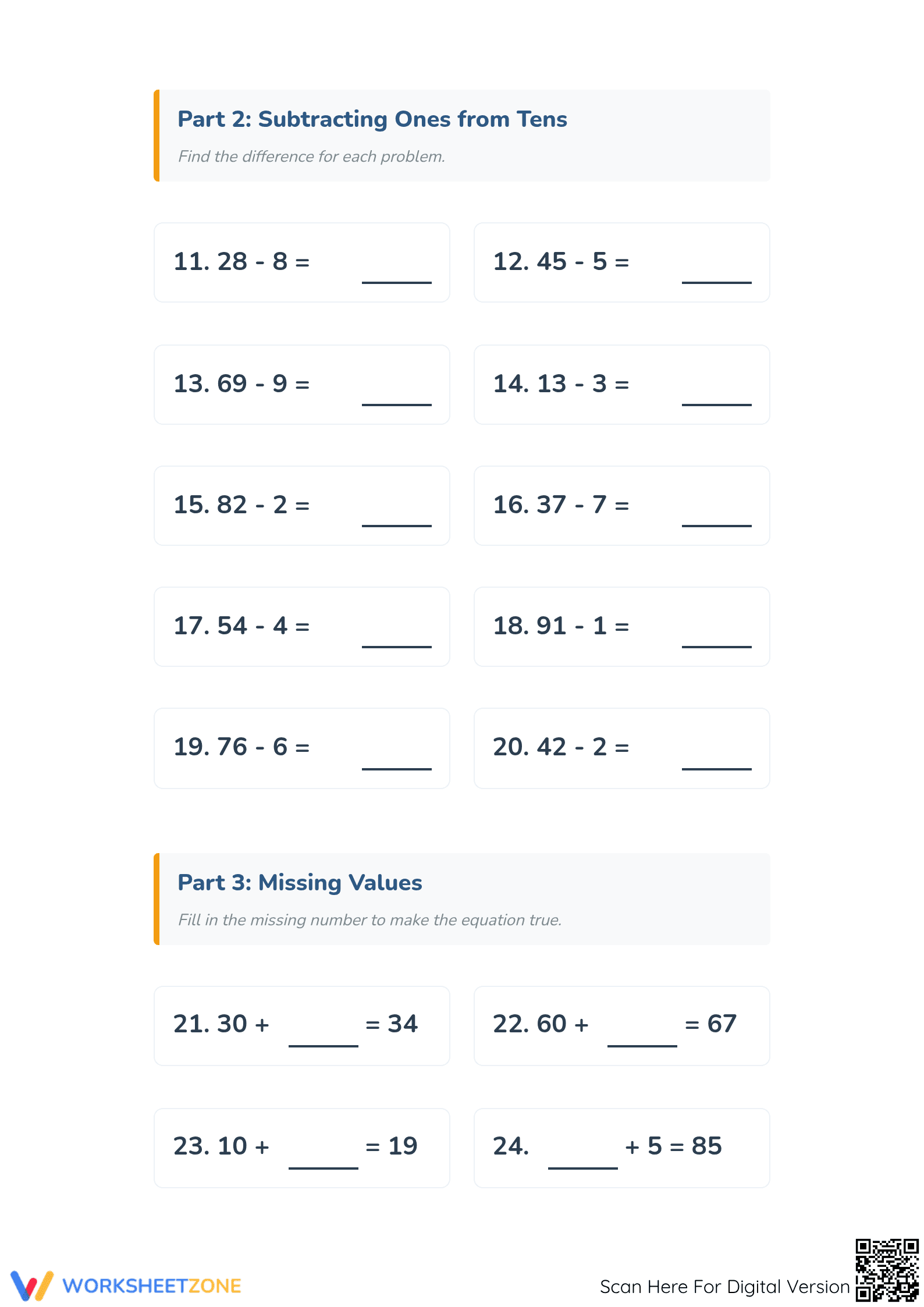
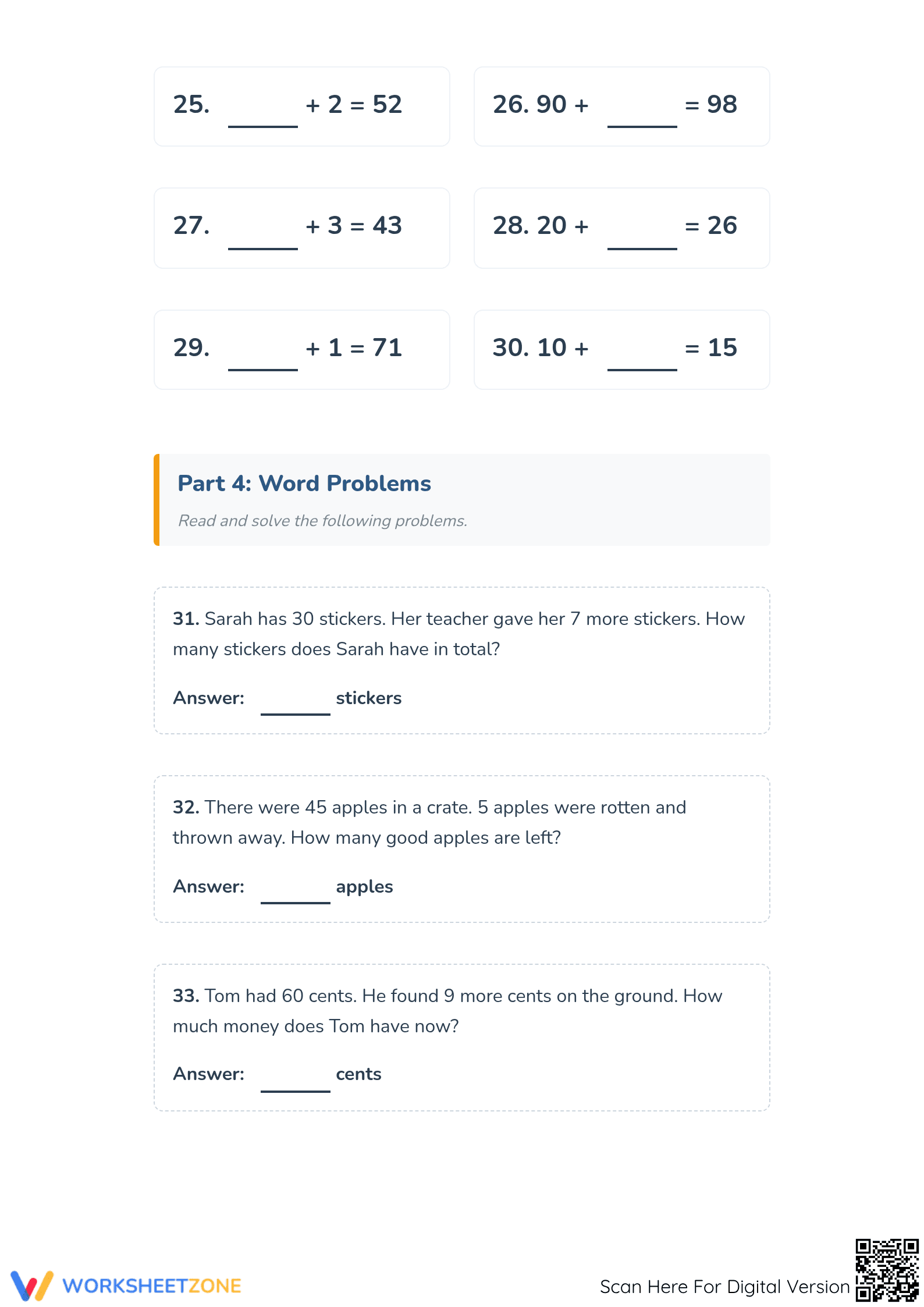
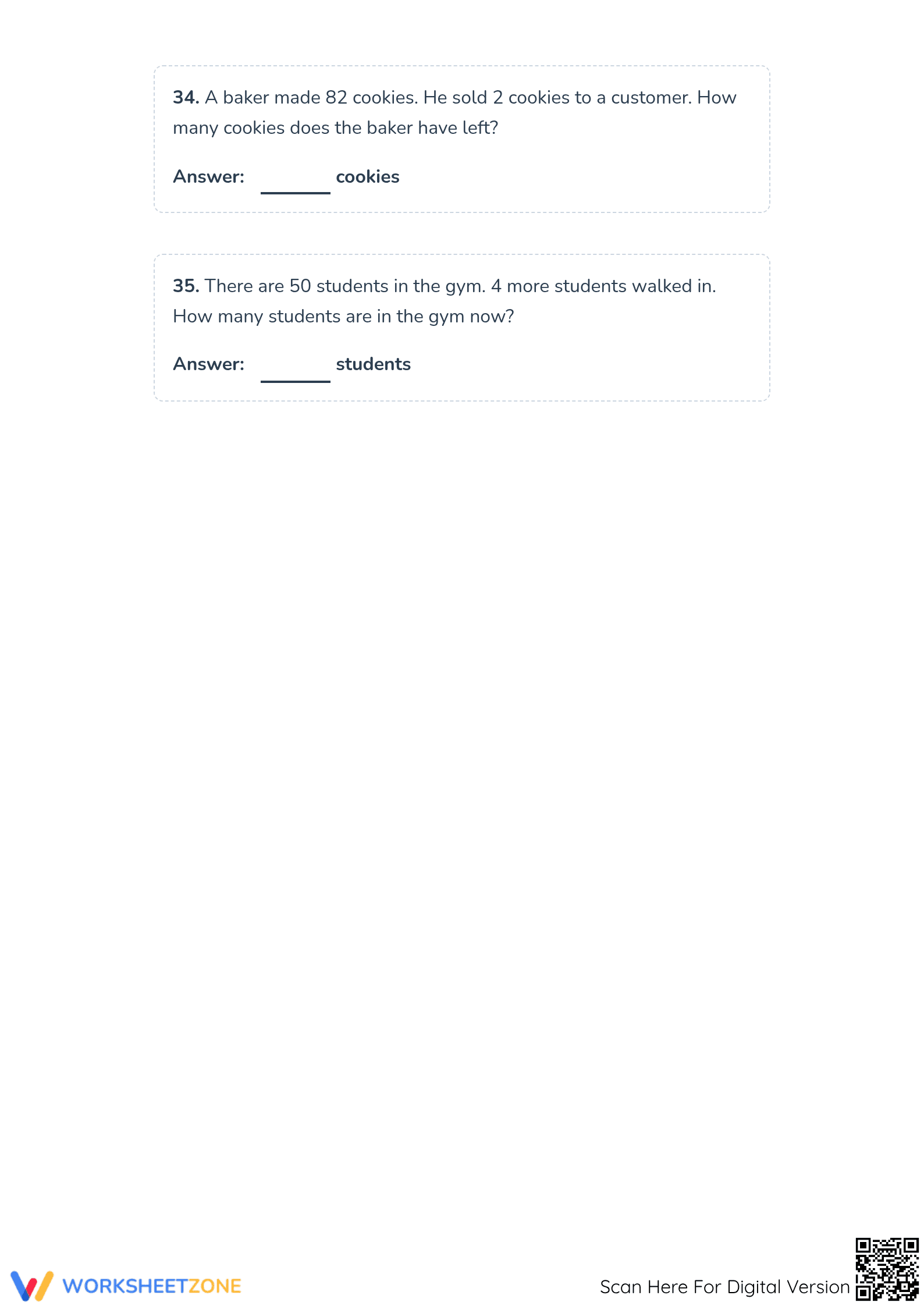
This comprehensive resource contains four distinct sections designed to scaffold student understanding. Part 1 and 2 provide 20 direct calculation problems for adding ones to tens and subtracting ones from tens. Part 3 introduces 10 missing-value equations to challenge algebraic thinking, while Part 4 offers 5 realistic word problems that require students to apply their skills in context.
Teachers can integrate this resource into their daily routine with minimal effort. First, print the four-page PDF (approx. 10 seconds). Second, distribute the packets to students for independent work or as a rotational center activity (approx. 1 minute). Third, review the results using the provided answer key to identify common misconceptions in place value regrouping (approx. 1 minute). Total teacher preparation is under two minutes.
The primary focus of this worksheet is `2.NBT.B.5`, which requires students to fluently add and subtract within 100 based on place value, properties of operations, and/or the relationship between addition and subtraction. It also supports `1.NBT.C.4` by reinforcing the concept of adding a two-digit number and a one-digit number. Both standard codes can be copied directly into lesson plans, IEP goals, or district curriculum mapping tools.
Deploy this packet during the "Independent Practice" phase of a lesson on place value. As students work, walk around and observe if they are counting on their fingers or utilizing the "tens and ones" structure to solve mentally. For students who finish early, ask them to write their own word problem involving a missing addend. This provides a quick formative assessment of their conceptual depth.
This resource is tailored for Grade 2 students but serves as an excellent enrichment tool for Grade 1 or a remedial review for Grade 3. It pairs naturally with base-ten blocks or a hundreds chart to provide a concrete visual for students who need additional scaffolding during the subtraction phase. The clean layout ensures that students can focus on the digits without visual distractions.
Modern educational research emphasizes the importance of place value fluency as a predictor of later success in complex arithmetic. According to a RAND AIRS 2024 analysis of instructional materials, scaffolded practice that moves from abstract numeric expressions to contextual applications significantly improves student retention of base-ten concepts. This worksheet leverages a gradual-release model, providing 35 targeted opportunities for students to internalize the relationship between digits in the tens and ones places. By standardizing the format and aligning closely with the 2.NBT.B.5 framework, the resource ensures that learners are meeting high-bar expectations for Grade 2. Fisher & Frey (2014) note that purposeful practice in identifying missing values within an equation—as seen in the third section of this packet—fosters the algebraic reasoning necessary for higher-level mathematics. Teachers can use this tool to gather empirical evidence of student mastery for progress monitoring or standard-based grading.


