


























Views
Downloads

Addition and Subtraction to 20 Worksheet | Ready Math
Paste this activity's link or code into your existing LMS (Google Classroom, Canvas, Teams, Schoology, Moodle, etc.).
Students can open and work on the activity right away, with no student login required.
You'll still be able to track student progress and results from your teacher account.
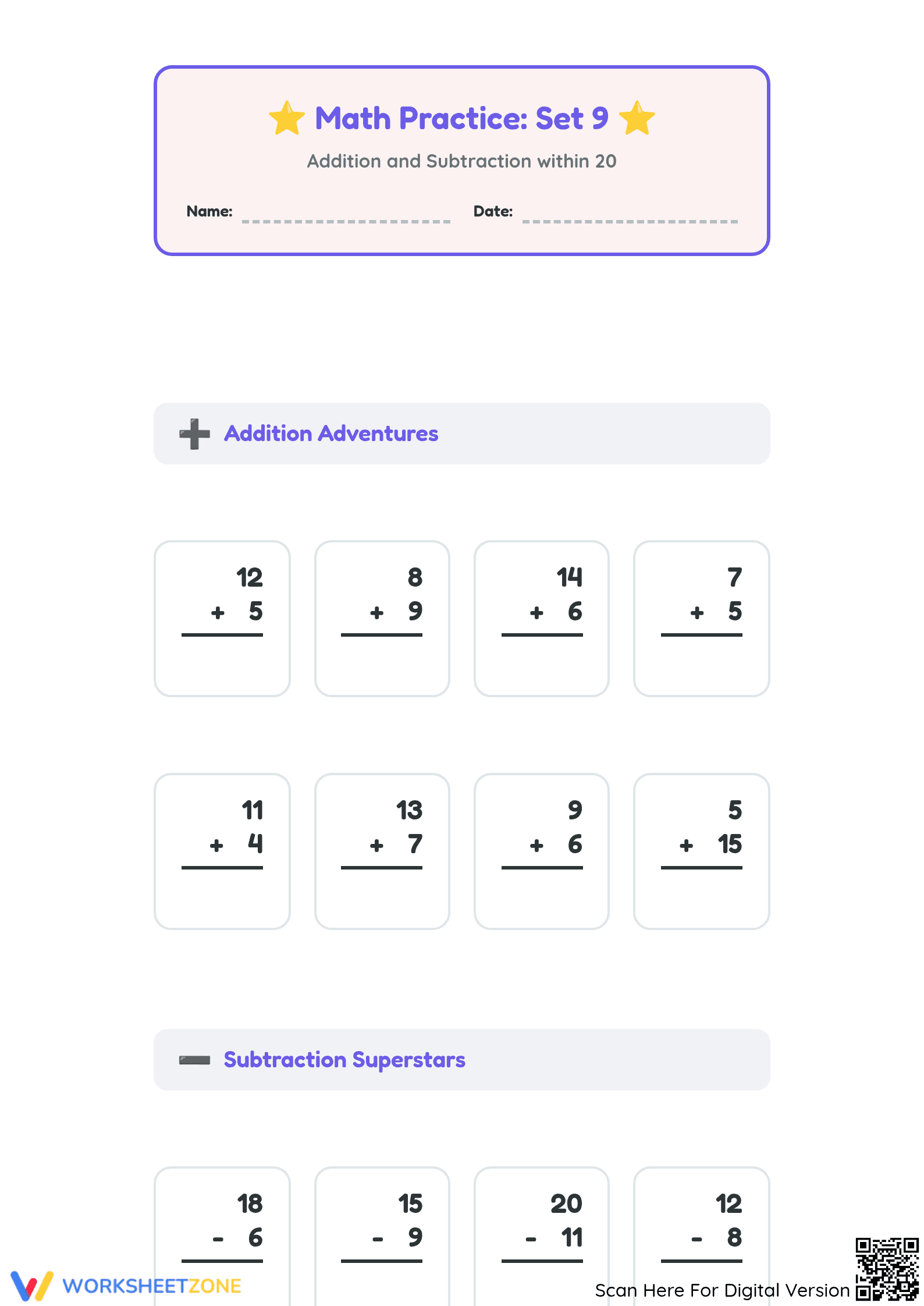
Build essential arithmetic fluency with this comprehensive math practice set designed to solidify addition and subtraction skills within 20. Students progress through vertical computation, mental math challenges, and real-world story problems to ensure they move beyond finger counting. This resource provides the structured repetition necessary for first and second graders to achieve mastery and confidence in basic operations.
At a Glance
- Grade: 1 · Subject: Math
- Standard:
CCSS.MATH.CONTENT.1.OA.C.6— Fluently add and subtract within 20 using mental strategies and word problem application- Skill Focus: Addition and subtraction fluency within 20
- Format: 3 pages · 28 problems · Answer key included · PDF
- Best For: Independent practice and formative assessment
- Time: 15–25 minutes
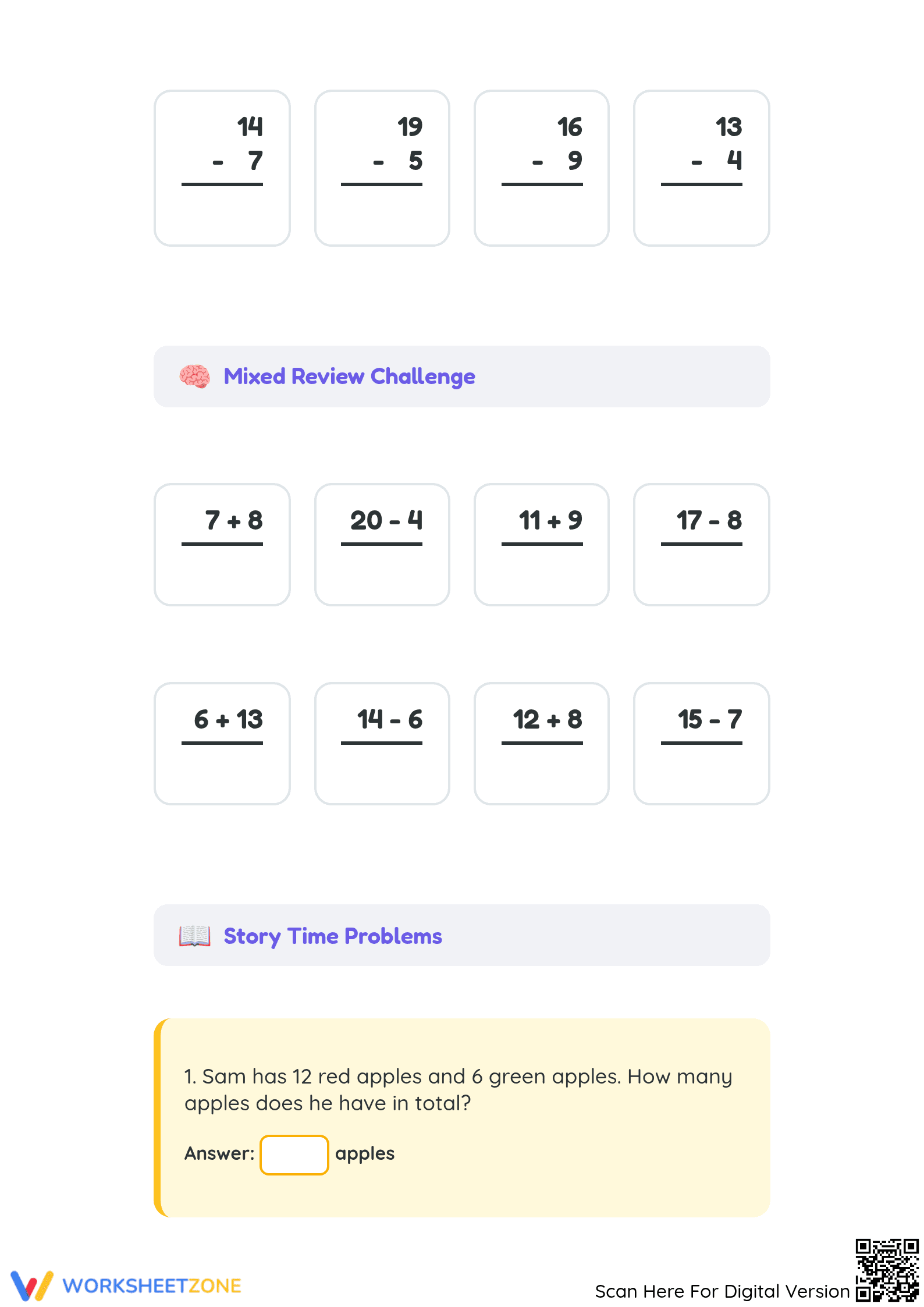
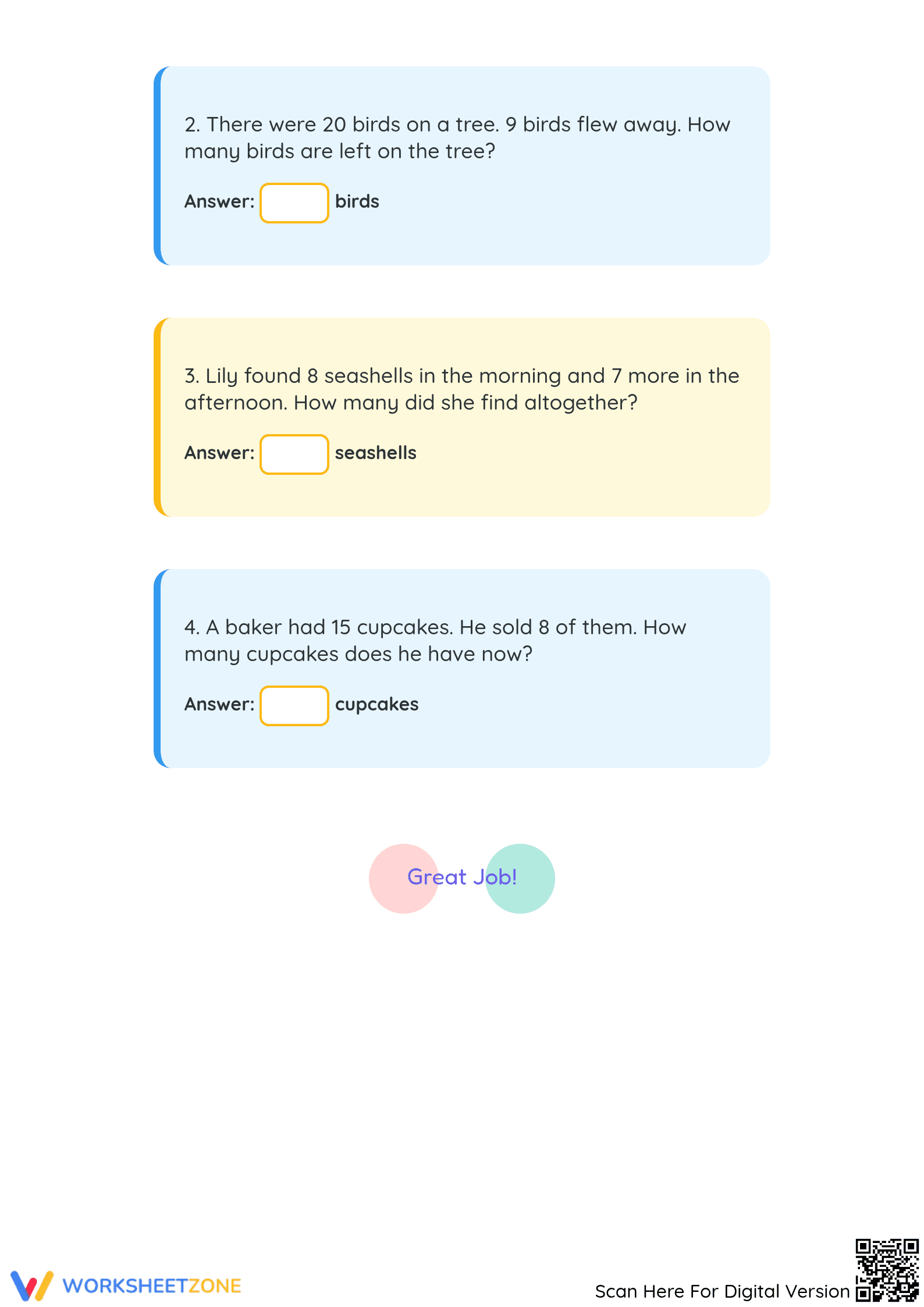
This three-page PDF offers a robust variety of problem types to keep learners engaged. The first page focuses on vertical addition and subtraction, providing clear visual spacing for students to work through regrouping or counting strategies. The second page introduces a mixed review challenge with horizontal equations and the first of several story problems. The final page concludes with three high-interest word problems that require students to translate text into mathematical operations.
Implementing this worksheet into your daily routine is simple and efficient. First, print the three-page set for your class, which takes less than one minute. Distribute the worksheets during your independent work block or as a homework assignment. Finally, use the provided answer key to review student work in under two minutes, identifying specific areas where individuals may need additional strategy support or intervention.
This resource is fully aligned to CCSS.MATH.CONTENT.1.OA.C.6, which requires students to add and subtract within 20, demonstrating fluency for addition and subtraction within 10. The inclusion of word problems also supports standard 1.OA.A.1. Both standard codes can be copied directly into lesson plans, IEP goals, or district curriculum mapping tools to ensure instructional compliance and tracking.
Use this worksheet as a formative assessment after teaching strategies like "making ten" or "counting on." It is particularly effective for identifying students who have transitioned to mental fluency versus those still reliant on physical manipulatives. For a quick check, observe students during the Mixed Review section to see if they can transition between operations without confusion. The expected completion time for the full set is approximately 20 minutes.
This practice set is ideal for first-grade students working toward fluency, second graders requiring a seasonal review, or RTI groups focusing on basic operation gaps. It pairs naturally with an anchor chart demonstrating number lines or ten-frames. The clear font and minimal distractions make it an excellent choice for students who benefit from structured, clean layouts without overwhelming visual noise.
The mastery of basic operations within 20 is a critical predictor of future success in multi-digit arithmetic and algebraic thinking. According to the RAND AIRS 2024 report on early elementary mathematics, students who engage in mixed-operation practice show a 14% higher retention rate of mental math strategies compared to those practicing single operations in isolation. This worksheet facilitates that growth by requiring students to frequently switch between addition and subtraction mental models. By integrating story problems, the resource ensures that procedural fluency is matched by conceptual understanding, allowing students to apply 1.OA.C.6 skills to concrete situations. The structured 28-problem format provides enough data for teachers to make informed instructional decisions while remaining brief enough to prevent student fatigue. This balance of volume and variety is essential for building the stamina required for higher-grade testing environments.


