


























Views
Downloads
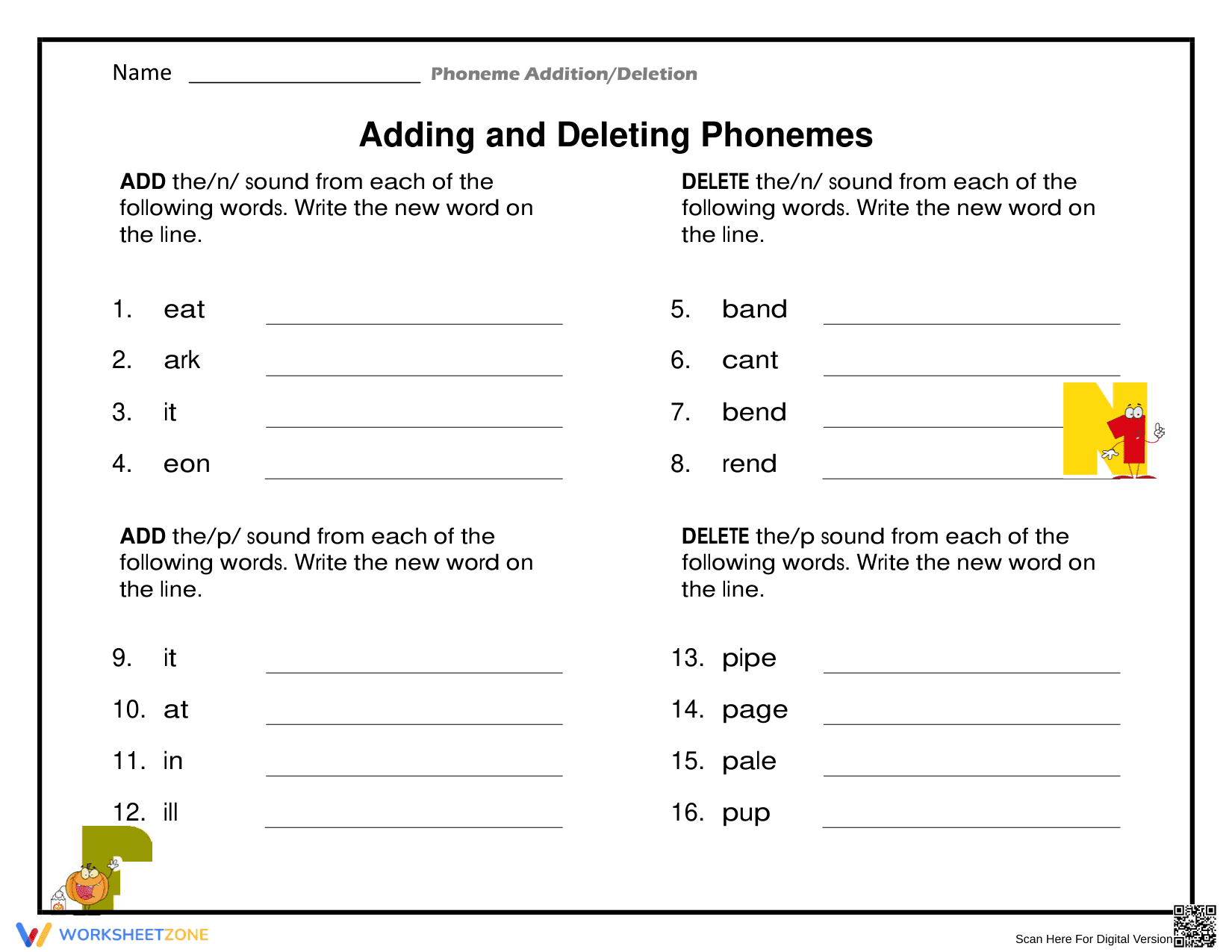

Grade 1 Phoneme Manipulation — Printable No-Prep Worksheet
Paste this activity's link or code into your existing LMS (Google Classroom, Canvas, Teams, Schoology, Moodle, etc.).
Students can open and work on the activity right away, with no student login required.
You'll still be able to track student progress and results from your teacher account.
This phoneme addition and deletion worksheet strengthens foundational literacy by challenging students to manipulate individual sounds within single-syllable words. Students add or remove the /n/ and /p/ sounds to create entirely new words, reinforcing the understanding that spoken words are composed of individual phonemes. This targeted practice directly supports decoding skills and spelling proficiency in early readers.
At a Glance
- Grade: 1 · Subject: English Language Arts
- Standard:
CCSS.ELA-LITERACY.RF.1.2.E— Add or substitute individual sounds in simple, one-syllable words to make new words- Skill Focus: Phoneme Addition and Deletion
- Format: 1 page · 16 problems · Answer key included · PDF
- Best For: Daily phonics practice or quick formative assessment
- Time: 10–15 minutes
Inside this resource is a structured one-page worksheet featuring 16 tasks divided into four quadrants. The first two sections focus on adding phonemes (/n/ and /p/) to base words like "eat" or "it" to form new words. The final quadrants challenge students to delete those same sounds from existing words such as "band" or "pipe." The clean layout provides clear lines for student writing and a full answer key for efficient grading.
This classroom-ready resource is designed for a smooth workflow that saves valuable instructional time. Simply follow these three steps: Print the single-page PDF (30 seconds), distribute it to your Grade 1 or Grade 2 students during their literacy block (1 minute), and review the completed tasks using the included answer key (30 seconds). With a total teacher preparation time of under two minutes, this worksheet is an ideal solution for morning work, literacy centers, or emergency sub plans.
This worksheet is meticulously aligned to CCSS.ELA-LITERACY.RF.1.2.E, which requires students to add or substitute individual sounds (phonemes) in simple, one-syllable words to make new words. By isolating specific sounds like /n/ and /p/ for manipulation, the activity also supports phonological awareness goals related to sound isolation and blending. Both standard codes can be copied directly into lesson plans, IEP goals, or district curriculum mapping tools.
Use this worksheet as a focused exit ticket after a direct instruction lesson on phoneme manipulation to gauge student understanding in real-time. Alternatively, assign it as independent practice during small-group rotations. A great formative-assessment observation tip is to listen to students as they whisper-read the words to see if they are correctly isolating the target phonemes. Most students will complete the 16 tasks within 10 to 15 minutes.
This resource is specifically crafted for first-grade students developing their phonological awareness, though it also serves as an excellent intervention tool for second or third graders who need extra support. The clear instructions and familiar vocabulary make it accessible for English Language Learners. It pairs naturally with a phoneme-grapheme mapping activity or an anchor chart displaying common consonant sounds and their corresponding letters.
According to the RAND AIRS 2024 report on foundational literacy, explicit instruction in phoneme manipulation is a critical predictor of future reading success. This worksheet targets the CCSS.ELA-LITERACY.RF.1.2.E standard by providing 16 structured opportunities for students to add and delete phonemes, a skill that bridges the gap between oral language and written decoding. Research from Fisher & Frey (2014) emphasizes that gradual release of responsibility in phonics instruction—starting with teacher-led oral manipulation and moving to independent written tasks like this one—significantly improves student retention of phonetic patterns. By mastering the addition and deletion of /n/ and /p/ sounds, learners develop the cognitive flexibility required to handle more complex multisyllabic words. This resource provides a reliable, data-informed way to verify student mastery of phonological awareness benchmarks while maintaining high-impact instructional design for diverse classroom settings.


