




























Views
Downloads

Printable Addition & Subtraction Worksheet | Grade 2 Math

Paste this activity's link or code into your existing LMS (Google Classroom, Canvas, Teams, Schoology, Moodle, etc.).
Students can open and work on the activity right away, with no student login required.
You'll still be able to track student progress and results from your teacher account.
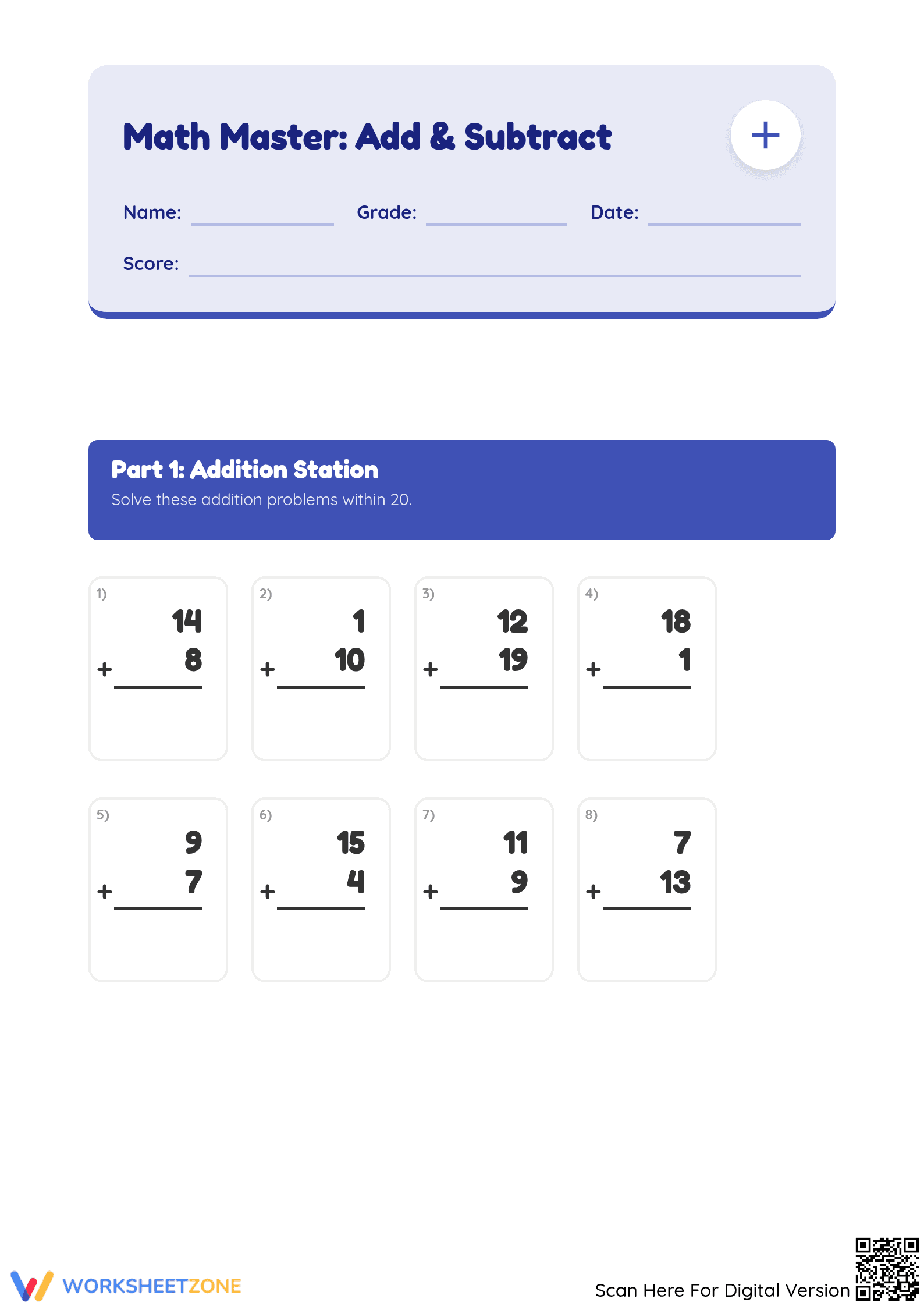
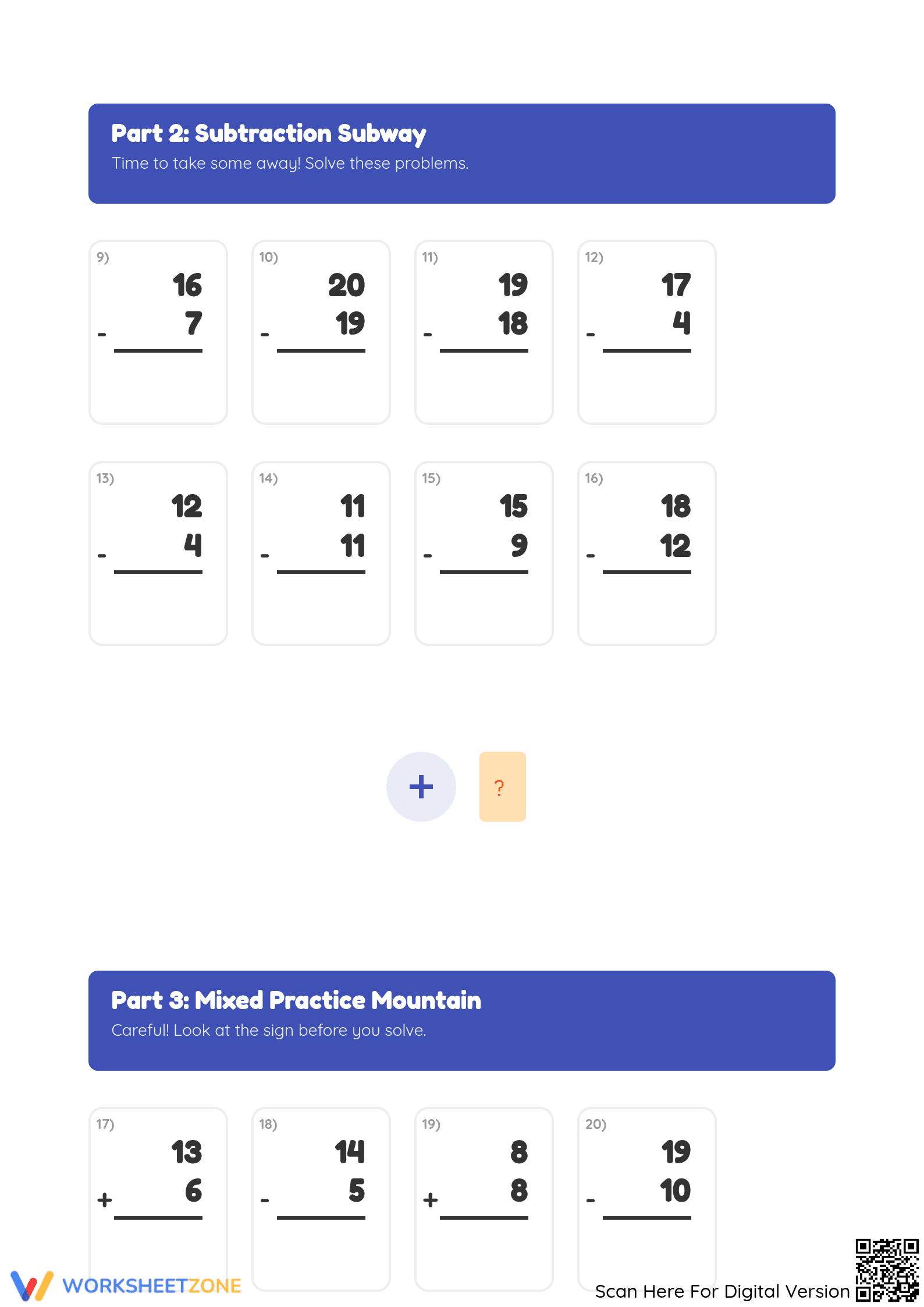
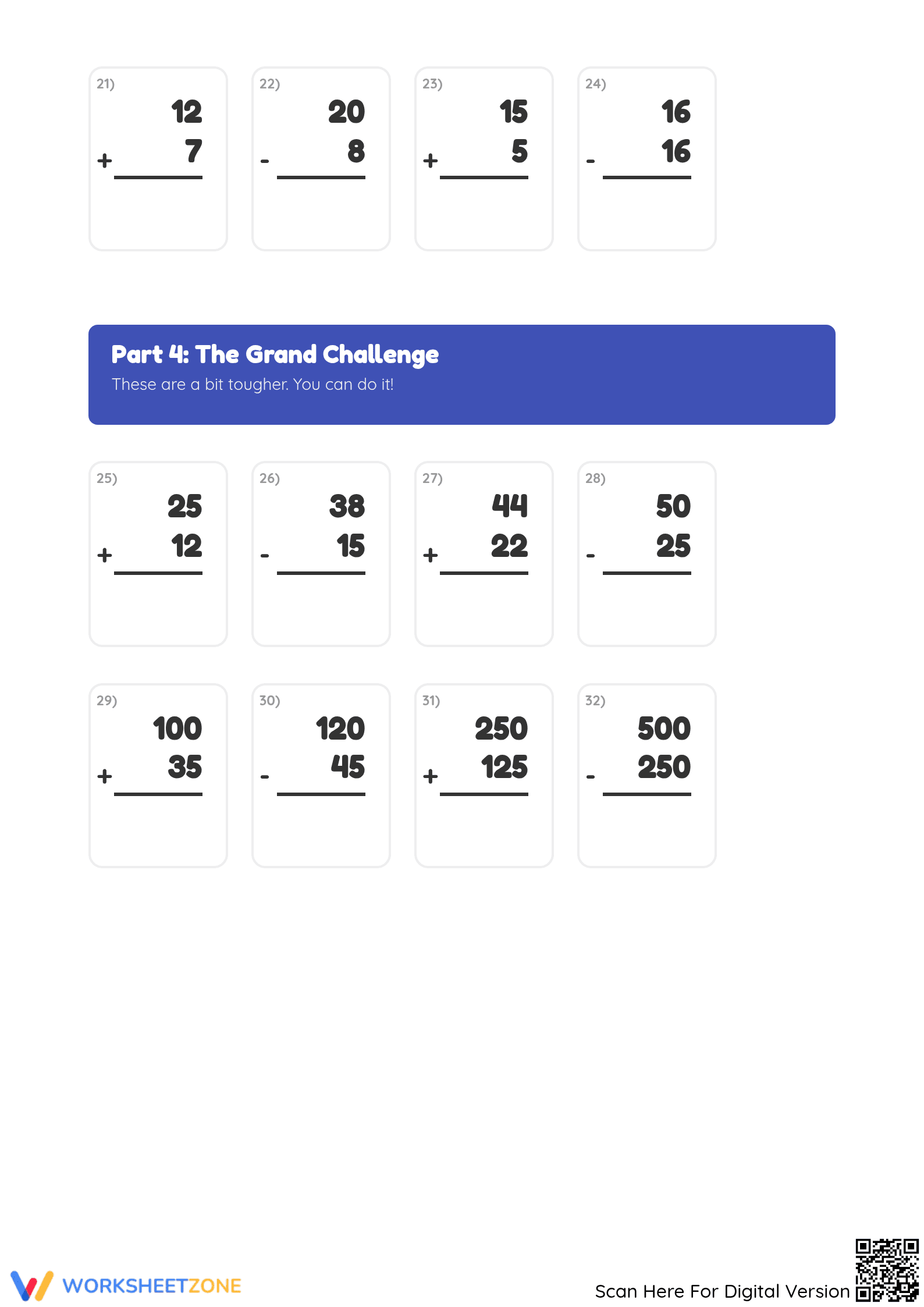
Build computational fluency with this comprehensive addition and subtraction worksheet for second grade. Students solve 32 problems across four distinct sections, moving from simple operations within 20 to more complex mixed calculations within 1,000. It's an ideal tool for practice, review, or formative assessment of key arithmetic skills.
At a Glance
- Grade: 2 · Subject: Math
- Standard:
CCSS.MATH.CONTENT.2.OA.B.2— Fluently add and subtract within 20 using mental strategies.- Skill Focus: Addition and Subtraction Fluency
- Format: 3 pages · 32 problems · Answer key included · PDF
- Best For: Independent practice, skill reinforcement, homework
- Time: 20–30 minutes
What's Inside
This three-page resource is structured to guide students through a logical skill progression. The first page focuses solely on addition, the second on subtraction and mixed practice, and the third page presents "The Grand Challenge" with multi-digit numbers. A complete answer key is provided for easy grading or self-correction, making the entire package a self-contained instructional tool.
Skill Progression
This worksheet follows a gradual release model to build student independence.
- Guided Practice: The first two sections (16 problems) isolate addition and subtraction, allowing students to focus on one process at a time.
- Supported Practice: The "Mixed Practice Mountain" section requires students to switch between operations, a key cognitive step demanding attention to detail.
- Independent Practice: "The Grand Challenge" serves as the final application phase, extending skills to larger numbers up to 1,000 and requiring sustained accuracy.
Standards Alignment
This worksheet is primarily aligned with Common Core standard CCSS.MATH.CONTENT.2.OA.B.2, which requires students to "Fluently add and subtract within 20 using mental strategies." The challenge section also provides extension practice for CCSS.MATH.CONTENT.2.NBT.B.7 on adding and subtracting within 1,000. Both standard codes can be copied directly into lesson plans, IEP goals, or district curriculum mapping tools.
How to Use It
Use this worksheet for independent practice after a lesson on addition and subtraction. For formative assessment, observe where students struggle; difficulty with the mixed practice section indicates a need for more work on identifying operators. The worksheet also functions well as a 20-30 minute homework assignment or math center activity.
Who It's For
Designed for second-grade students, the clear progression is accessible for most learners, while challenge problems extend the task for advanced students. It pairs well with a number line anchor chart or a lesson on place value strategies.
Structured, repetitive practice is key for mathematical fluency, a finding supported by the RAND AIRS (2024) analysis of effective math interventions. This worksheet directly targets CCSS.MATH.CONTENT.2.OA.B.2, which focuses on fluent addition and subtraction within 20. It offers 32 problems that scaffold from single-operation tasks to mixed practice and multi-digit challenges. By requiring students to consistently apply basic facts and procedural strategies, the worksheet helps move these skills from effortful calculation to automatic recall. This automaticity frees up cognitive resources for higher-order problem-solving, a critical step in mathematical development. The inclusion of problems extending to 1,000 also provides a bridge to developing number sense with larger quantities, reinforcing place value in a practical context.


