


























Views
Downloads
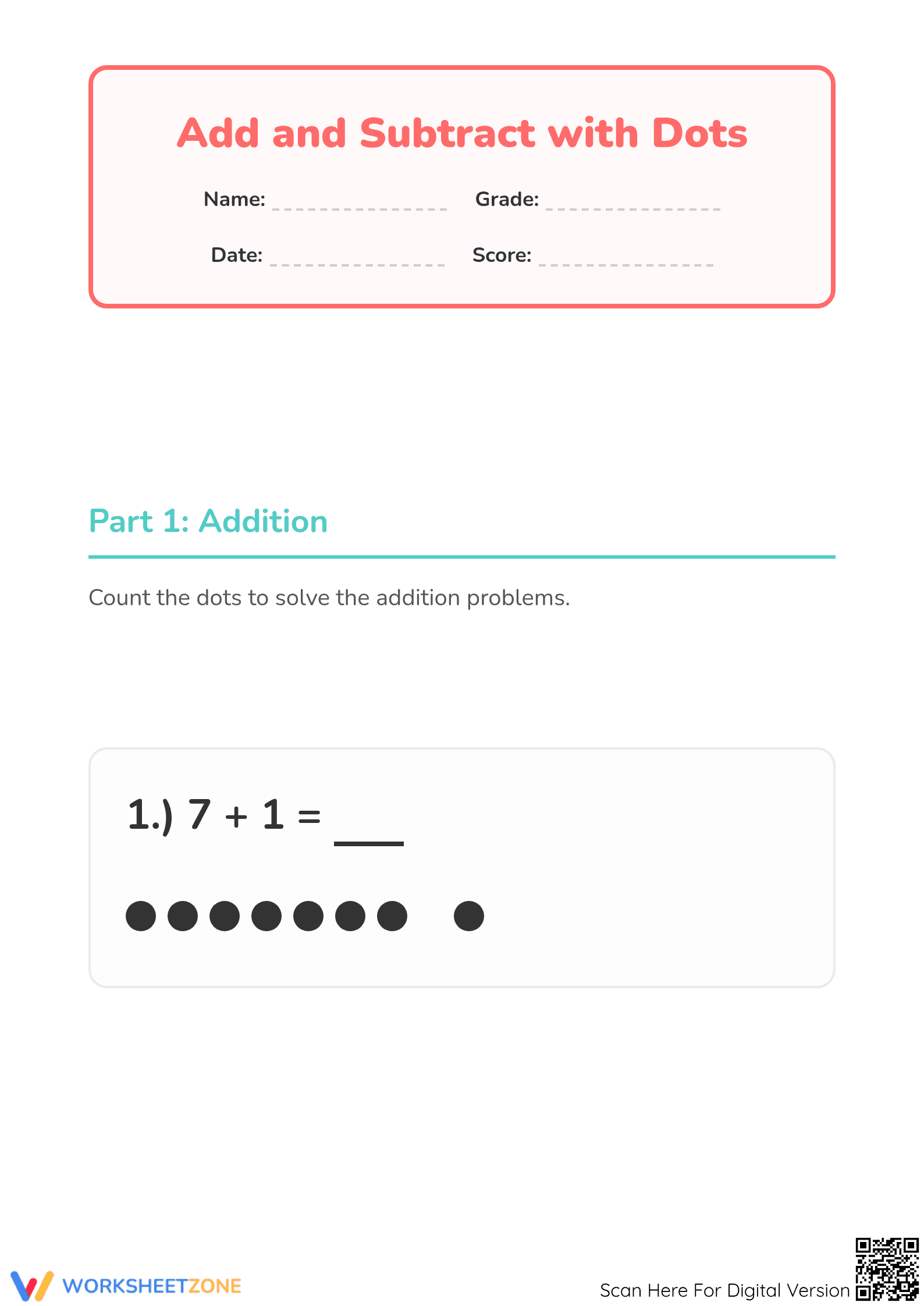
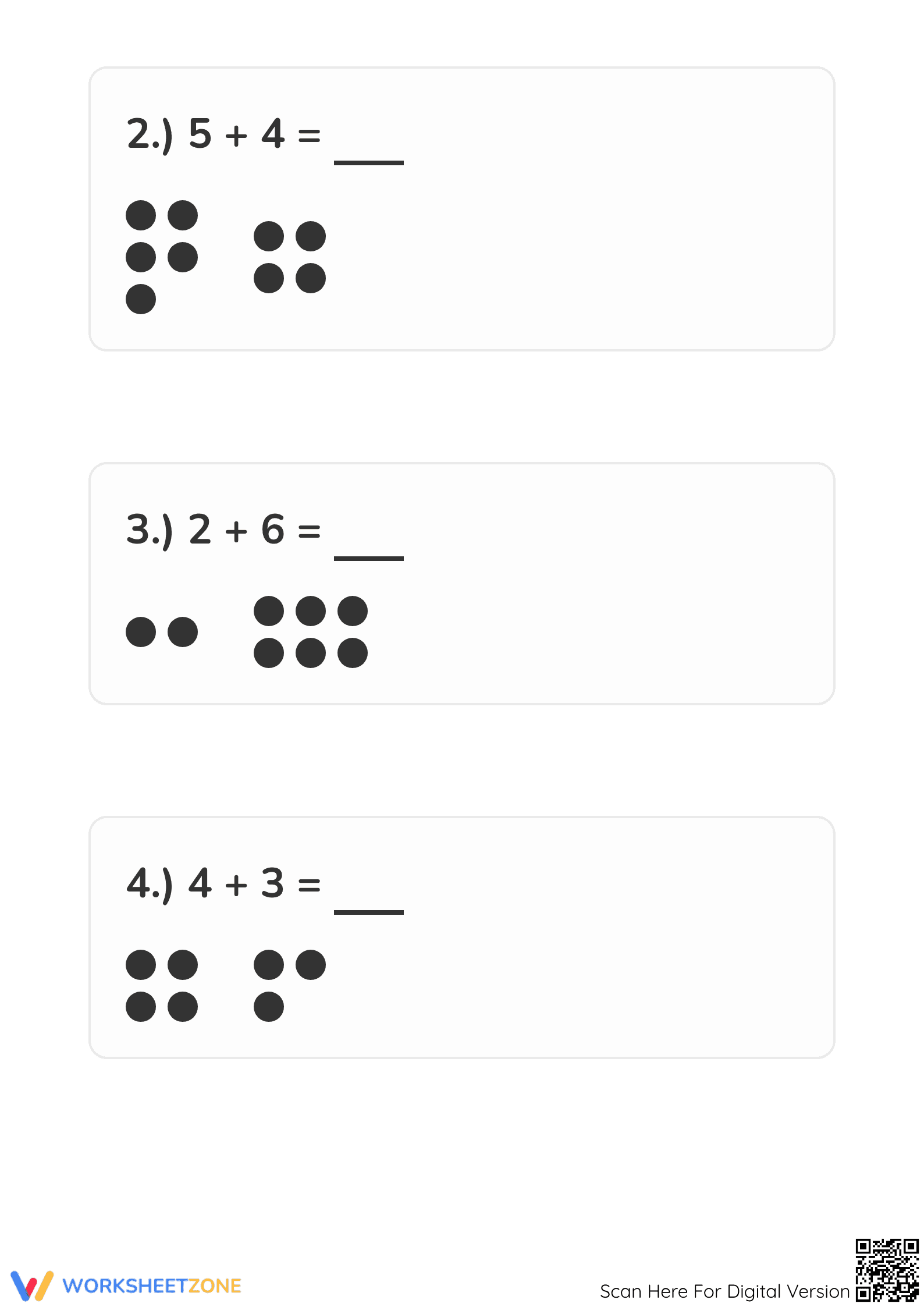
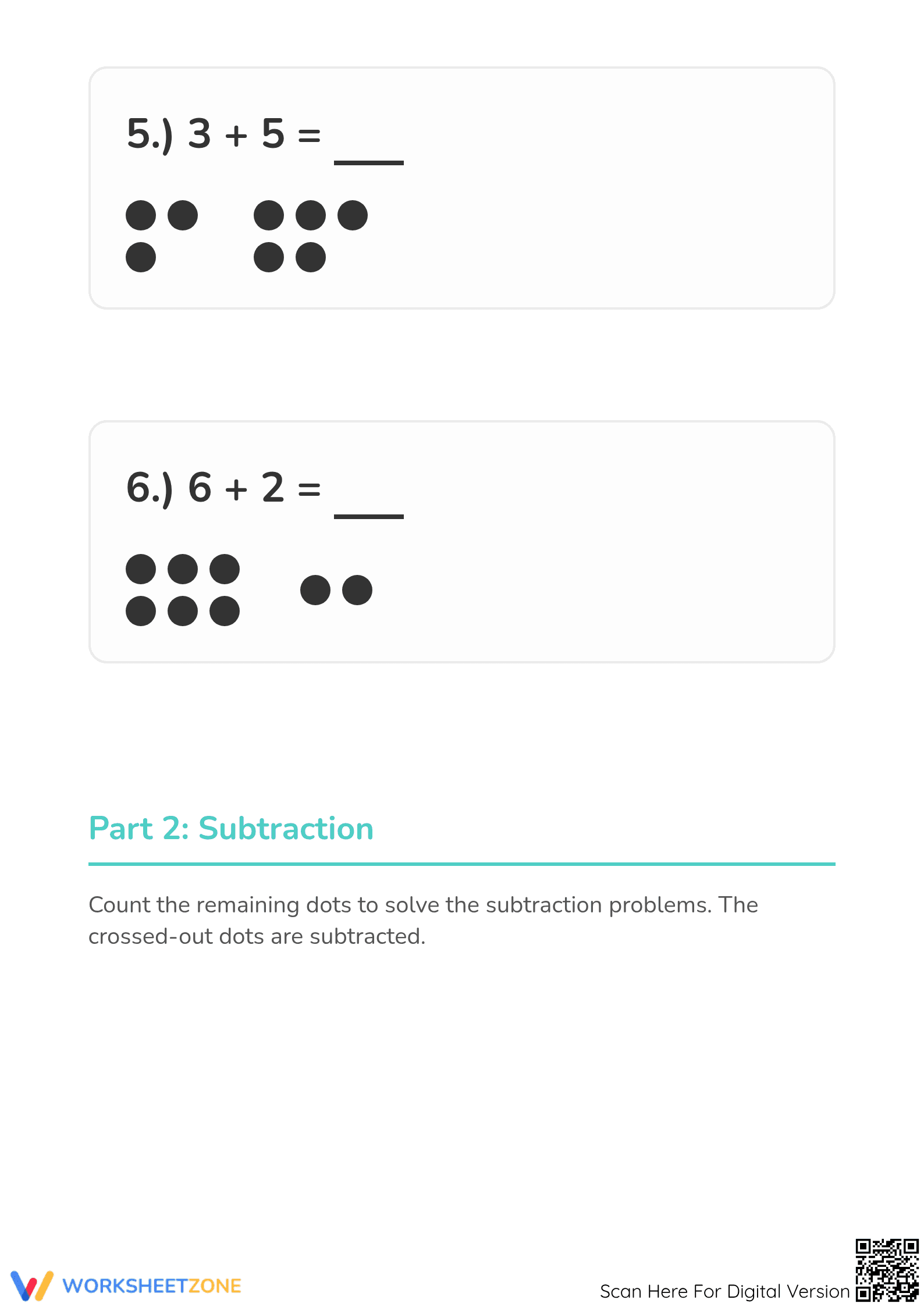
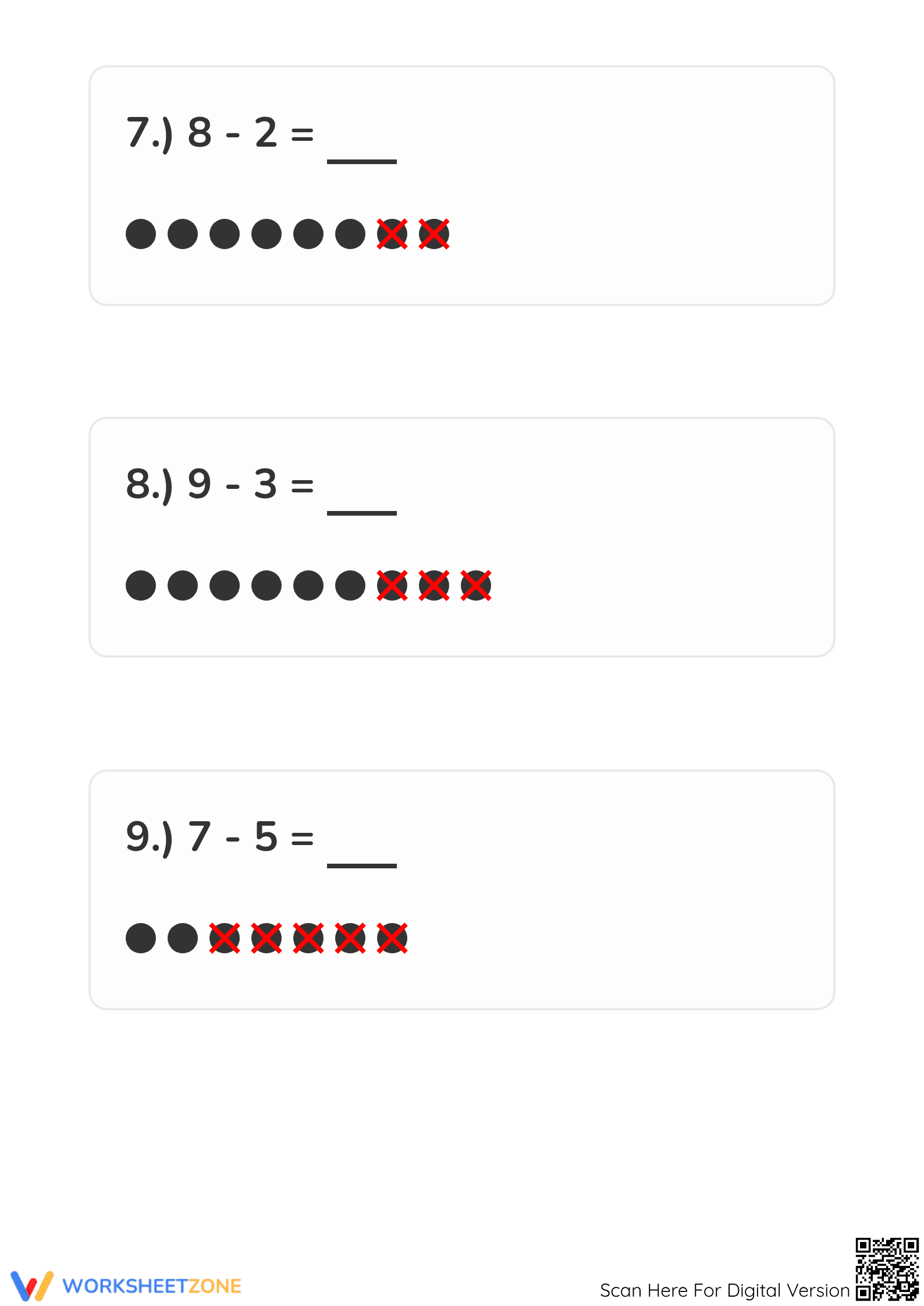

Essential Add and Subtract with Dots Worksheet | Grade K-1
Paste this activity's link or code into your existing LMS (Google Classroom, Canvas, Teams, Schoology, Moodle, etc.).
Students can open and work on the activity right away, with no student login required.
You'll still be able to track student progress and results from your teacher account.
This foundational Grade K-1 math worksheet provides a concrete, visual approach to mastering basic arithmetic operations within ten. By using tactile-style dot models, students bridge the gap between physical manipulatives and abstract number sentences, ensuring a deep conceptual understanding of what it means to join or separate sets.
At a Glance
- Grade: K–1 · Subject: Math
- Standard:
CCSS.MATH.CONTENT.K.OA.A.1— Represent addition and subtraction with objects, fingers, mental images, drawings, or sounds- Skill Focus: Visual addition and subtraction
- Format: 5 pages · 12 problems · Answer key included · PDF
- Best For: Early numeracy centers and sub plans
- Time: 15–20 minutes
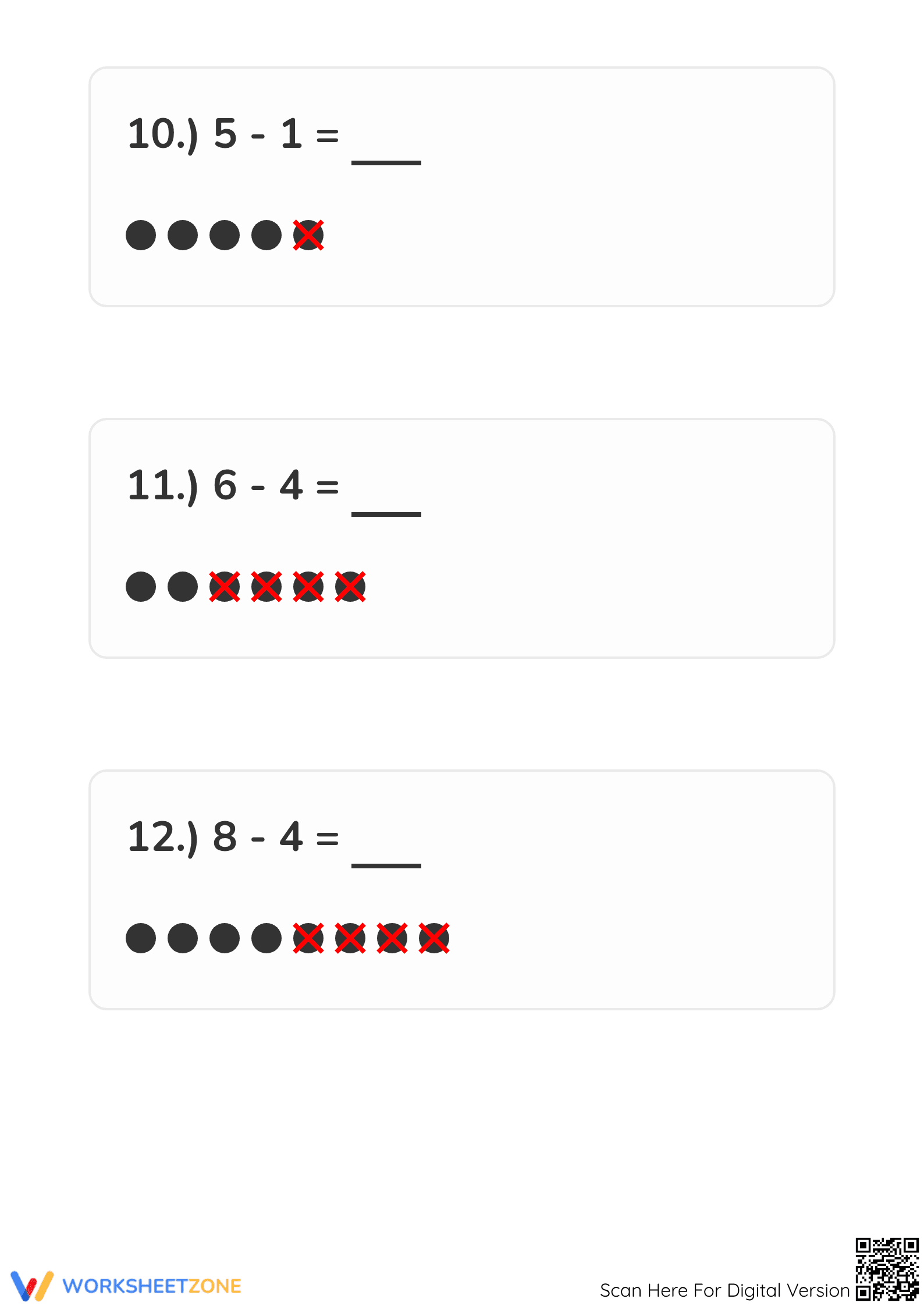
The 5-page PDF contains 12 structured problems divided into two distinct sections. Part one features 6 addition equations supported by grouped dot arrays, while part two offers 6 subtraction problems using a cross-out visual method. A complete, high-contrast answer key is provided to facilitate rapid grading or student self-correction.
Zero-Prep Workflow: Step 1: Print all 5 pages in seconds (under 1 minute). Step 2: Distribute to students for independent or guided work (0 minutes setup). Step 3: Review using the visual answer key (under 1 minute). Total teacher preparation time is less than two minutes, making this an ideal "grab-and-go" resource for busy mornings or unexpected sub plans.
This resource aligns with `CCSS.MATH.CONTENT.K.OA.A.1`, which requires students to represent addition and subtraction with objects, mental images, drawings, or other representations. The worksheet specifically utilizes the "drawing" and "object" representation to solidify the concept of basic operations. Both standard codes can be copied directly into lesson plans, IEP goals, or district curriculum mapping tools.
Use this worksheet during the "guided practice" phase of a lesson on operations within ten to provide a visual scaffold for struggling learners. Alternatively, assign it as a formative assessment after introducing the cross-out subtraction method to observe if students correctly identify the "remaining" set. Expected completion time is 15-20 minutes.
This tool is designed for Kindergarten and Grade 1 students, as well as Special Education populations requiring high-visual, low-distraction mathematical tasks. It pairs naturally with physical counters or an anchor chart showing different ways to represent numbers (fingers, tallies, and ten-frames) during direct instruction.
According to the RAND AIRS 2024 report on early childhood numeracy, visual representations like dot models are critical for developing subitizing skills and numerical fluency in primary learners. The CCSS.MATH.CONTENT.K.OA.A.1 standard emphasizes that students must move beyond rote memorization to understand the physical reality of addition and subtraction. By counting dots and observing the "cross-out" visual for subtraction, students internalize the concepts of cardinality and decomposition. Research by Fisher & Frey (2014) indicates that the gradual release of responsibility is most effective when initial scaffolds are highly concrete and visual. This worksheet provides exactly that support, allowing students to transition from counting individual items to recognizing sets within a larger sum. This 12-task exercise is a validated method for building the mathematical foundations necessary for later success with multi-digit operations and abstract algebraic thinking in higher grades.


