


























Views
Downloads

Action vs. Linking Verbs Worksheet | Grade 3 Essential
Paste this activity's link or code into your existing LMS (Google Classroom, Canvas, Teams, Schoology, Moodle, etc.).
Students can open and work on the activity right away, with no student login required.
You'll still be able to track student progress and results from your teacher account.
This Grade 3 ELA worksheet provides targeted practice for students to distinguish between action verbs and linking verbs. By identifying whether a word expresses a physical or mental action or connects the subject to a description, learners build a stronger foundation for sentence structure and grammatical precision in their writing.
At a Glance
- Grade: 3 · Subject: ELA
- Standard:
CCSS.ELA-LITERACY.L.3.1— Demonstrate command of the conventions of standard English grammar and usage when writing- Skill Focus: Action vs. Linking Verbs
- Format: 2 pages · 9 problems · Answer key included · PDF
- Best For: Grammar reinforcement and formative assessment
- Time: 15–20 minutes
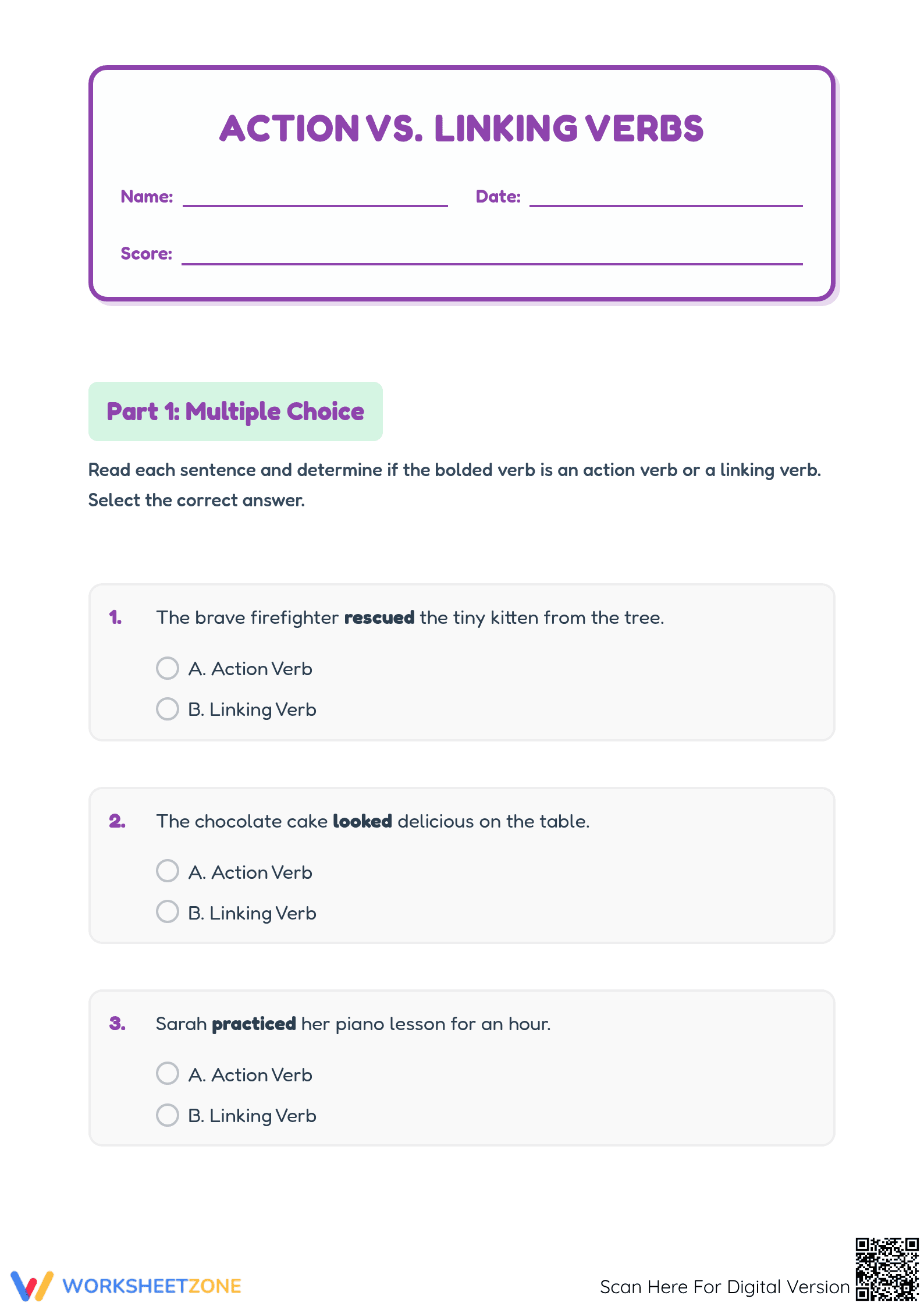
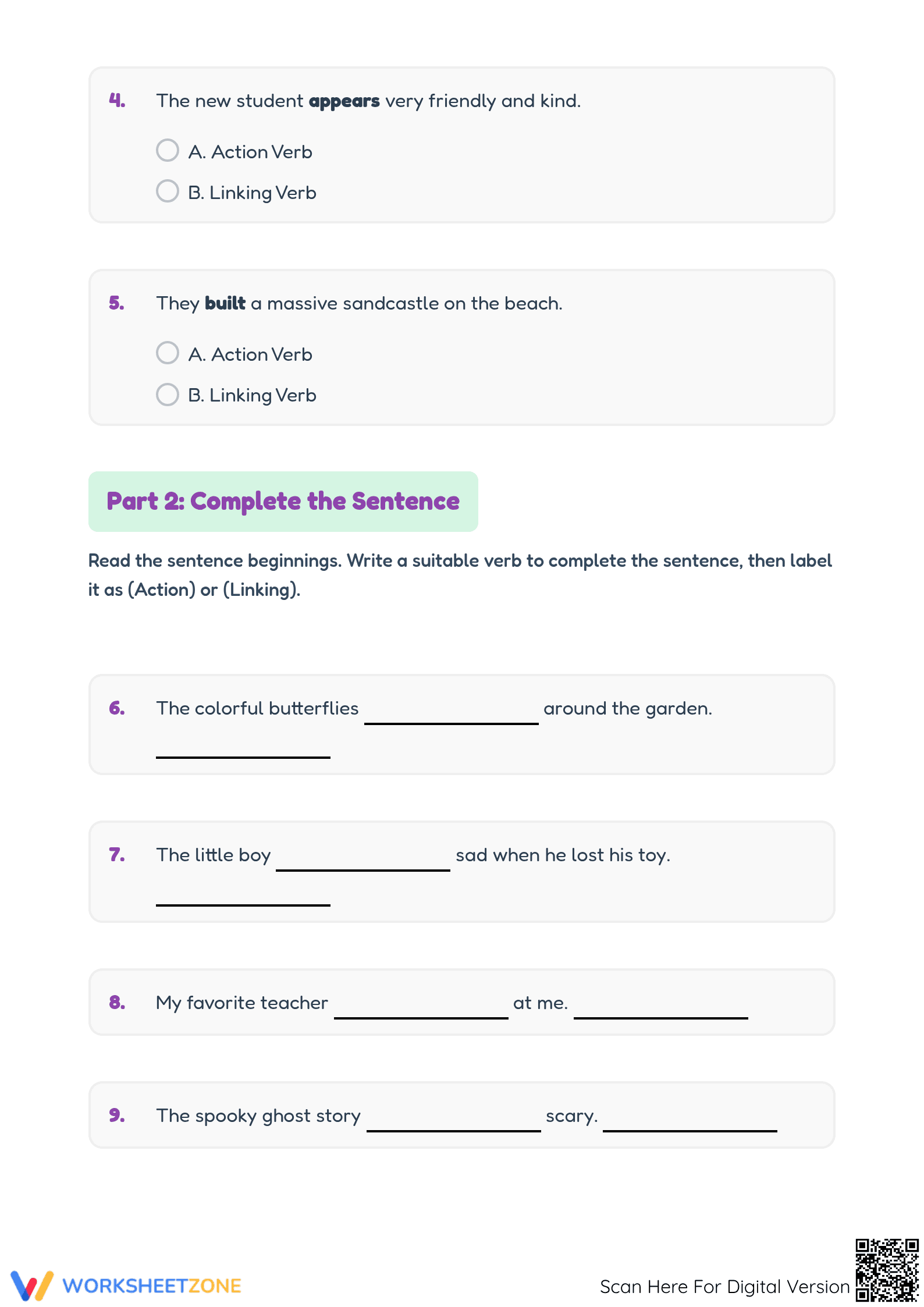
The resource consists of a two-page PDF document featuring nine distinct tasks. The first page contains five multiple-choice questions where students identify bolded verbs in context. The second page challenges students with four open-ended sentence completion tasks, requiring them to generate their own verbs and categorize them. A full answer key is provided for rapid grading and feedback.
Skill Progression
- Guided Identification: The first 5 tasks provide bolded verbs within complete sentences, allowing students to focus purely on categorization between action and linking types without the distraction of identifying the verb itself.
- Supported Application: Tasks 6 through 9 transition to a fill-in-the-blank format, where students must select a contextually appropriate verb before labeling its function.
- Independent Synthesis: By requiring students to both write and label, the worksheet moves from passive recognition to active production.
This sequence follows the gradual-release model, moving from identification to application to ensure student mastery.
Standards Alignment
This worksheet aligns with `CCSS.ELA-LITERACY.L.3.1`, which requires students to demonstrate command of the conventions of standard English grammar and usage. Specifically, it addresses the functional differences between verbs that convey action and those that link subjects to adjectives or nouns. Both standard codes can be copied directly into lesson plans, IEP goals, or district curriculum mapping tools.
How to Use It
Use this worksheet during the guided practice phase of a grammar lesson. After introducing the concept of linking verbs (like is, seems, or looks), assign the first page to check for immediate understanding. Use the second page as a formative assessment exit ticket to see if students can independently generate correct verb types. Completion typically takes 15 to 20 minutes depending on student proficiency.
Who It's For
This resource is designed for Grade 3 students but is highly effective for Grade 2 enrichment or Grade 4 review. It is particularly useful for English Language Learners (ELLs) who struggle with the abstract nature of linking verbs. Pair this with a classroom anchor chart listing common linking verbs for additional support during the independent practice phase.
According to research by Fisher & Frey (2014) on the gradual release of responsibility, students achieve higher mastery when instructional materials transition from identification to production. This worksheet implements that framework by first asking students to recognize verbs in Part 1 before requiring them to generate and label their own verbs in Part 2. By focusing on CCSS.ELA-LITERACY.L.3.1, the resource ensures that Grade 3 learners develop the linguistic precision necessary for complex sentence construction. The inclusion of 9 specific tasks provides enough data points for teachers to identify specific misconceptions regarding state-of-being versus physical action. Such targeted practice is essential for moving students toward the independent application phase of language acquisition. This structured approach is a proven method for improving student outcomes in elementary literacy and standard English conventions.


