


























Views
Downloads


Grade 3 Action and Linking Verbs — Printable Worksheet
Paste this activity's link or code into your existing LMS (Google Classroom, Canvas, Teams, Schoology, Moodle, etc.).
Students can open and work on the activity right away, with no student login required.
You'll still be able to track student progress and results from your teacher account.
This Grade 3 ELA worksheet helps students distinguish between action verbs that express physical or mental activity and linking verbs that connect subjects to descriptive words. By completing these 12 targeted exercises, learners build the foundational grammar skills necessary for clear and effective writing. Students will move from simple identification to active sentence construction.
At a Glance
- Grade: 3 · Subject: ELA
- Standard:
L.3.1.A— Explain the function of verbs in general and their functions in particular sentences- Skill Focus: Action vs. Linking Verbs
- Format: 2 pages · 12 problems · Answer key included · PDF
- Best For: Independent practice or quick formative assessment
- Time: 15–20 minutes
What's Inside
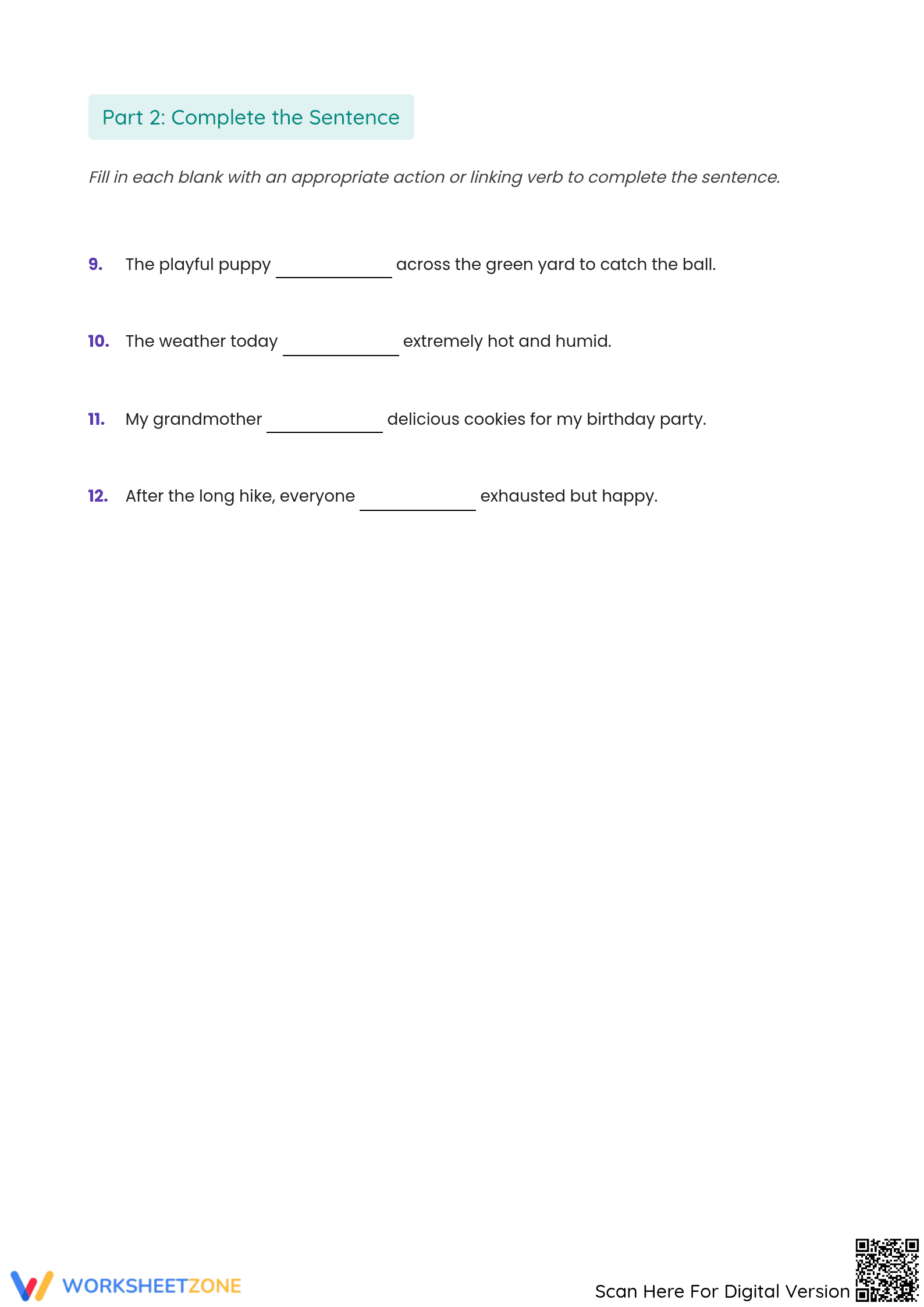
The resource consists of two distinct parts across two pages. Part 1 features 8 identification problems where students must classify bolded verbs in context as either action or linking. Part 2 provides 4 sentence-completion tasks that require students to select and write the correct verb type to fit the narrative context. A full answer key is included for easy grading or student self-correction.
Zero-Prep Workflow
This resource is designed for immediate implementation:
- Step 1: Print the two-page PDF (30 seconds).
- Step 2: Distribute to students for independent practice (1 minute).
- Step 3: Review using the included answer key (5 minutes).
Total teacher prep time is under 2 minutes, making this ideal for morning work or sub plans.
Standards Alignment
This worksheet is primarily aligned with CCSS.ELA-LITERACY.L.3.1.A, which requires students to explain the function of verbs and use them correctly in sentences. It also supports L.4.1 by reinforcing the command of the conventions of standard English grammar. Both standard codes can be copied directly into lesson plans, IEP goals, or district curriculum mapping tools.
How to Use It
Use this worksheet during the independent practice phase of a grammar lesson after introducing the concept of linking verbs like "is," "seem," and "smell." It serves as an excellent formative assessment to check for understanding before moving to paragraph writing. Expect students to complete the 12 items in approximately 15 to 20 minutes.
Who It's For
This resource is designed for Grade 3 students but is highly effective for Grade 2 enrichment or Grade 4 review. It is particularly helpful for English Language Learners who struggle with the non-action nature of linking verbs. Pair this with a verb anchor chart or a short reading passage to reinforce the concept in a broader context.
Research from Fisher & Frey (2014) emphasizes the importance of explicit grammar instruction within the gradual release of responsibility framework. This worksheet supports that model by requiring students to first identify linguistic structures (action vs. linking verbs) before applying them in original sentence completion tasks. By isolating the lexical category of verbs, learners develop the metalinguistic awareness necessary for complex sentence construction. According to the NAEP 2023 framework, mastery of basic parts of speech in the elementary years is a significant predictor of later writing proficiency and syntactic variety. This resource aligns with CCSS.ELA-LITERACY.L.3.1.A, providing the targeted practice needed to move students from recognition to application. The inclusion of an answer key ensures immediate feedback, a critical component for consolidating grammatical rules. Educators can use these 12 tasks to bridge the gap between rote memorization and functional literacy.


