


























Views
Downloads
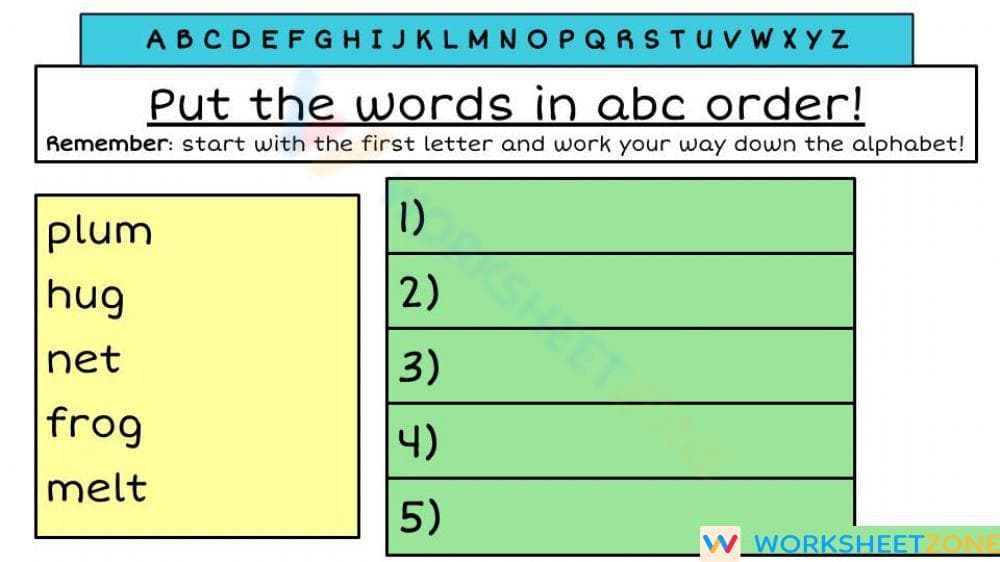

Grade 2 ABC Order — Printable No-Prep Worksheet
Paste this activity's link or code into your existing LMS (Google Classroom, Canvas, Teams, Schoology, Moodle, etc.).
Students can open and work on the activity right away, with no student login required.
You'll still be able to track student progress and results from your teacher account.
This ready-to-use worksheet provides focused practice on alphabetical order for second-grade students. Learners will arrange a list of five common words, strengthening their understanding of letter sequencing as a foundational skill for using dictionaries and other reference materials. It's a perfect quick activity for any ELA block.
At a Glance
- Grade: 2 · Subject: ELA
- Standard:
CCSS.ELA-LITERACY.L.2.4.e— Use alphabetical order to locate words in reference materials.- Skill Focus: Alphabetical Order (to the first letter)
- Format: 1 page · 5 problems · Answer key included · PDF
- Best For: Independent practice or literacy centers
- Time: 5–10 minutes
What's Inside
This resource is a single-page PDF download that includes the student worksheet and a corresponding answer key. The worksheet features a clear, easy-to-read layout with a list of five words and a numbered area for students to write them in correct alphabetical order. An alphabet strip is included at the top of the page for visual support.
Zero-Prep Workflow
Designed for busy classrooms, this worksheet follows a simple three-step workflow that requires virtually no teacher preparation.
- Print (1 minute): Just print a class set of the single-page worksheet. The PDF is formatted for immediate use.
- Distribute (1 minute): Hand out the sheets. The directions are self-explanatory: "Put the words in abc order!" so no lengthy instructions are needed.
- Review (2 minutes): Use the included answer key to quickly check student work or have students self-correct, reinforcing the concept instantly.
Total time is under five minutes, making it ideal for sub plans, morning work, or quick skill review.
Standards Alignment
This worksheet is directly aligned with the foundational skills needed for CCSS.ELA-LITERACY.L.2.4.e, which requires students to consult reference materials like beginning dictionaries. Mastering alphabetical order is a critical prerequisite for meeting this standard. This focus ensures students can navigate text resources efficiently. The standard code can be copied directly into lesson plans or curriculum maps.
How to Use It
This versatile worksheet can be used at multiple points in an instructional cycle. Use it as a warm-up activity before a reading lesson to activate students' knowledge of the alphabet. Alternatively, assign it as an exit ticket after direct instruction on alphabetical order to quickly assess understanding. For a formative assessment, observe who relies on the alphabet strip versus who works from memory. This gives valuable insight for small groups. Most students will complete the task in 5 to 10 minutes.
Who It's For
This activity is designed for second-grade students who are learning or reinforcing their knowledge of alphabetical order. The simple, uncluttered format is accessible for all learners, including students in special education or intervention settings. To extend the learning, pair this worksheet with a children's dictionary and challenge students to find each of the five words after they have ordered them.
Foundational literacy skills, such as understanding alphabetical order, are crucial for navigating academic texts and are a key component of standards like CCSS.ELA-LITERACY.L.2.4.e. This worksheet provides targeted practice in this essential convention of print. For example, a comprehensive analysis by RAND AIRS 2024 emphasized that mastery of print concepts, including letter order, is a strong predictor of future reading comprehension success. By providing a clear, structured task, this resource allows students to build automaticity with alphabetizing. This skill is the underlying architecture for information retrieval, enabling learners to efficiently use dictionaries, glossaries, and indexes, supporting vocabulary acquisition and content knowledge development across all subjects.


