


























Views
Downloads
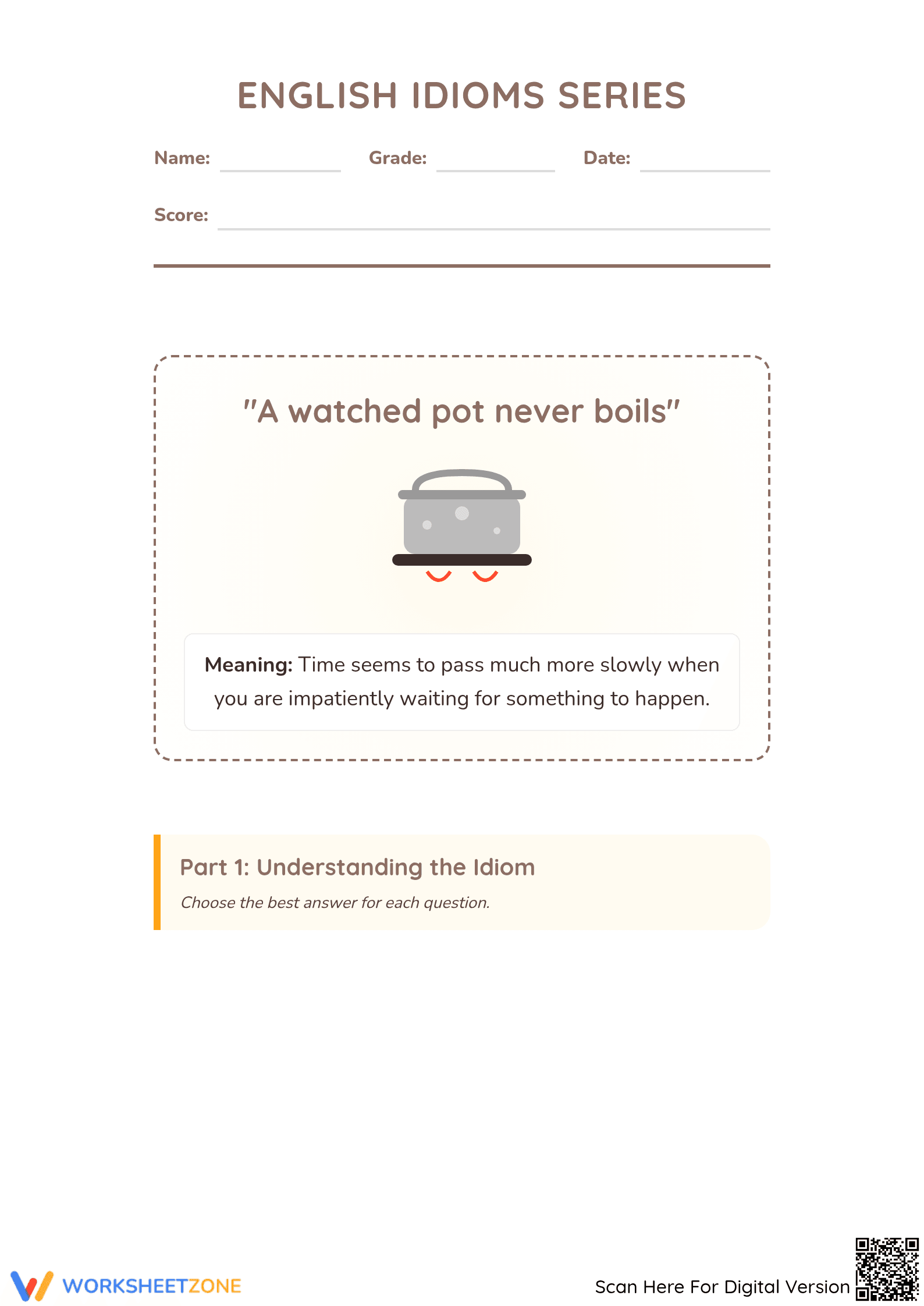


Printable Idiom Worksheet: 'A Watched Pot Never Boils'
Paste this activity's link or code into your existing LMS (Google Classroom, Canvas, Teams, Schoology, Moodle, etc.).
Students can open and work on the activity right away, with no student login required.
You'll still be able to track student progress and results from your teacher account.
Students master the meaning and application of the figurative phrase "a watched pot never boils" through this comprehensive worksheet. By connecting the literal image of a boiling pot to the psychological experience of impatience, learners develop a concrete understanding of how idioms function in English. This resource ensures students can identify, explain, and use this specific adage in real-world contexts.
At a Glance
- Grade: 4 · Subject: English Language Arts
- Standard:
CCSS.ELA-LITERACY.L.4.5.B— Explain the meaning of common idioms and adages- Skill Focus: Figurative Language: Idioms
- Format: 4 pages · 10 problems · Answer key included · PDF
- Best For: Individual practice or literacy centers
- Time: 20–30 minutes
What's Inside
This four-page resource provides a structured journey from definition to independent application. It includes a clear visual anchor, two multiple-choice comprehension questions, three sentence-completion tasks based on realistic scenarios, and two open-ended prompts for personal connection. The final page features a vocabulary matching activity to reinforce the core terminology used throughout the lesson, including "impatient" and "idiom."
Skill Progression
- Guided Practice: Students begin with the provided definition and two scaffolded multiple-choice questions that check for initial conceptual understanding.
- Supported Practice: Learners apply the idiom to three detailed scenarios, such as waiting for a text message or a birthday, using context clues to complete sentences.
- Independent Practice: The worksheet concludes with two synthesis tasks where students describe personal experiences and connect the concept to other related idioms.
Standards Alignment
This worksheet is primarily aligned with `CCSS.ELA-LITERACY.L.4.5.B`, which requires students to recognize and explain the meaning of common idioms, adages, and proverbs. The exercises focus on the nuance of waiting and the subjective perception of time. Both standard codes can be copied directly into lesson plans, IEP goals, or district curriculum mapping tools.
How to Use It
Use this worksheet during a unit on figurative language as a targeted follow-up to direct instruction. For a formative assessment, observe students during the "Real-Life Scenarios" section to see if they can identify the specific emotional cues that trigger the idiom's use. The expected completion time is 25 minutes, making it an ideal choice for a quiet independent work block or a rotating literacy station.
Who It's For
This resource is designed for intermediate elementary students in grades 3 through 6. It is particularly effective for English Language Learners (ELLs) who often struggle with non-literal phrases. Pair this worksheet with a short reading passage containing the target idiom to provide further contextual reinforcement and help students see the phrase in natural narrative dialogue.
According to the RAND AIRS 2024 report on literacy instruction, explicit teaching of figurative language is a critical component of building complex reading comprehension skills in the upper elementary grades. Idioms like "a watched pot never boils" present unique challenges because their meanings cannot be derived from individual word definitions. This worksheet addresses that gap by providing a direct link between the literal imagery and the figurative meaning of "explaining common idioms and adages" as defined by standard `CCSS.ELA-LITERACY.L.4.5.B`. By engaging in multiple modalities—multiple choice, fill-in-the-blank, and creative writing—students solidify their understanding and are better prepared to encounter such phrases in complex literature. Research indicates that targeted practice with common adages significantly boosts nuance-based comprehension scores. This comprehensive resource provides the exact scaffolding necessary for students to bridge the gap between literal and figurative language.


