




























Views
Downloads
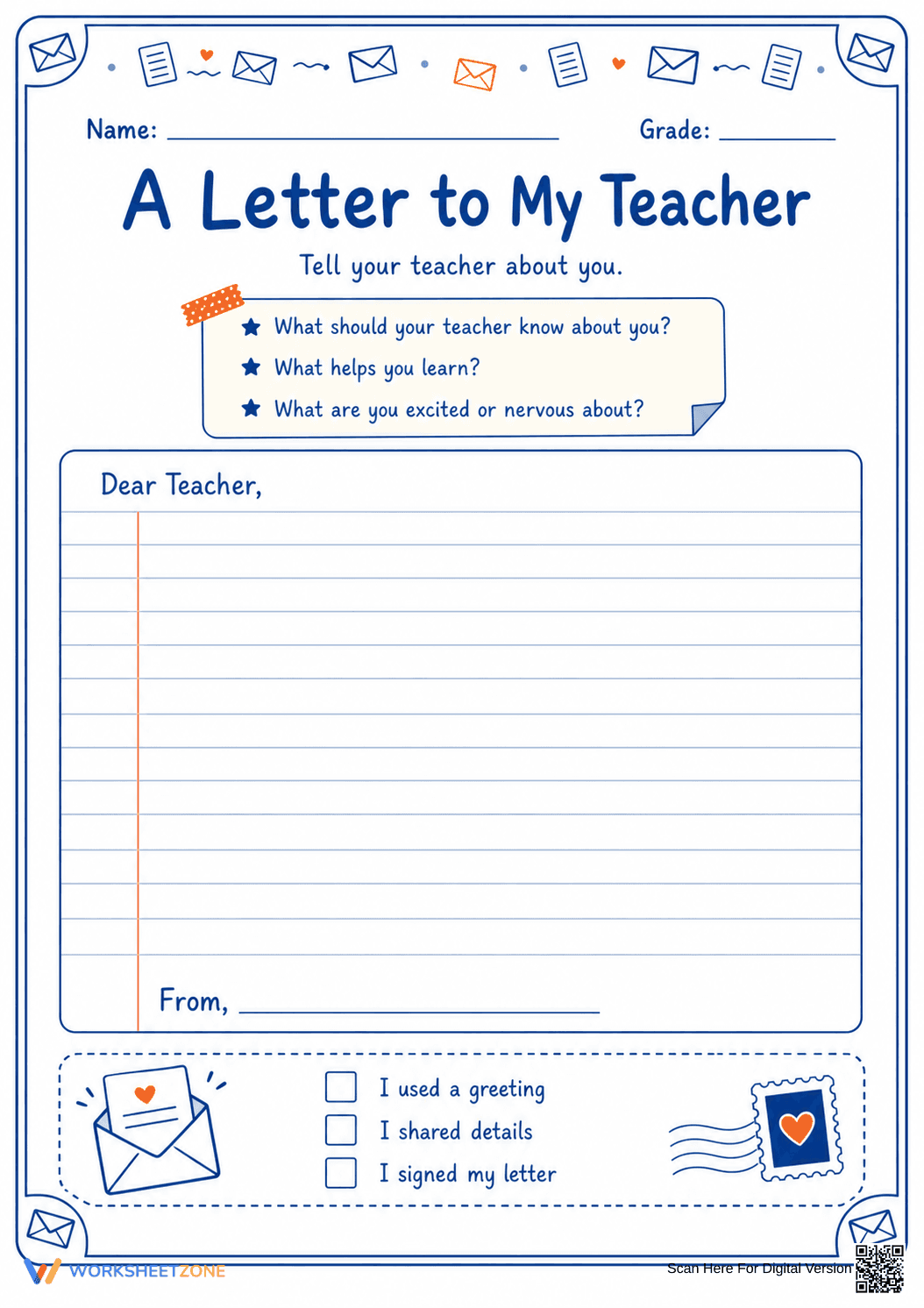

"A Letter to My Teacher" Worksheet | Grade 4 Essential

Paste this activity's link or code into your existing LMS (Google Classroom, Canvas, Teams, Schoology, Moodle, etc.).
Students can open and work on the activity right away, with no student login required.
You'll still be able to track student progress and results from your teacher account.
This Grade 4 writing worksheet facilitates meaningful communication between students and teachers. By providing a structured letter-writing template, students share personal insights, learning preferences, and emotional states. This activity establishes a positive classroom culture while assessing foundational writing skills and the ability to address a specific audience and purpose effectively.
At a Glance
- Grade: 4 · Subject: ELA
- Standard:
CCSS.ELA-LITERACY.W.4.4— Produce clear and coherent writing appropriate to task, purpose, and audience- Skill Focus: Letter Writing & Self-Reflection
- Format: 1 page · 1 task · Answer key not applicable · PDF
- Best For: Back-to-school icebreaker and writing assessment
- Time: 20–30 minutes
What's Inside
The worksheet features a visually engaging mail-themed layout with a dedicated prompt box. It includes three guiding questions to spark reflection: what the teacher should know, what helps the student learn, and current feelings about the school year. The main writing area provides ruled lines with a "Dear Teacher" salutation and a signature line. A three-item self-editing checklist ensures students include a greeting, details, and a signature.
Zero-Prep Workflow
This resource is designed for immediate classroom implementation with a total teacher prep time of under 2 minutes. First, print the single-page PDF for your class. Second, distribute the sheets during a morning meeting or writing block. Third, review the completed letters to gain immediate diagnostic data on student writing levels and social-emotional needs. It serves as an ideal sub plan or first-day activity.
Standards Alignment
This resource aligns with `CCSS.ELA-LITERACY.W.4.4`, which requires students to produce clear and coherent writing in which the development and organization are appropriate to task, purpose, and audience. It also supports W.4.2 by encouraging students to convey ideas and information clearly. Both standard codes can be copied directly into lesson plans, IEP goals, or district curriculum mapping tools.
How to Use It
Use this worksheet during the first week of school as a formative assessment of student writing stamina and organization. It provides a low-stakes environment to observe how students structure a formal letter. Alternatively, assign it mid-semester to check in on student well-being. Expect students to take 20 to 30 minutes to brainstorm and draft their responses.
Who It's For
This template is ideal for general education students in Grades 3–6, as well as English Language Learners who benefit from the included sentence starters and checklist. It pairs naturally with a classroom anchor chart on the parts of a letter or a read-aloud about starting a new school year.
According to Fisher & Frey (2014), structured writing tasks that allow for personal expression significantly increase student engagement and provide teachers with critical formative data. This worksheet addresses CCSS.ELA-LITERACY.W.4.4 by requiring students to adapt their tone and content for a specific audience—their teacher. Research from the NAEP indicates that students who practice writing for varied purposes, including self-reflection, demonstrate higher proficiency in organizational skills. By utilizing the included three-item checklist, students engage in metacognitive monitoring, a practice shown to improve writing quality across elementary grades. This 1-page resource streamlines the instructional process, allowing educators to focus on building relationships while simultaneously gathering evidence of student mastery in letter-writing conventions. The clear prompts and ruled layout reduce cognitive load, making the task accessible for diverse learners while maintaining high expectations for coherent, purposeful communication in the classroom setting.


