


























Views
Downloads
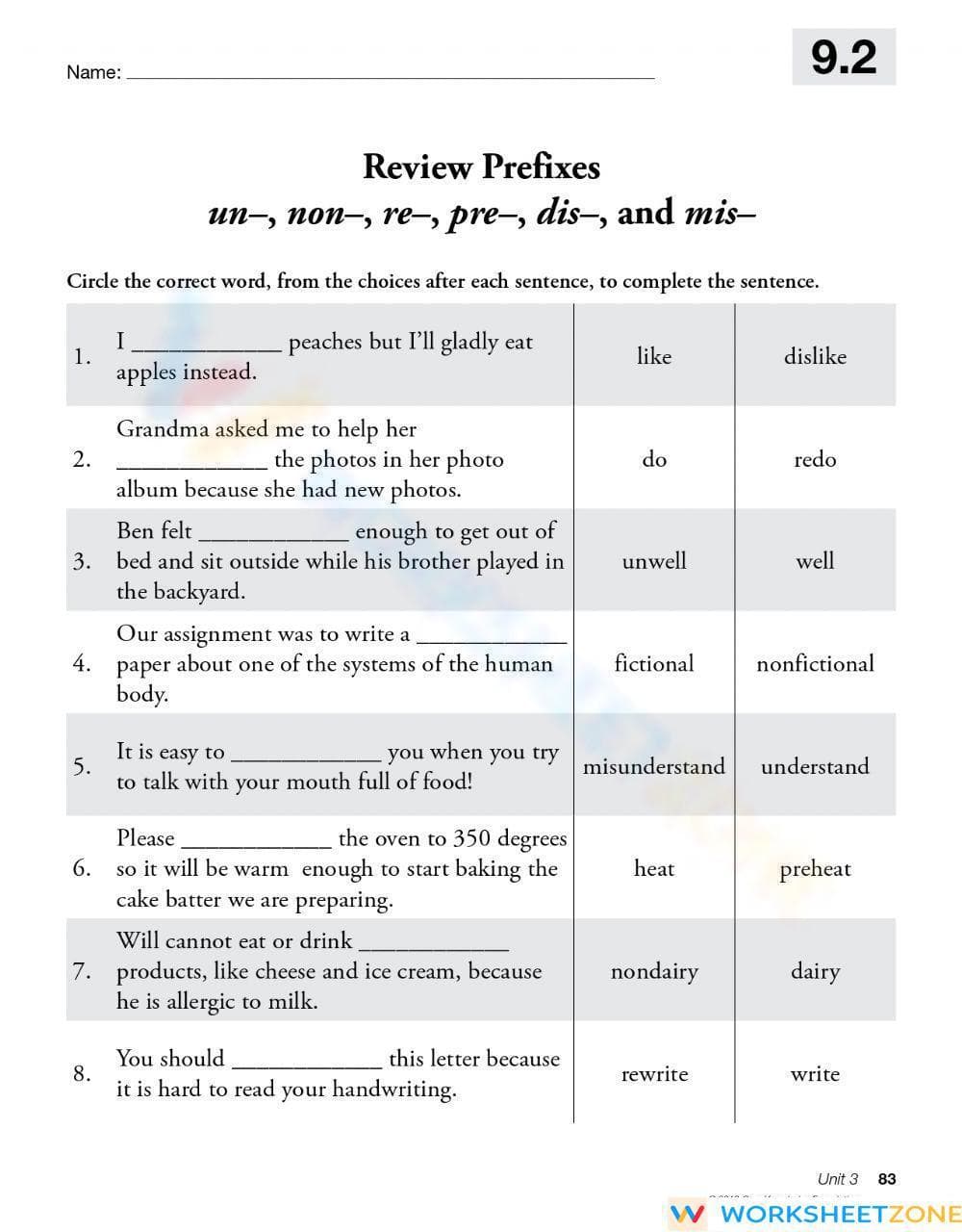

Essential Prefixes Review Worksheet | Grade 3-4 ELA Ready
Paste this activity's link or code into your existing LMS (Google Classroom, Canvas, Teams, Schoology, Moodle, etc.).
Students can open and work on the activity right away, with no student login required.
You'll still be able to track student progress and results from your teacher account.
Strengthen your students' vocabulary and decoding skills with this essential prefix review worksheet designed for Grade 3 and Grade 4. By practicing with six common affixes—un-, non-, re-, pre-, dis-, and mis—learners develop the ability to determine word meanings through structural analysis. This printable resource ensures students can confidently navigate complex text by mastering word parts.
At a Glance
- Grade: 3–4 · Subject: English Language Arts
- Standard:
CCSS.ELA-LITERACY.L.3.4.B— Determine meanings of words formed when known affixes are added to known words- Skill Focus: Prefix Application (un-, non-, re-, pre-, dis-, mis-)
- Format: 1 page · 8 problems · Answer key included · PDF
- Best For: Independent practice or quick formative assessment
- Time: 10–15 minutes
What's Inside
This focused one-page worksheet features eight sentence-completion tasks. Students choose the correct prefixed word from a two-option word bank, reinforcing semantic shifts. The clean layout provides clear examples such as "dislike" vs "like" and "preheat" vs "heat." Each task helps students move from recognition to contextual application, and a full answer key is included for rapid grading.
Zero-Prep Workflow
Integrating this resource is simple. First, Print the single-page PDF for your class in under one minute. Second, Distribute the worksheet; instructions are self-explanatory, requiring no teacher introduction. Finally, Review the eight answers using the included key, which takes less than two minutes, allowing for immediate feedback and instructional course correction.
Standards Alignment
This resource is directly aligned to `CCSS.ELA-LITERACY.L.3.4.B` regarding determining word meanings through affixes. It also supports `CCSS.ELA-LITERACY.L.4.4.B` by utilizing common Greek and Latin affixes as clues to meaning. Both standard codes can be copied directly into lesson plans, IEP goals, or district curriculum mapping tools to ensure compliance and instructional rigor.
How to Use It
Use this worksheet as a formative assessment after a direct instruction lesson on affixes to gauge student understanding of specific prefix meanings. Observe students as they work to identify which prefixes (like 'mis-' or 'non-') cause the most confusion. Alternatively, assign it as a low-stakes homework task or a "must-do" in a literacy center to provide necessary repetition for students working toward mastery.
Who It's For
This resource is ideal for third and fourth-grade students who are building their foundational reading and language skills. It is particularly effective for English Language Learners (ELLs) who benefit from the explicit contrast between root words and their prefixed counterparts. The scaffolded two-choice format provides enough support for struggling readers while still demanding critical thinking about word usage.
The systematic instruction of affixes, such as those covered in this "Review Prefixes" resource, is a cornerstone of effective literacy development in the upper elementary grades. According to the RAND AIRS 2024 report on foundational reading skills, students who receive explicit practice with morphology—specifically the relationship between prefixes and root words—demonstrate significantly higher gains in reading comprehension and vocabulary acquisition compared to those receiving incidental exposure alone. This worksheet provides the structured repetition necessary for students to internalize the semantic roles of un-, non-, re-, pre-, dis-, and mis-. By engaging with eight high-utility word parts in a contextualized format, learners develop the "word-solving" strategies essential for tackling increasingly complex texts in middle childhood. This resource bridges the gap between basic decoding and advanced linguistic analysis, serving as a reliable tool for both general education and intervention settings.


