


























Views
Downloads
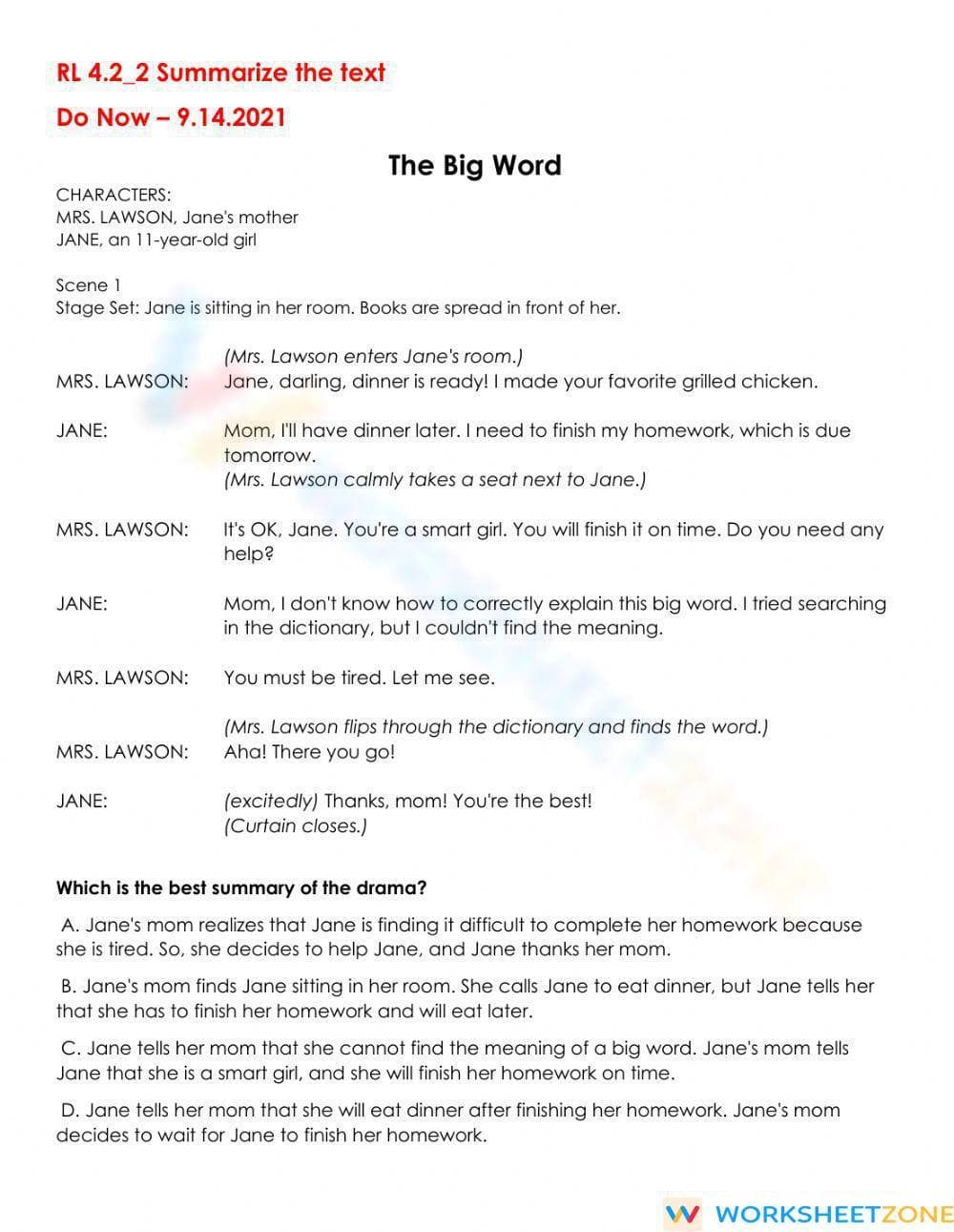

RL.4.2 Worksheet: Summarizing Drama — Grade 4 Aligned
Paste this activity's link or code into your existing LMS (Google Classroom, Canvas, Teams, Schoology, Moodle, etc.).
Students can open and work on the activity right away, with no student login required.
You'll still be able to track student progress and results from your teacher account.
Improve student mastery of literary analysis with this focused Grade 4 summarizing drama worksheet. This resource provides a targeted 'Do Now' activity that challenges students to read a original dramatic scene and select the most accurate summary from four distinct choices. It effectively builds the synthesis skills required for successful reading comprehension in upper elementary grades.
At a Glance
- Grade: 4 · Subject: English Language Arts
- Standard:
RL.4.2— Determine a theme and summarize a story, drama, or poem from details- Skill Focus: Summarizing Dramatic Structures
- Format: 1 page · 1 multi-part task · Answer key included · PDF
- Best For: Bell-ringers, assessment prep, and literacy rotations
- Time: 10–15 minutes
This high-utility printable features 'The Big Word,' a dramatic scene involving character dialogue and stage directions between a mother and her daughter. The single-page layout includes the complete script followed by a rigorous multiple-choice question designed to test the student's ability to distinguish essential plot points from minor narrative details. A full answer key is provided for immediate grading.
This resource serves as clear evidence of mastery by mapping student responses to the specific components of the RL.4.2 standard. Each distractor in the multiple-choice section is carefully crafted to represent common summarizing errors, such as focusing too narrowly on a single detail or omitting the resolution. Teachers can enter these scores directly into gradebooks or IEP progress notes to document proficiency in identifying central ideas.
Primary alignment is to CCSS.ELA-LITERACY.RL.4.2: 'Determine a theme of a story, drama, or poem from details in the text; summarize the text.' This worksheet focuses specifically on the latter requirement, ensuring students can synthesize character motivations and scene outcomes into a cohesive whole. Both standard codes can be copied directly into lesson plans, IEP goals, or district curriculum mapping tools.
For best results, assign this as a morning 'Do Now' or bell-ringer to activate prior knowledge before a larger lesson on dramatic elements. During instruction, use the answer choices as a springboard for a class discussion; ask students to explain why specific options are incomplete or inaccurate. This formative-assessment observation tip helps identify students who may need additional scaffolding with complex text structures.
This worksheet is ideal for Grade 4 students working toward grade-level standards, though it remains highly relevant for Grade 3 enrichment or Grade 5 remedial support. It pairs naturally with anchor charts detailing the 'Somebody, Wanted, But, So, Then' summarizing framework or direct instruction lessons on reading dramatic scripts versus narrative prose.
The CCSS.ELA-LITERACY.RL.4.2 standard requires Grade 4 students to determine a theme of a story, drama, or poem from details in the text and summarize the text. This specific worksheet focuses on the critical skill of summarizing dramatic works by identifying key plot points and character interactions within a scene. According to the Fisher & Frey (2014) research on scaffolding literacy, summarizing is a foundational meta-cognitive strategy that allows students to synthesize information and demonstrate deep comprehension of narrative structures. By evaluating four distinct summary options, students practice distinguishing between minor details and essential plot elements, a key requirement for achieving mastery in literary analysis. This assessment-aligned resource provides a structured environment for students to apply their knowledge of dramatic elements, such as character motivation and scene resolution, to create a concise and accurate overview of the provided text. Educators can use these results to track individual progress toward state and national proficiency goals.


