


























Views
Downloads
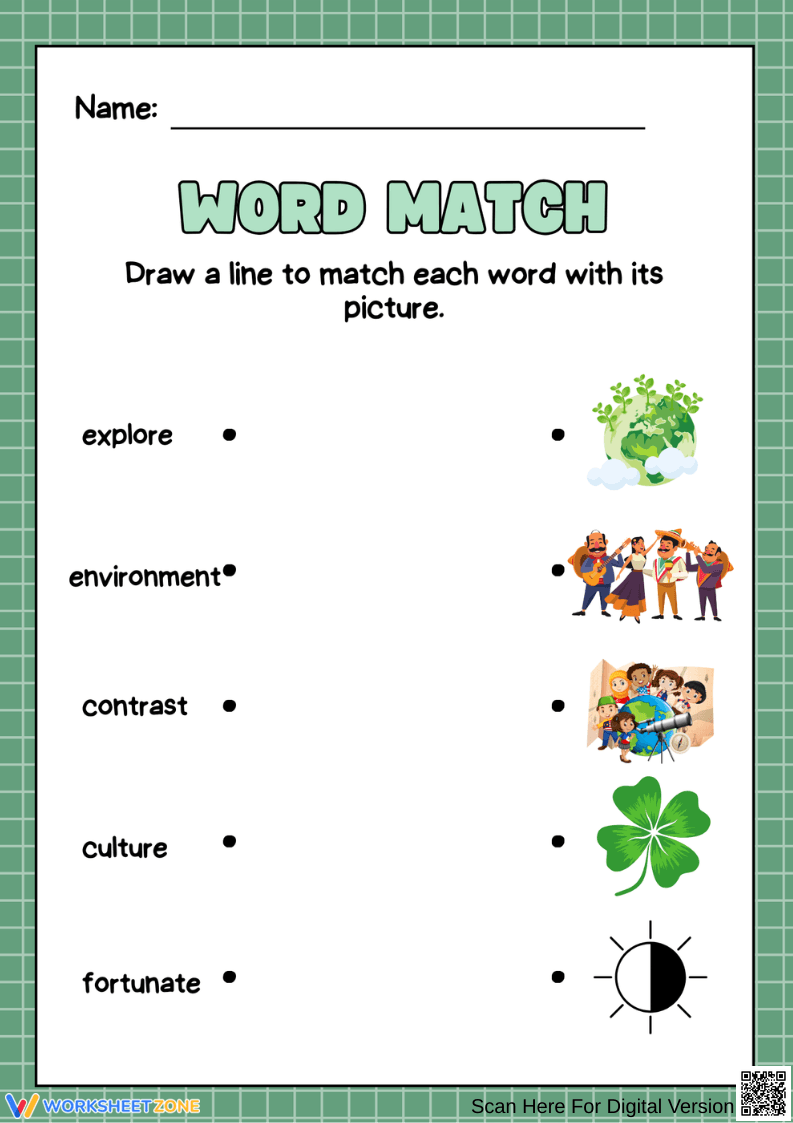

Grade 6 Vocabulary Match — Printable No-Prep Worksheet
Paste this activity's link or code into your existing LMS (Google Classroom, Canvas, Teams, Schoology, Moodle, etc.).
Students can open and work on the activity right away, with no student login required.
You'll still be able to track student progress and results from your teacher account.
This ready-to-use Grade 6 vocabulary worksheet helps students build essential word recognition and comprehension skills. By matching academic terms to clear visual representations, learners reinforce their understanding of context and meaning. This straightforward activity ensures students can independently connect words like "environment" and "contrast" to their definitions.
At a Glance
- Grade: 6 · Subject: ELA
- Standard:
CCSS.ELA-LITERACY.L.6.6— Acquire and use accurately grade-appropriate academic vocabulary words.- Skill Focus: Vocabulary and Word Recognition
- Format: 1 page · 5 problems · Answer key included · PDF
- Best For: Independent practice or morning work
- Time: 5–10 minutes
This single-page resource features a visual matching activity for quick vocabulary reinforcement. Students see five academic words—explore, environment, contrast, culture, and fortunate—alongside five illustrations. The task requires drawing a line connecting each term to its image. A complete answer key ensures rapid grading, making the layout intuitive for educators and learners.
Follow this zero-prep workflow:
- Print (1 minute): Print the PDF class set instantly. No special formatting required.
- Distribute (1 minute): Hand out the single-page activity as students enter the room or transition between subjects.
- Review (3 minutes): Use the included answer key to quickly check student responses or project it on the board for self-correction.
With a total prep time of under two minutes, this worksheet is an ideal emergency sub-plan or last-minute filler activity that maintains high instructional value.
This activity is directly aligned to CCSS.ELA-LITERACY.L.6.6: "Acquire and use accurately grade-appropriate general academic and domain-specific words and phrases; gather vocabulary knowledge when considering a word or phrase important to comprehension or expression." It also supports visual literacy and context clue strategies. Both standard codes can be copied directly into lesson plans, IEP goals, or district curriculum mapping tools.
Use this worksheet as a focused bell-ringer before direct instruction to activate prior knowledge. Alternatively, assign it as a quick exit ticket to gauge comprehension after a reading block. For formative assessment, observe whether students rely on process of elimination for abstract words like "contrast" versus concrete words like "environment," which can inform future vocabulary interventions. Expected completion time ranges from five to ten minutes.
This resource is primarily designed for sixth-grade general education students, but its visual nature makes it highly effective for English Language Learners (ELLs) and students receiving special education services. The picture cues provide essential scaffolding for those reading below grade level. Pair this worksheet with a short informational text or a classroom anchor chart detailing root words and affixes to deepen the vocabulary acquisition process.
Effective vocabulary instruction relies heavily on multimodal representations to solidify student comprehension and retention. Aligning with CCSS.ELA-LITERACY.L.6.6, which requires students to acquire and use accurately grade-appropriate academic vocabulary words, this visual matching task bridges the gap between abstract text and concrete meaning. According to a comprehensive EdReports 2024 analysis of high-quality instructional materials, integrating visual scaffolds into routine vocabulary practice significantly increases word acquisition rates, particularly for diverse learners. By requiring students to actively link terms like "culture" and "fortunate" to specific imagery, educators facilitate deeper cognitive processing than traditional rote memorization allows. Such structured, low-stakes practice opportunities are essential for building the automaticity required for fluent reading. This evidence-based approach ensures that brief, targeted interventions yield measurable improvements in overall reading comprehension and academic language proficiency across multiple subject areas.


