


























Views
Downloads


Grade 6 Chocolate History — Printable No-Prep Worksheet
Paste this activity's link or code into your existing LMS (Google Classroom, Canvas, Teams, Schoology, Moodle, etc.).
Students can open and work on the activity right away, with no student login required.
You'll still be able to track student progress and results from your teacher account.
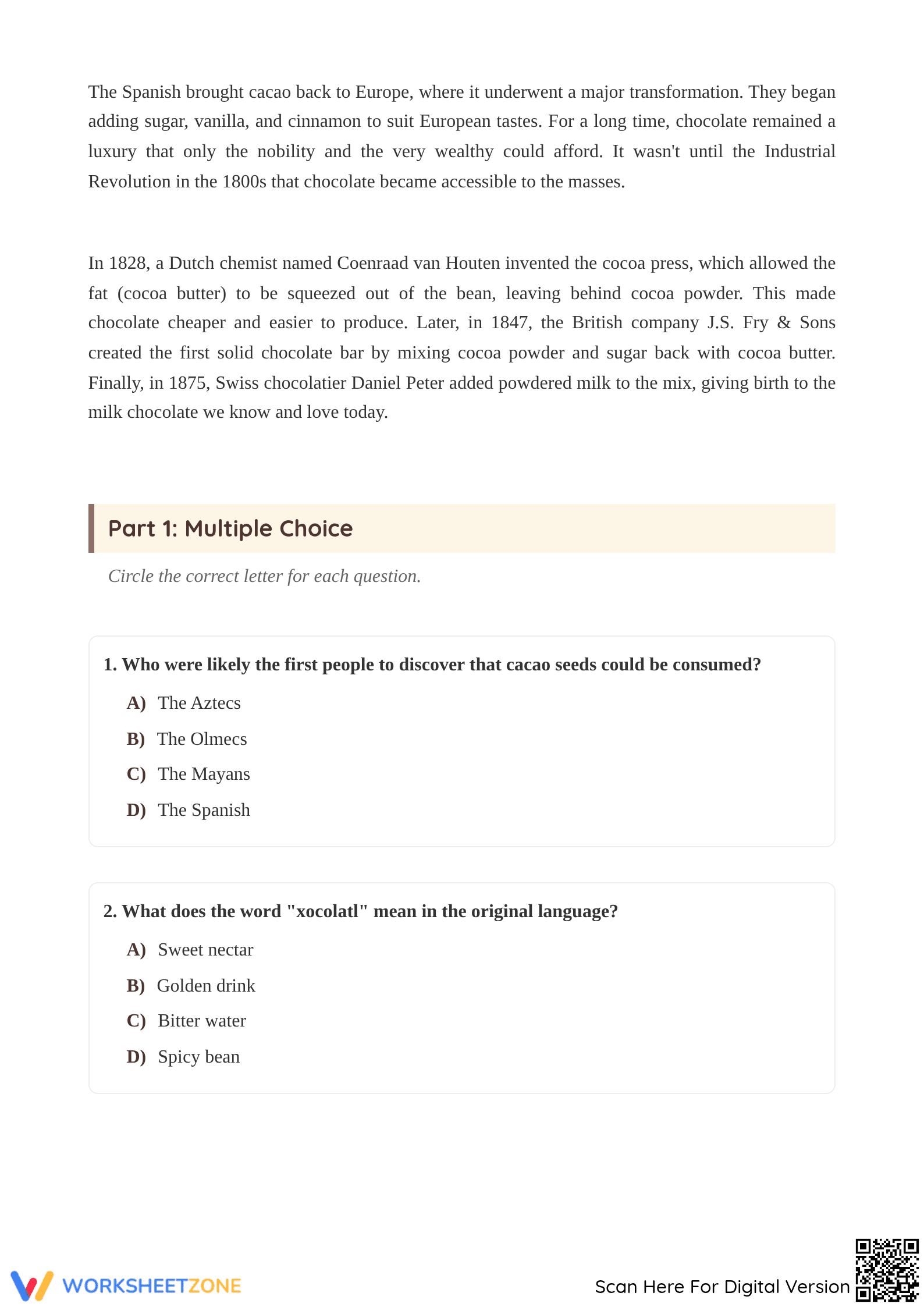
This Grade 6 reading comprehension worksheet guides students through the fascinating evolution of chocolate from ancient Mesoamerican bitter drinks to modern candy bars. Students analyze informational text to identify key historical figures, inventions, and cultural shifts. It provides a structured way to build literacy while engaging with a high-interest historical topic.
At a Glance
- Grade: 6 · Subject: English Language Arts
- Standard:
CCSS.ELA-LITERACY.RI.6.1— Cite textual evidence to support analysis of what the text says explicitly- Skill Focus: Informational Text Analysis
- Format: 5 pages · 14 problems · Answer key included · PDF
- Best For: Independent practice or sub plans
- Time: 35–45 minutes
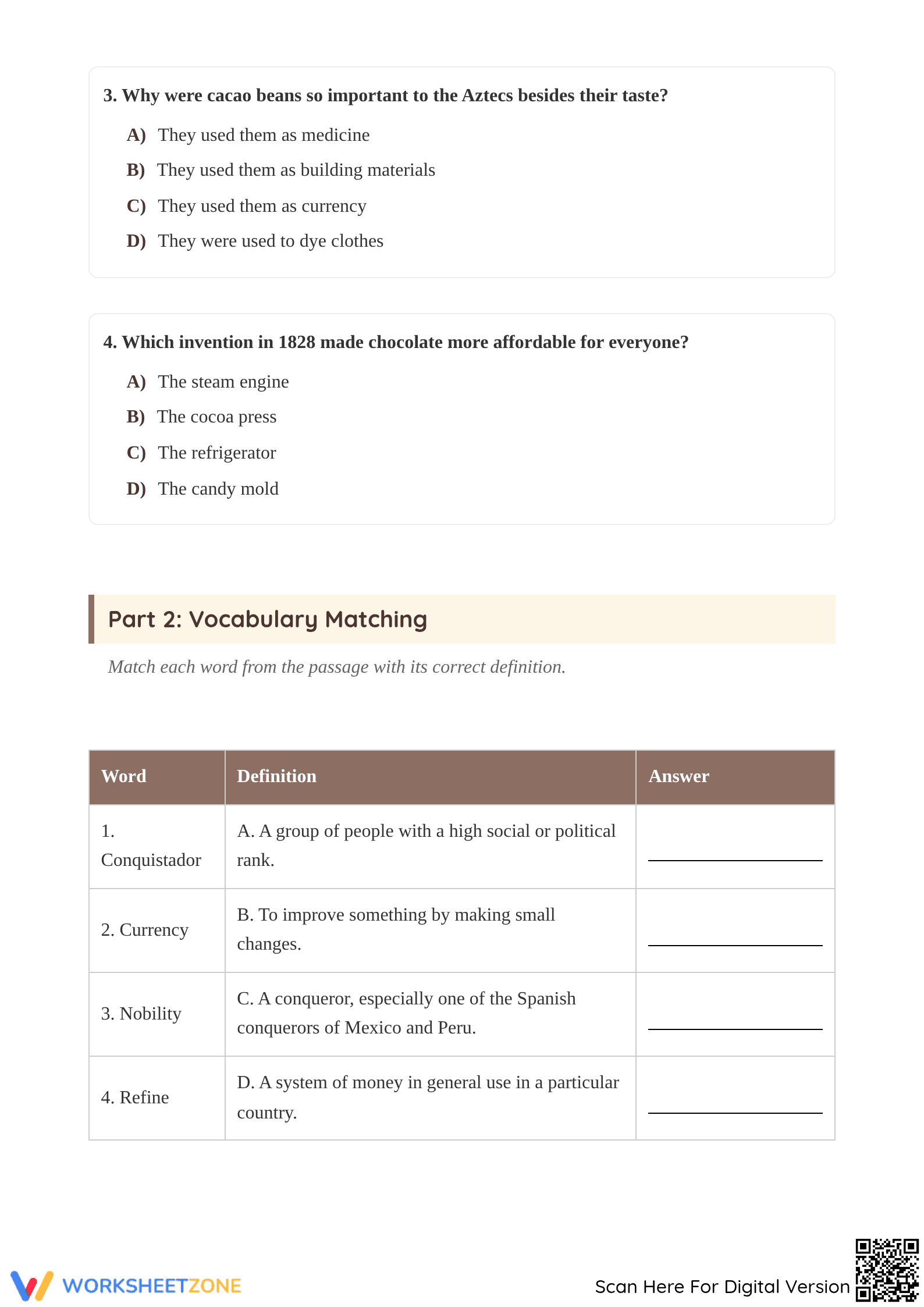
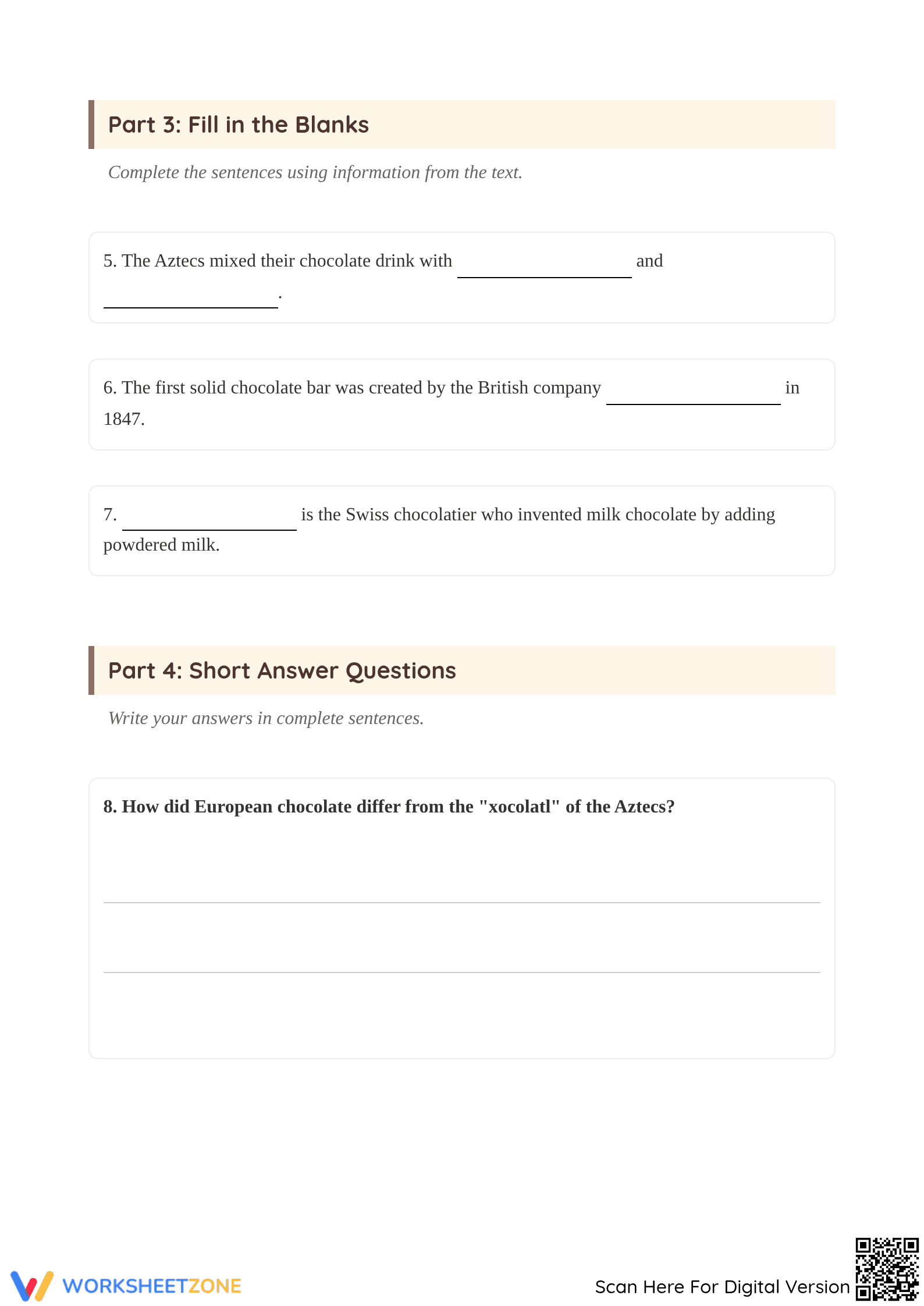
The packet contains a multi-page reading passage followed by five distinct assessment sections. It includes four multiple-choice questions, a vocabulary matching table for academic terms like conquistador and nobility, three fill-in-the-blank sentences, two short-answer prompts requiring complete sentences, and a final critical thinking reflection. A comprehensive answer key is provided for rapid grading.
The workflow is designed for immediate classroom implementation. First, print the five-page PDF in under 30 seconds. Second, distribute the packets to students for independent or paired reading which takes about 1 minute. Third, review the completed work using the included answer key or use the critical thinking prompt for a whole-class discussion. Total teacher preparation time is under two minutes.
The primary focus is CCSS.ELA-LITERACY.RI.6.1, which requires students to cite textual evidence to support analysis of what the text says explicitly. Supporting standards include RI.6.4 for determining the meaning of domain-specific words. Both standard codes can be copied directly into lesson plans, IEP goals, or district curriculum mapping tools.
Use this as a mid-unit formative assessment during a non-fiction study to check for literal comprehension and vocabulary acquisition. Alternatively, assign it as a high-quality sub plan that requires no prior context. During the activity, observe if students refer back to the text for the vocabulary matching section. Completion typically takes 40 minutes.
This resource is ideal for general education sixth-grade classrooms, ESL students needing structured informational text, and reading intervention groups. It pairs naturally with a social studies unit on Mesoamerican civilizations or an introductory lesson on the Industrial Revolution's impact on food production. The layout is clean and professional for middle school learners.
According to the RAND AIRS 2024 report on literacy instruction, providing students with high-interest informational texts paired with varied question types—such as multiple choice and short answer—significantly improves retention of historical facts and domain-specific vocabulary. This worksheet aligns with the CCSS.ELA-LITERACY.RI.6.1 standard by requiring students to extract explicit details about the Olmecs, Mayans, and Aztecs to answer comprehension questions. By moving from literal recall to critical thinking, the resource supports the gradual release of responsibility model. Research from Fisher & Frey (2014) suggests that such structured scaffolds are essential for middle schoolers transitioning to complex non-fiction. This 5-page resource ensures that Grade 6 students practice evidence-based reading while exploring the cultural and technological history of chocolate, making it a robust tool for any ELA curriculum focused on informational text mastery and historical literacy.


