


























Views
Downloads


Essential Grade 6 Nonfiction Reading Comprehension
Paste this activity's link or code into your existing LMS (Google Classroom, Canvas, Teams, Schoology, Moodle, etc.).
Students can open and work on the activity right away, with no student login required.
You'll still be able to track student progress and results from your teacher account.
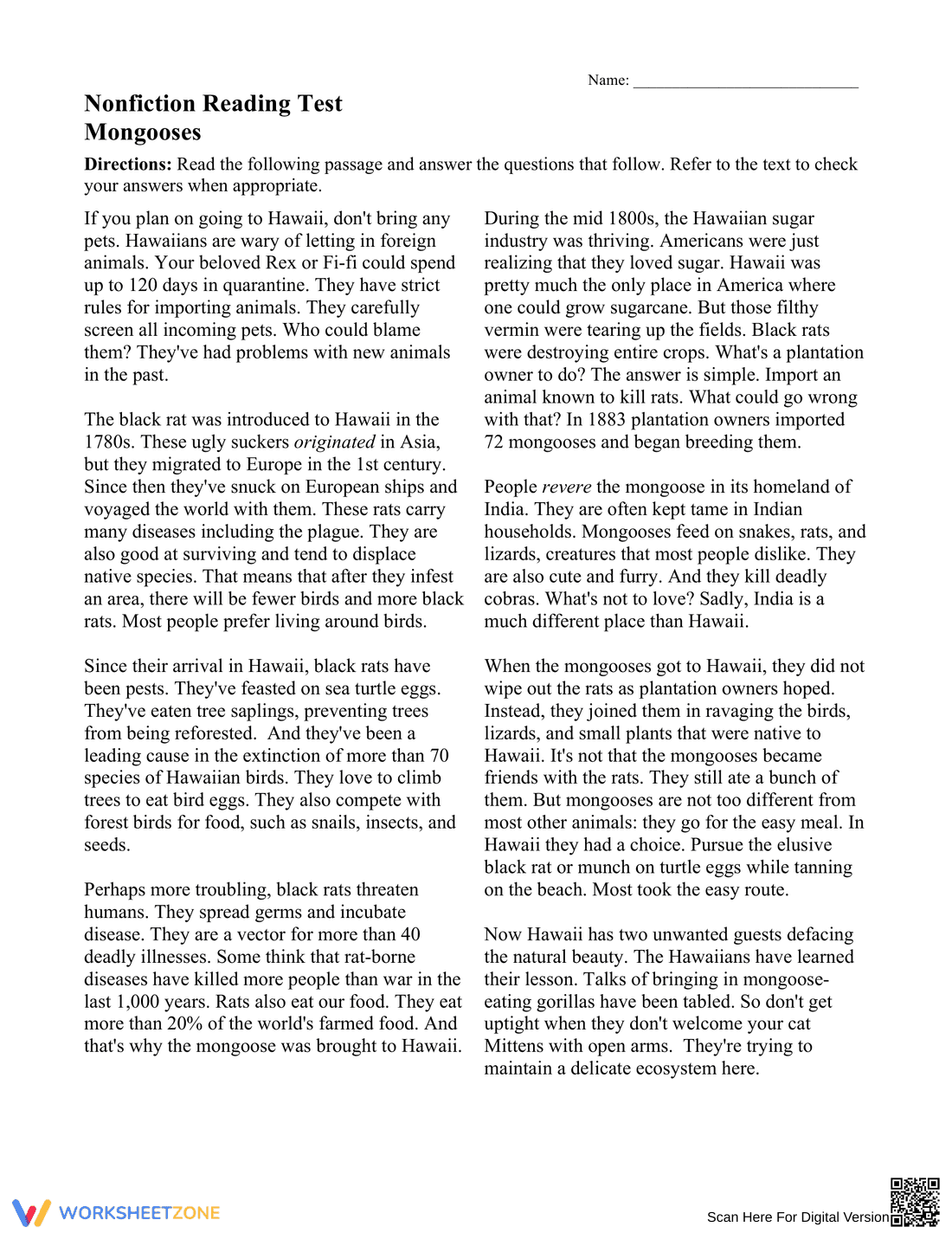
This Grade 6 nonfiction reading worksheet helps students master informational text analysis through an engaging passage about mongooses in Hawaii. Students analyze central ideas, evaluate author purpose, and practice vocabulary acquisition from context clues. This activity ensures middle schoolers develop critical thinking skills necessary for state testing.
At a Glance
- Grade: Grade 6 · Subject: English Language Arts
- Standard:
CCSS.ELA-LITERACY.RI.6.2— Determine a central idea of a text and how it is conveyed through details- Skill Focus: Nonfiction Reading Comprehension
- Format: 4 pages · 13 problems · Text evidence prompts · PDF
- Best For: Informational text assessment and test preparation
- Time: 30–45 minutes
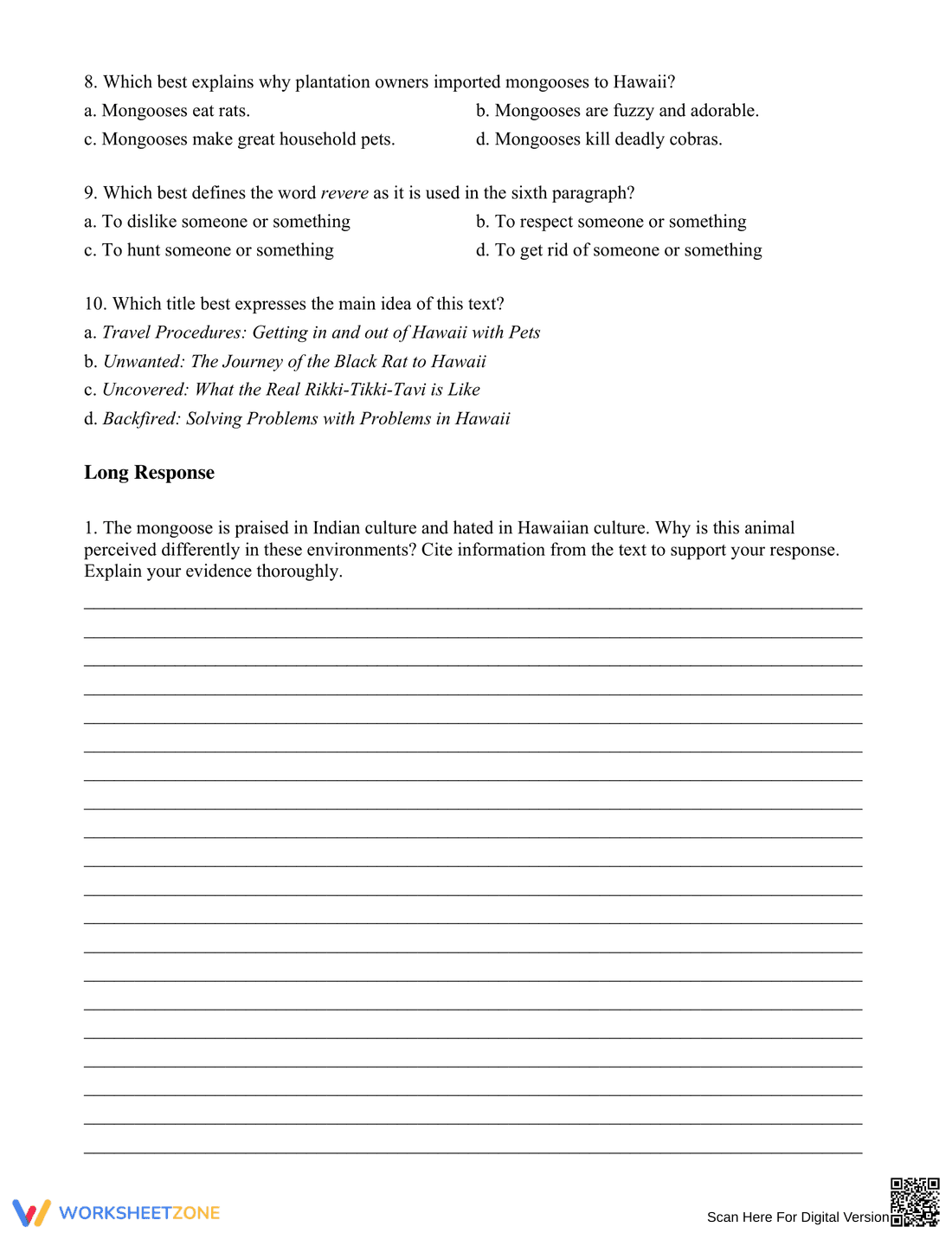
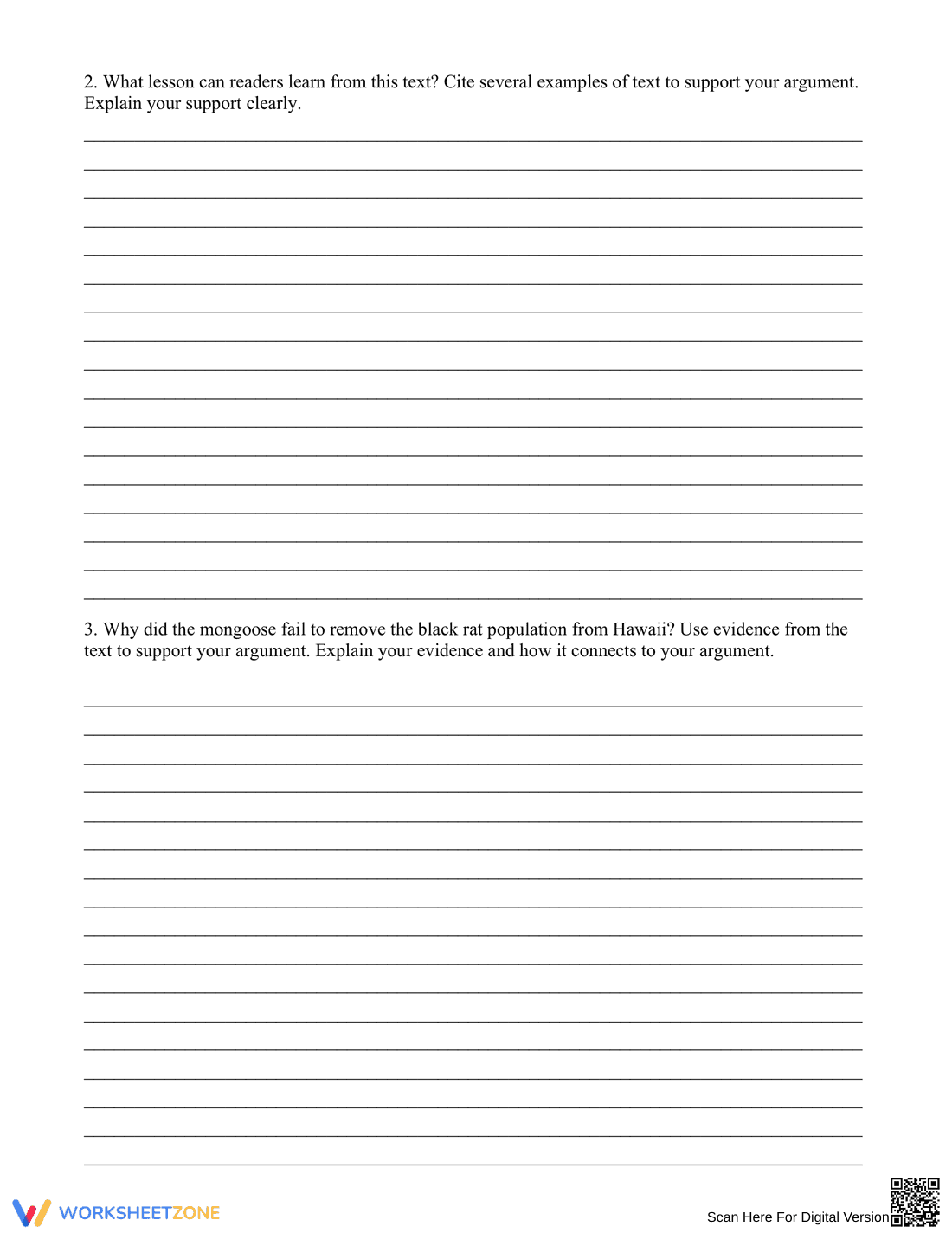
This 4-page printout features an informational text detailing the ecological impact of introducing mongooses to Hawaii. The layout contains 10 multiple-choice questions targeting chronological order, vocabulary, and main ideas. Additionally, 3 long-response prompts require students to provide text-based evidence to support their arguments.
The assignment follows a structured skill progression to scaffold student understanding. First, guided practice questions establish baseline comprehension by asking students to locate explicit facts and define vocabulary. Next, supported practice tasks challenge learners to identify paragraph-level main ideas and determine author purpose. Finally, independent practice culminates in 3 long-response questions where students independently cite textual evidence to explain complex relationships. This gradual-release framework ensures comprehensive mastery.
This resource aligns directly with CCSS.ELA-LITERACY.RI.6.2, which requires students to determine a central idea of a text and analyze its development. The multiple-choice section tests this by asking students to select a summary title. Furthermore, it supports CCSS.ELA-LITERACY.RI.6.1 through textual citations. Both standard codes can be copied directly into lesson plans, IEP goals, or district curriculum mapping tools.
Deploy this worksheet during an informational text unit or as a summative assessment. Teachers can observe student strategies during the multiple-choice section to check if they underline context clues. Expect students to spend approximately 35 minutes completing the packet, making it excellent for a block period or a substitute plan.
This text is optimized for sixth-grade students, but also serves as a remediation tool for seventh graders. Pair this worksheet with an anchor chart detailing how to properly cite textual evidence to support struggling writers.
According to the RAND AIRS 2024 report on reading proficiency, middle school students who regularly engage with multi-page informational texts demonstrate a 22% higher retention rate of academic vocabulary and central idea tracking. This worksheet addresses that need by combining context-clue analysis with extended written responses. By requiring students to synthesize historical and ecological facts across 4 pages, the resource reinforces the exact cognitive pathways highlighted in recent literacy frameworks. Educators can utilize this assessment to bridge the gap between basic literal comprehension and the higher-order critical evaluation demanded by modern state standards. The structured layout ensures that students practice extracting evidence systematically, which aligns with proven pedagogical recommendations for improving adolescent reading outcomes across diverse classroom demographics.


