


























Views
Downloads
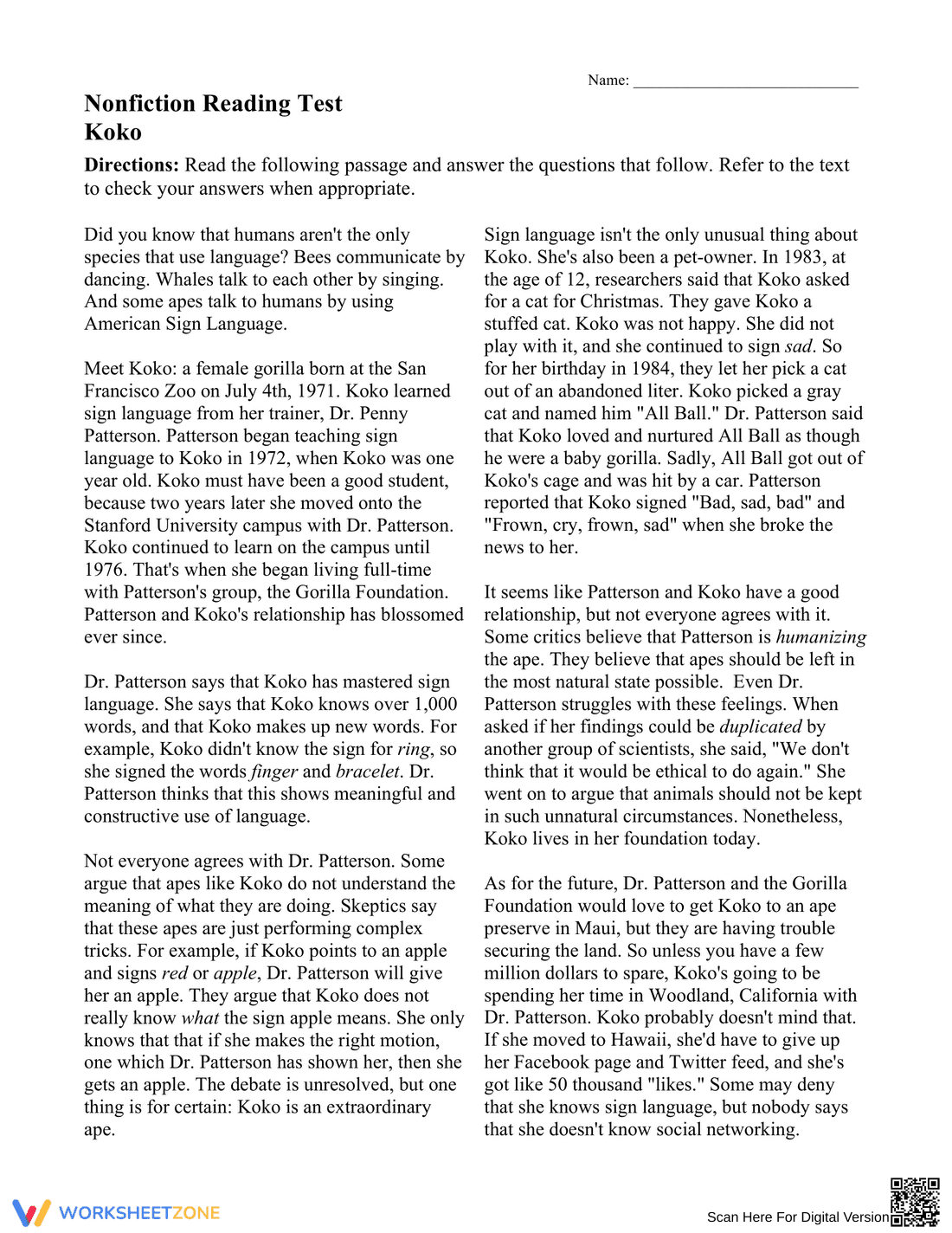

Reading Comprehension Worksheet | Grade 6 ELA Printable
Paste this activity's link or code into your existing LMS (Google Classroom, Canvas, Teams, Schoology, Moodle, etc.).
Students can open and work on the activity right away, with no student login required.
You'll still be able to track student progress and results from your teacher account.
This Grade 6 reading comprehension worksheet provides focused practice on analyzing nonfiction texts and citing textual evidence. By reading an engaging passage about Koko the gorilla, students will develop their ability to identify main ideas, determine author's purpose, and support their inferences with direct quotes from the text.
At a Glance
- Grade: 6 · Subject: ELA
- Standard:
CCSS.ELA-LITERACY.RI.6.1— Cite textual evidence to support analysis and inferences- Skill Focus: Reading Comprehension & Textual Evidence
- Format: 4 pages · 13 problems · Answer key included · PDF
- Best For: Independent practice or assessment
- Time: 30–45 minutes
What's Inside
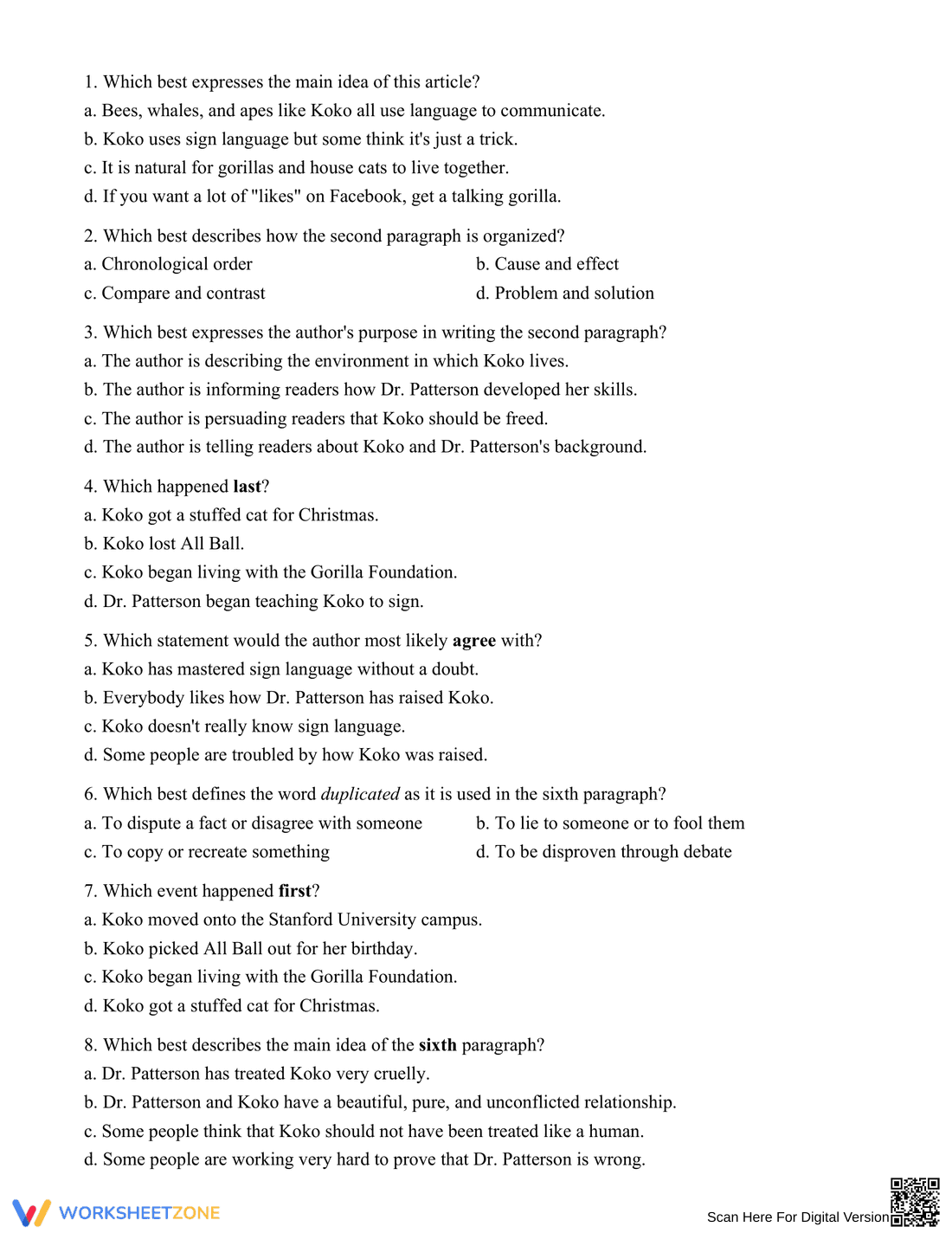
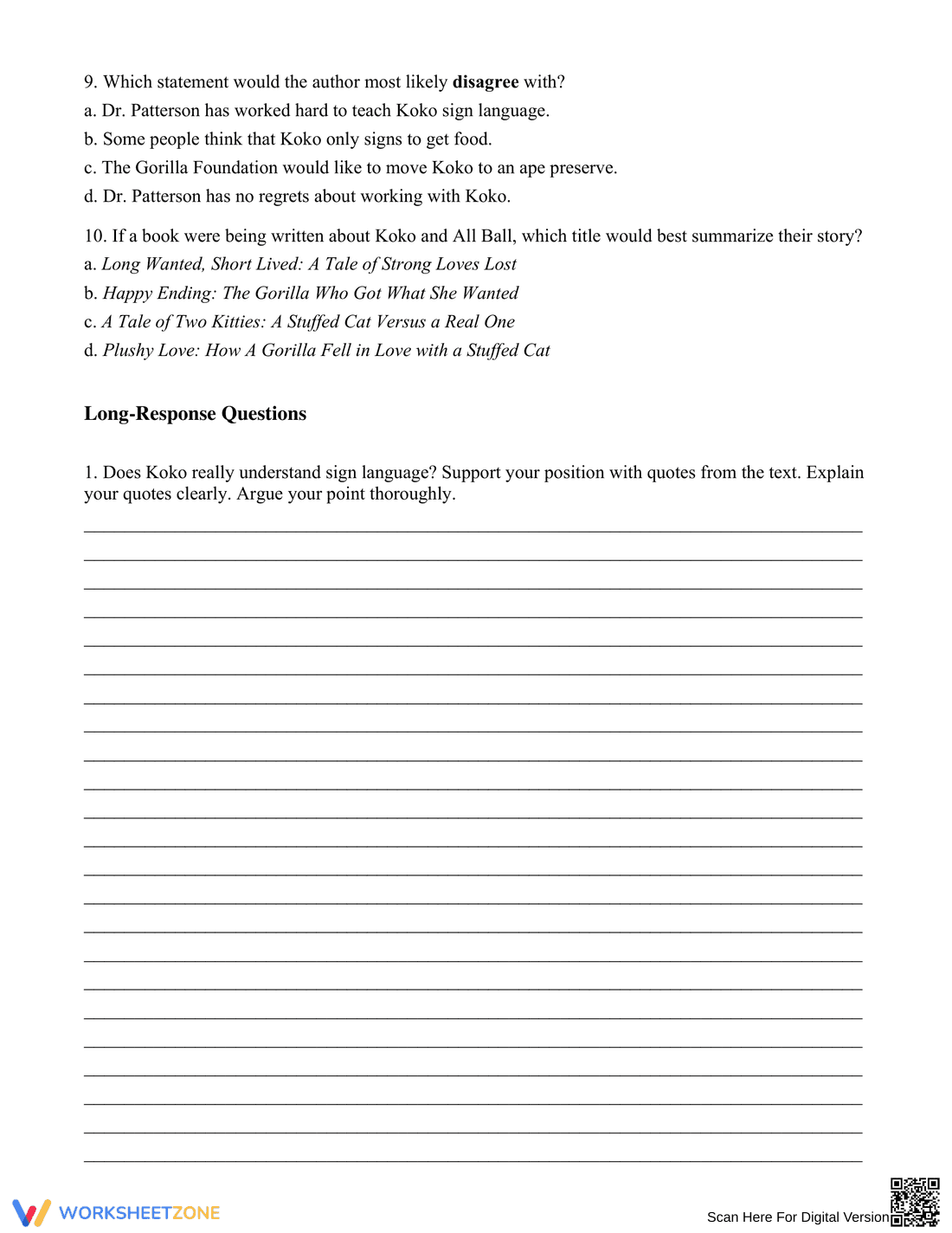
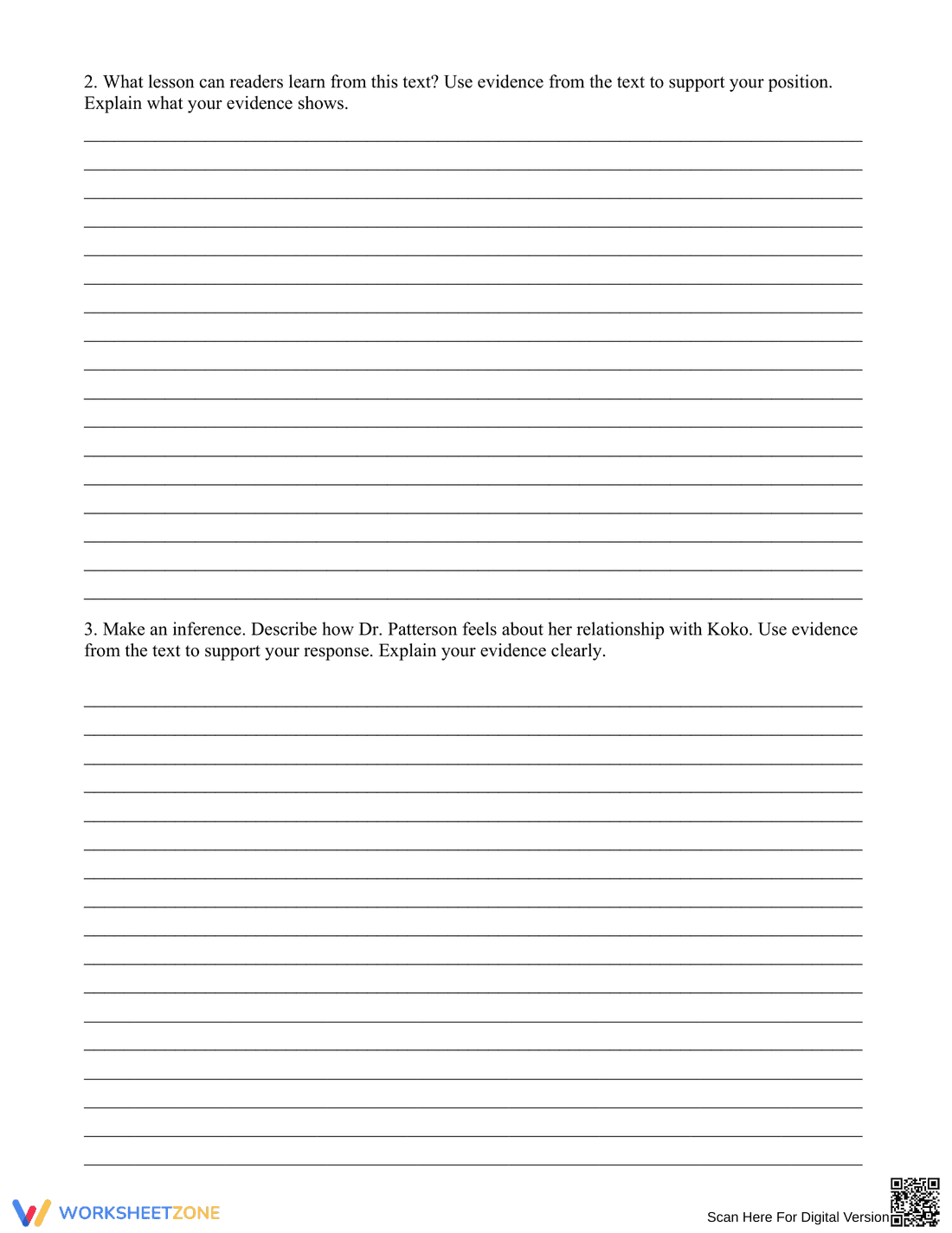
This comprehensive resource includes a high-interest nonfiction passage about Koko the sign-language-using gorilla, followed by a two-part assessment. The first section features 10 multiple-choice questions targeting main idea, text structure, vocabulary in context, and chronological order. The second section contains three long-response questions that require students to make inferences and construct written arguments using direct textual evidence.
Skill Progression
- Guided practice: Teachers can read the passage aloud and model how to annotate key details about Koko's life and Dr. Patterson's research.
- Supported practice: Students tackle the 10 multiple-choice questions, using the text to verify their answers regarding author's purpose and paragraph organization.
- Independent practice: The final 3 long-response questions challenge students to independently synthesize information and cite specific quotes to defend their reasoning.
This gradual-release approach ensures students build confidence before tackling complex written responses.
Standards Alignment
Aligned to CCSS.ELA-LITERACY.RI.6.1: Cite textual evidence to support analysis of what the text says explicitly as well as inferences drawn from the text. It also supports RI.6.2 by asking students to determine the central idea of specific paragraphs. Both standard codes can be copied directly into lesson plans, IEP goals, or district curriculum mapping tools.
How to Use It
This worksheet is highly versatile for middle school ELA classrooms. Use it as a formative assessment after direct instruction on citing text evidence, or assign it as a meaningful substitute teacher activity that requires no prior setup. While students are working on the long-response section, teachers can circulate and observe whether they are selecting the most relevant quotes to support their claims. Expect students to complete the reading and questions in 30 to 45 minutes.
Who It's For
Designed primarily for 6th-grade general education students, this passage is also engaging enough for older students needing foundational reading intervention. For differentiation, teachers can allow students reading below grade level to work in pairs or provide sentence frames for the long-response questions. It pairs perfectly with an anchor chart on the "RACE" (Restate, Answer, Cite, Explain) writing strategy.
Aligning instruction to CCSS.ELA-LITERACY.RI.6.1 requires students to cite textual evidence to support analysis and inferences. According to Fisher & Frey (2014), providing students with high-interest nonfiction texts paired with text-dependent questions significantly increases their reading stamina and critical thinking capabilities. When students are prompted to return to the text to justify their answers, they move beyond surface-level comprehension and begin to engage in the analytical thinking required for advanced literacy. This practice of grounding arguments in evidence is a cornerstone of middle school ELA instruction and prepares learners for more complex informational texts in high school and beyond. Furthermore, consistent exposure to structured response formats helps students internalize the habit of validating their claims, a skill that translates directly to improved performance on standardized assessments and cross-curricular writing tasks.


