


























Views
Downloads

Essential Grade 5 Addition and Subtraction Aligned Worksheet
Paste this activity's link or code into your existing LMS (Google Classroom, Canvas, Teams, Schoology, Moodle, etc.).
Students can open and work on the activity right away, with no student login required.
You'll still be able to track student progress and results from your teacher account.
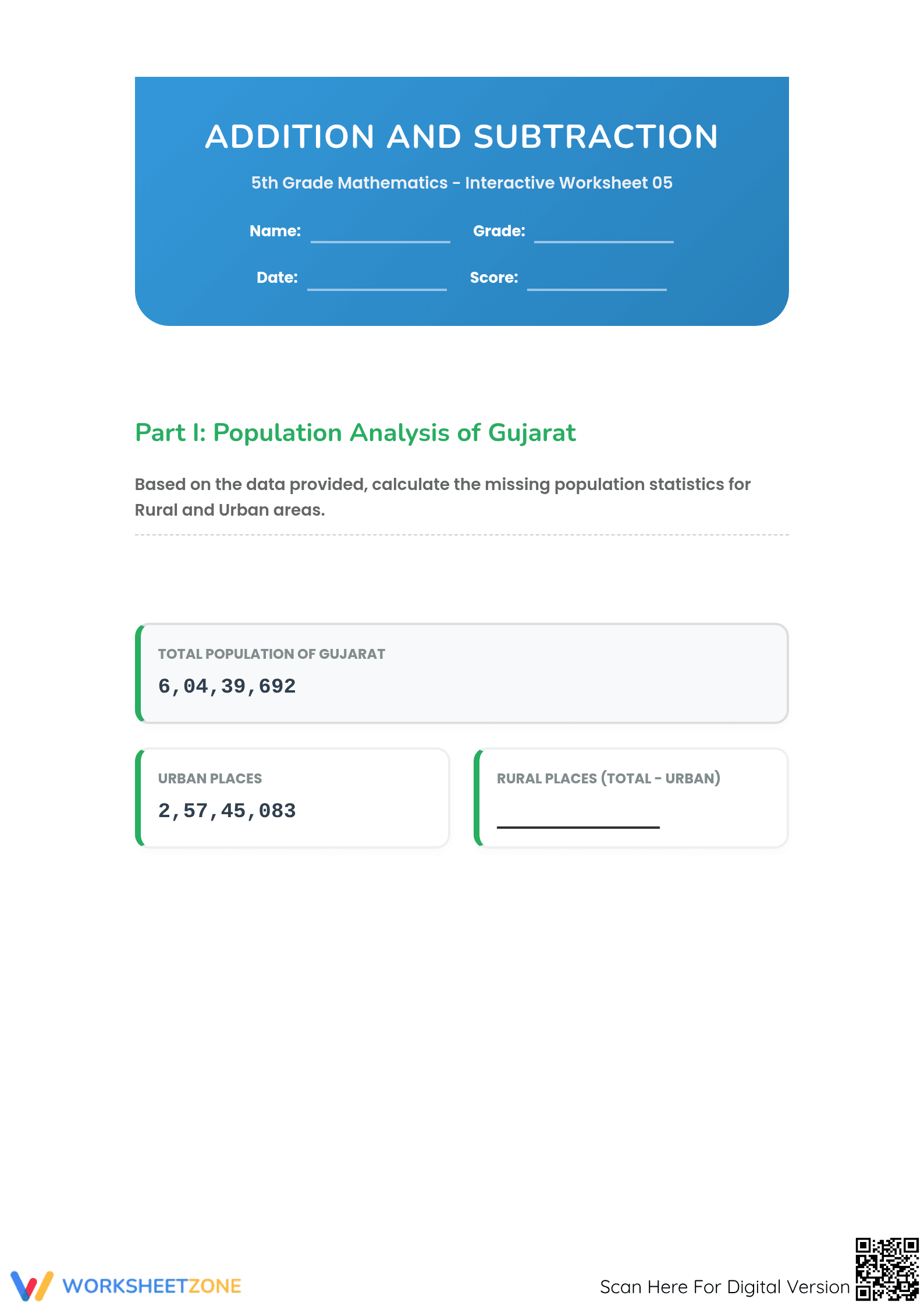
Strengthen student fluency in large-scale operations with this comprehensive 5th-grade math worksheet. Students apply multi-digit addition and subtraction to analyze population statistics from Gujarat and Tamilnadu. This real-world application transforms abstract calculation into meaningful data analysis, ensuring students understand the practical utility of their mathematical skills in demographic contexts.
At a Glance
- Grade: 5 · Subject: Math
- Standard:
CCSS.MATH.CONTENT.4.NBT.B.4— Fluently add and subtract multi-digit whole numbers using the standard algorithm- Skill Focus: Multi-digit addition and subtraction
- Format: 3 pages · 9 problems · Answer key included · PDF
- Best For: Real-world data application and skill fluency
- Time: 30–45 minutes
What's Inside
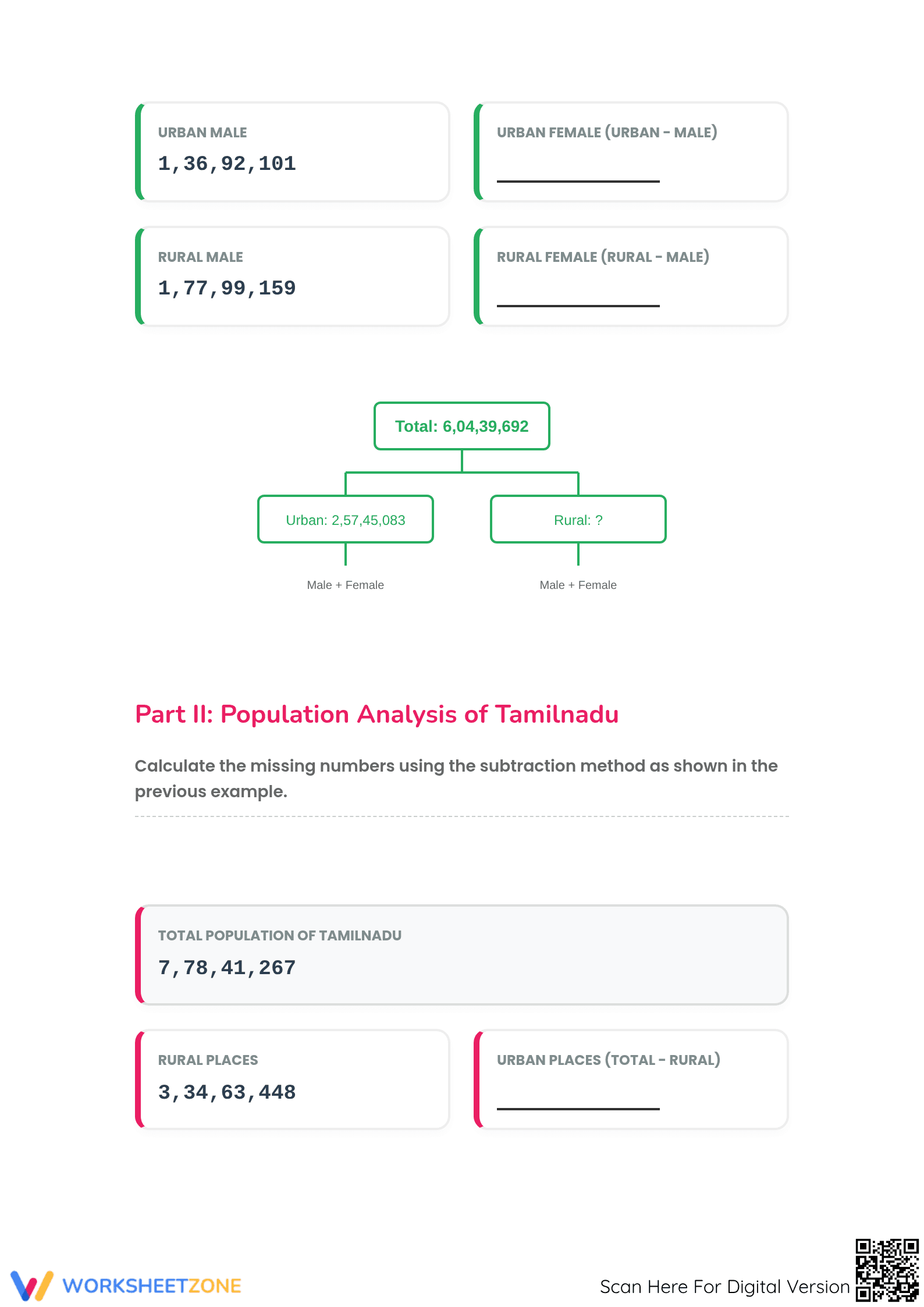
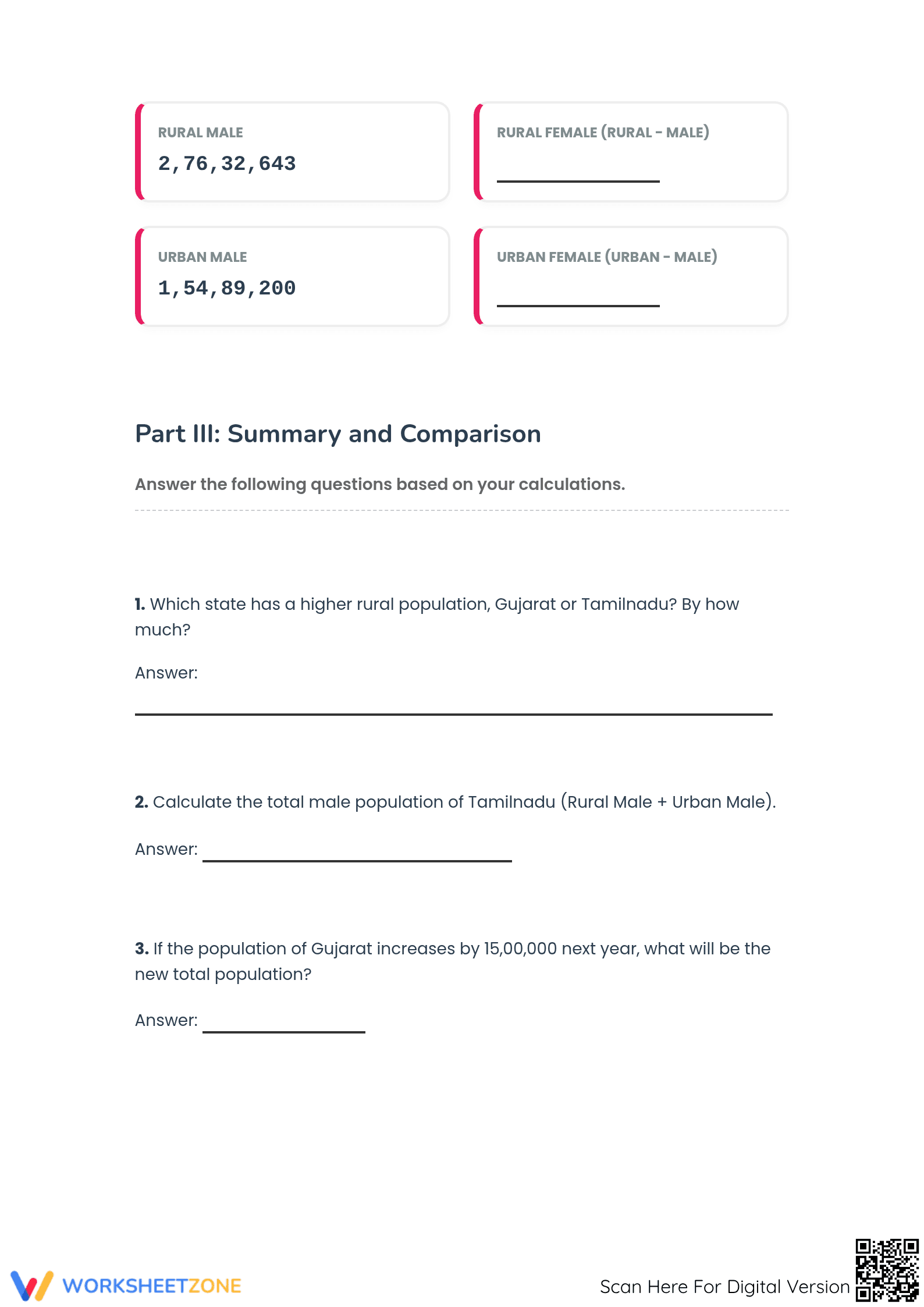
This three-page resource features a structured investigation into Indian state populations. The first two pages provide partial datasets for Gujarat and Tamilnadu, requiring students to calculate missing rural, urban, male, and female statistics using multi-digit operations. A tree diagram helps visualize the breakdown of total population. The final page includes three comparative word problems that challenge students to synthesize their findings and apply secondary operations, such as projecting population growth. A full answer key is provided for immediate verification.
Zero-Prep Workflow
Implementing this resource requires three simple steps:
- Print: Generate the three-page PDF and the answer key (30 seconds).
- Distribute: Hand out the worksheets and briefly review the population tables (1 minute).
- Review: Check final comparison answers as a class or using the provided key (5 minutes).
Total teacher preparation time is under two minutes, making this an ideal resource for substitute plans, independent practice, or a structured homework assignment that requires no additional manipulatives.
Standards Alignment
The primary focus of this worksheet is CCSS.MATH.CONTENT.4.NBT.B.4, which requires students to fluently add and subtract multi-digit whole numbers using the standard algorithm. By using 7- and 8-digit population figures, the tasks exceed basic requirements to prepare 5th graders for high-level numerical fluency. Both standard codes can be copied directly into lesson plans, IEP goals, or district curriculum mapping tools.
How to Use It
Use this worksheet as a culminating activity after teaching the standard algorithm for addition and subtraction. It serves as an excellent formative assessment to observe if students can correctly align place values in large numbers and manage regrouping across multiple zeros. Completion time typically ranges from 30 to 45 minutes, depending on whether students work independently or in pairs.
Who It's For
Designed for 5th-grade students mastering multi-digit operations, this resource is particularly effective for learners who benefit from seeing math applied to geography and social studies. It provides natural differentiation through the complexity of the numbers, while the structured tables support students who need organizational scaffolds. Pair this with a world atlas for an interdisciplinary approach.
According to research from Fisher & Frey (2014), using authentic datasets, such as the population statistics found in this CCSS.MATH.CONTENT.4.NBT.B.4 aligned worksheet, significantly increases student engagement and retention of computational strategies. By moving beyond isolated drills into population analysis, students develop a sense of number that is essential for processing large-scale information in the digital age. This 9-task resource ensures that students are not just performing algorithms but are interpreting results within a demographic context, meeting the rigorous demands of state and national standards. The inclusion of comparative summary questions further encourages higher-order thinking, moving students from basic calculation to critical analysis of mathematical outcomes. This approach aligns with the NAEP frameworks for mathematical literacy, ensuring students are prepared for more complex data analysis in middle school.


