




























Views
Downloads



Grade 5 Area and Perimeter — Printable No-Prep Worksheet

Paste this activity's link or code into your existing LMS (Google Classroom, Canvas, Teams, Schoology, Moodle, etc.).
Students can open and work on the activity right away, with no student login required.
You'll still be able to track student progress and results from your teacher account.
This comprehensive Grade 5 math worksheet transforms geometry practice into an engaging architectural exploration of the Golkonda Fort. Students will master the calculation of area and perimeter for squares and rectangles while progressing toward advanced challenges involving circles, triangles, and volume. This resource ensures students can confidently apply mathematical formulas to real-world scenarios.
At a Glance
- Grade: 5 · Subject: Math
- Standard:
CCSS.MATH.CONTENT.4.MD.A.3— Apply the area and perimeter formulas for rectangles in real world problems- Skill Focus: Area, Perimeter, and Volume
- Format: 5 pages · 26 problems · Answer key included · PDF
- Best For: Comprehensive geometry practice and unit review
- Time: 45–60 minutes
What's Inside
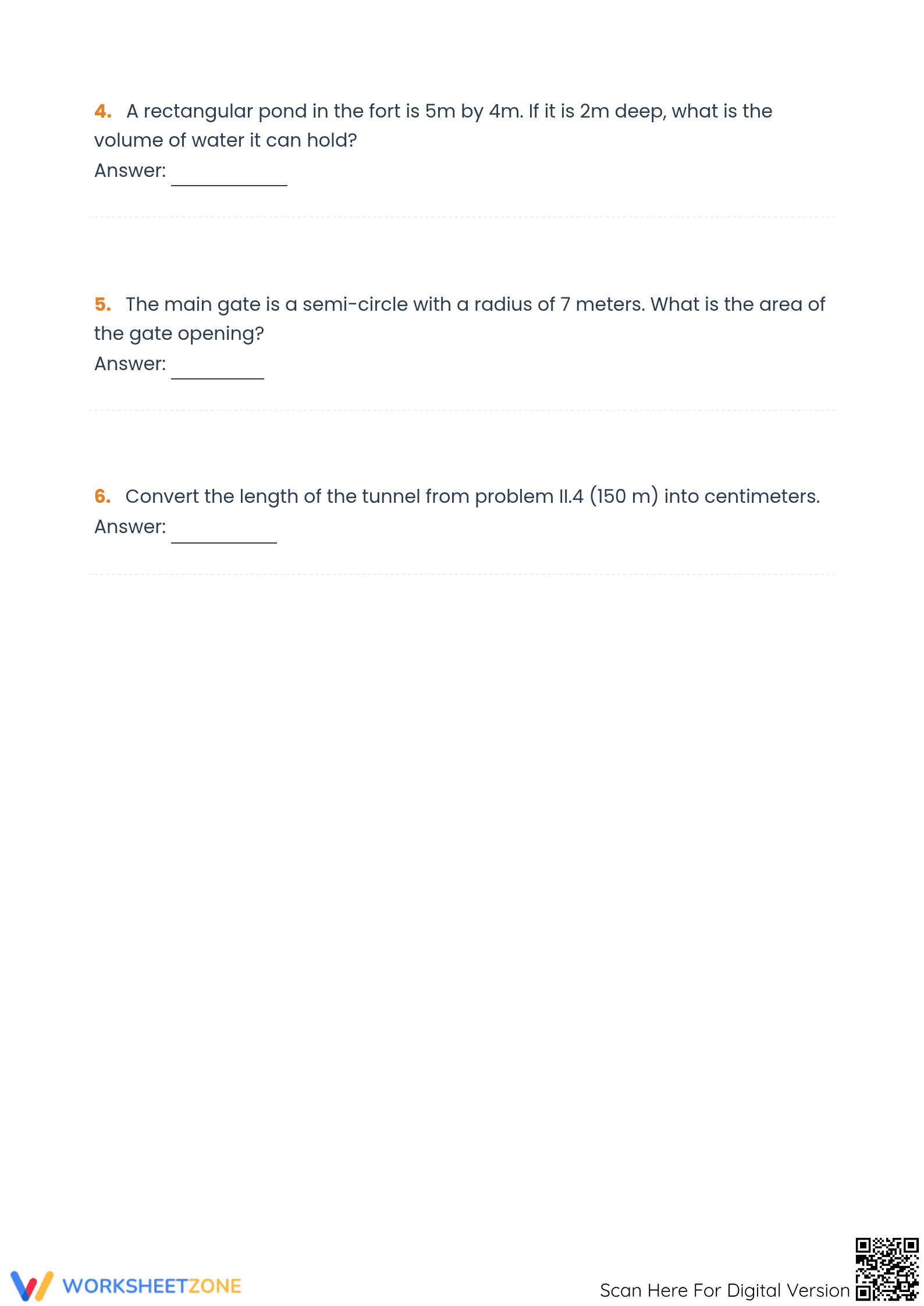
This extensive five-page packet features 26 targeted problems organized into four distinct modules. The worksheet includes calculation tasks for perimeter and area, data interpretation tables, and advanced geometric challenges. Every problem is supported by clear visualizations and ample workspace, and a full answer key is provided to facilitate rapid grading and student self-correction.
Zero-Prep Workflow
This resource is designed for immediate classroom implementation with zero teacher preparation required. First, print the five-page PDF (less than 1 minute). Next, distribute the packets for independent or small-group work (under 1 minute). Finally, use the provided answer key for a 5-minute collective review or quick grading, making this an ideal solution for substitute plans or unit reviews.
Standards Alignment
The primary focus is CCSS.MATH.CONTENT.4.MD.A.3, which requires students to apply the area and perimeter formulas for rectangles in real-world and mathematical problems. Additionally, the worksheet addresses CCSS.MATH.CONTENT.5.MD.C.3 through volume calculations and 5.MD.A.1 via unit conversions. Both standard codes can be copied directly into lesson plans, IEP goals, or district curriculum mapping tools.
How to Use It
Use this worksheet as a summative assessment at the end of a measurement unit to evaluate student mastery of geometric formulas. During the lesson, observe how students handle the transition from simple rectangle calculations to the advanced circle and triangle challenges to identify those needing targeted intervention. Expect a completion time of 45 to 60 minutes for the full packet.
Who It's For
This resource is tailored for Grade 5 students, providing scaffolded support for learners who are developing their spatial reasoning skills. It serves as an excellent pairing with a direct instruction lesson on historic architecture or as a rigorous practice set for advanced 4th graders ready for geometric extensions.
According to the RAND AIRS 2024 report on educational resource efficacy, contextualized math problems like those found in the Golkonda Fort worksheet significantly improve student engagement and retention of geometric concepts. By anchoring abstract calculations of area and perimeter in a real-world historical setting, students develop a deeper spatial awareness and mathematical reasoning capability. The worksheet aligns with CCSS.MATH.CONTENT.4.MD.A.3 by requiring students to apply formulas for rectangles in various problem-solving scenarios, ranging from simple perimeter calculations to complex data interpretation and advanced geometric challenges involving circles and triangles. This multi-page resource provides a comprehensive practice suite that transitions from scaffolded exercises to independent mastery, ensuring students can effectively relate mathematical principles to architectural and environmental contexts. Educators can use these tasks to evaluate not only computational accuracy but also the ability to synthesize dimensions into meaningful data summaries, facilitating a robust understanding of measurement and data standards in upper elementary mathematics.


