


























Views
Downloads

Printable Synonym Matching Crossword | Grade 3 ELA
Paste this activity's link or code into your existing LMS (Google Classroom, Canvas, Teams, Schoology, Moodle, etc.).
Students can open and work on the activity right away, with no student login required.
You'll still be able to track student progress and results from your teacher account.
This Grade 3 vocabulary worksheet reinforces synonym recognition through an engaging crossword puzzle format. By matching common adjectives and nouns to their near-meanings, students develop the lexical flexibility needed for nuanced reading and writing. This activity transforms rote word memorization into a logical problem-solving task that boosts long-term retention of essential vocabulary.
At a Glance
- Grade: 3 · Subject: English Language Arts
- Standard:
CCSS.ELA-LITERACY.L.3.5— Demonstrate understanding of word relationships and nuances in word meanings- Skill Focus: Synonym Identification & Word Relationships
- Format: 3 pages · 10 problems · Answer key included · PDF
- Best For: Vocabulary enrichment and independent practice
- Time: 15–20 minutes
What's Inside
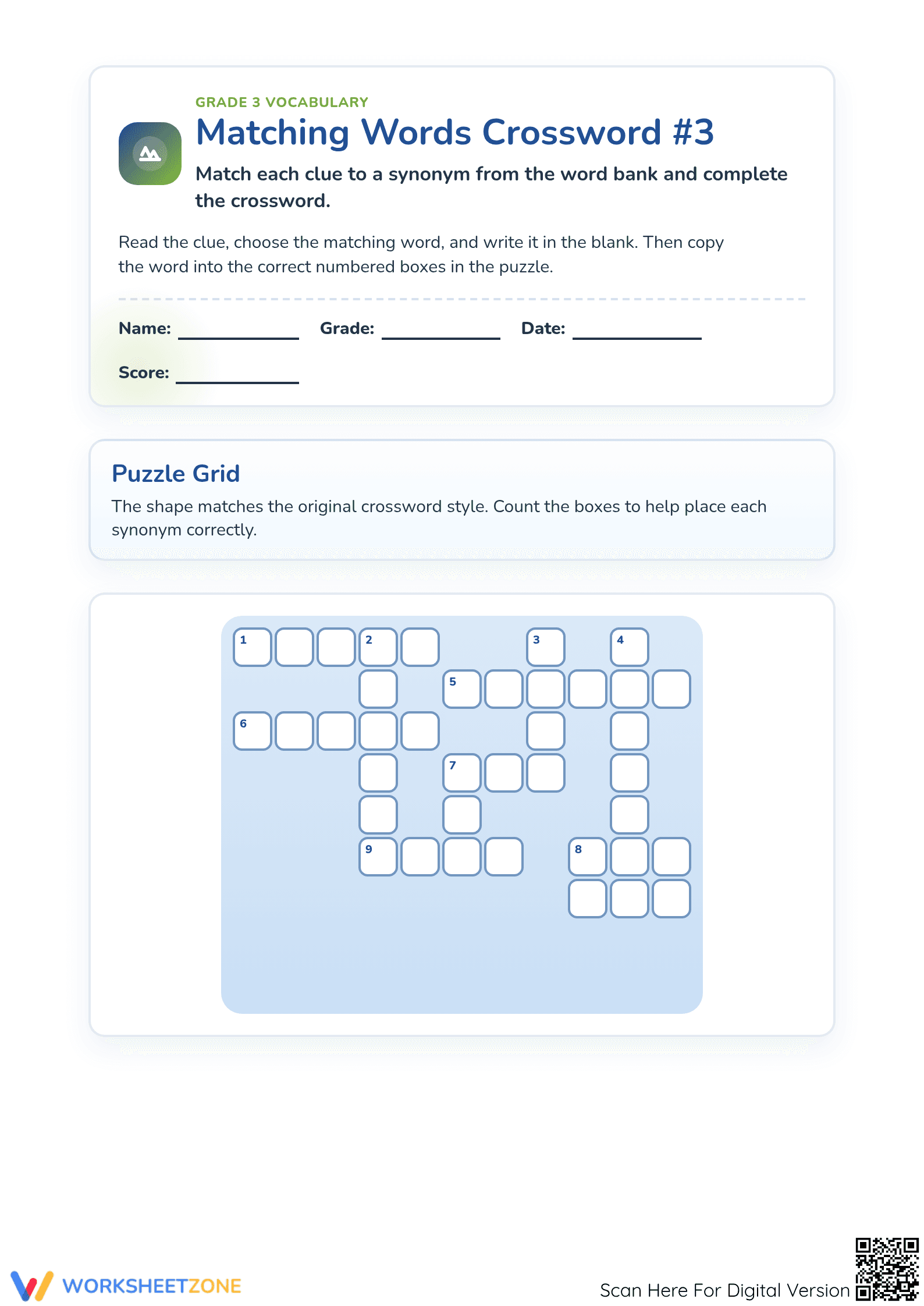
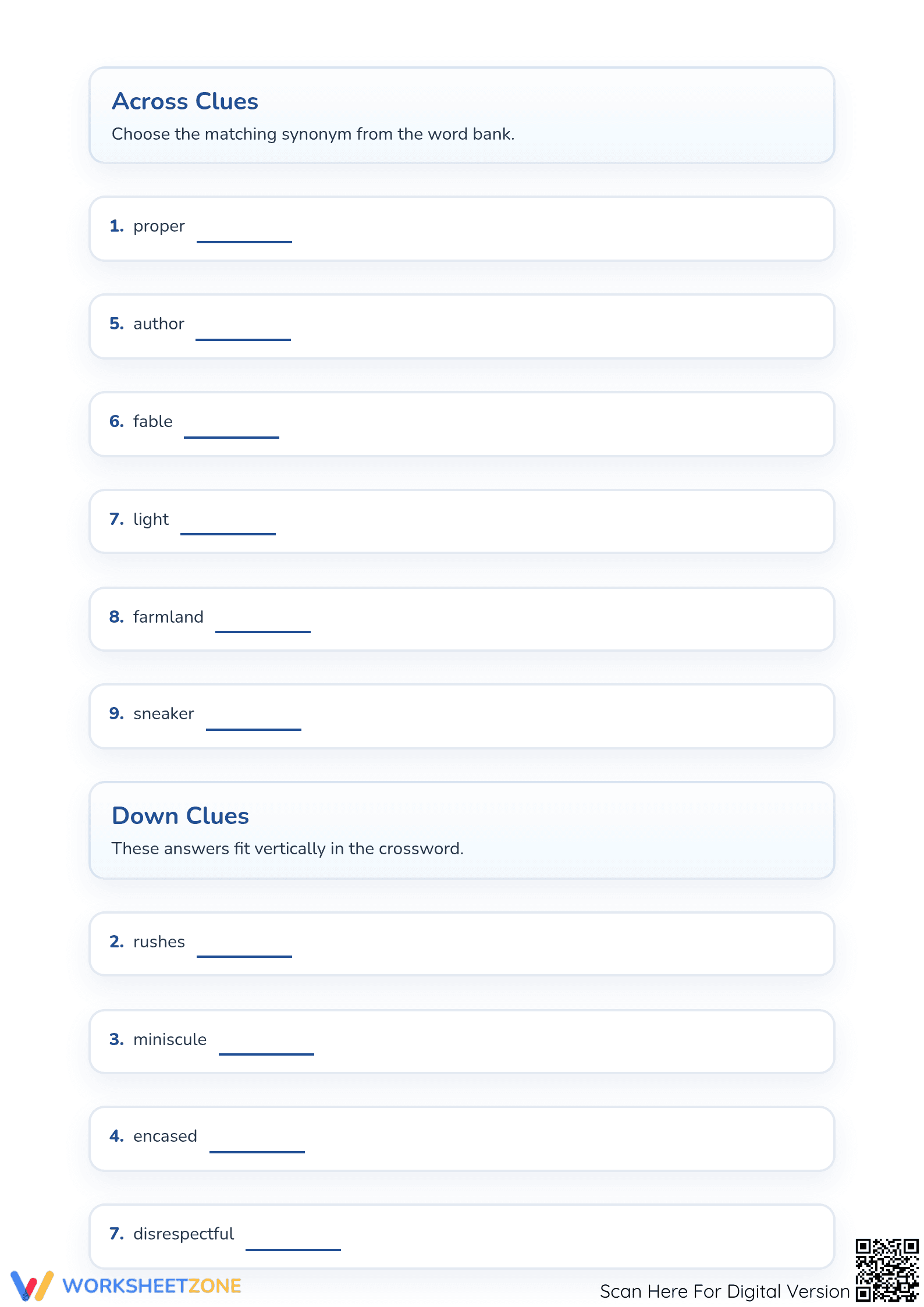
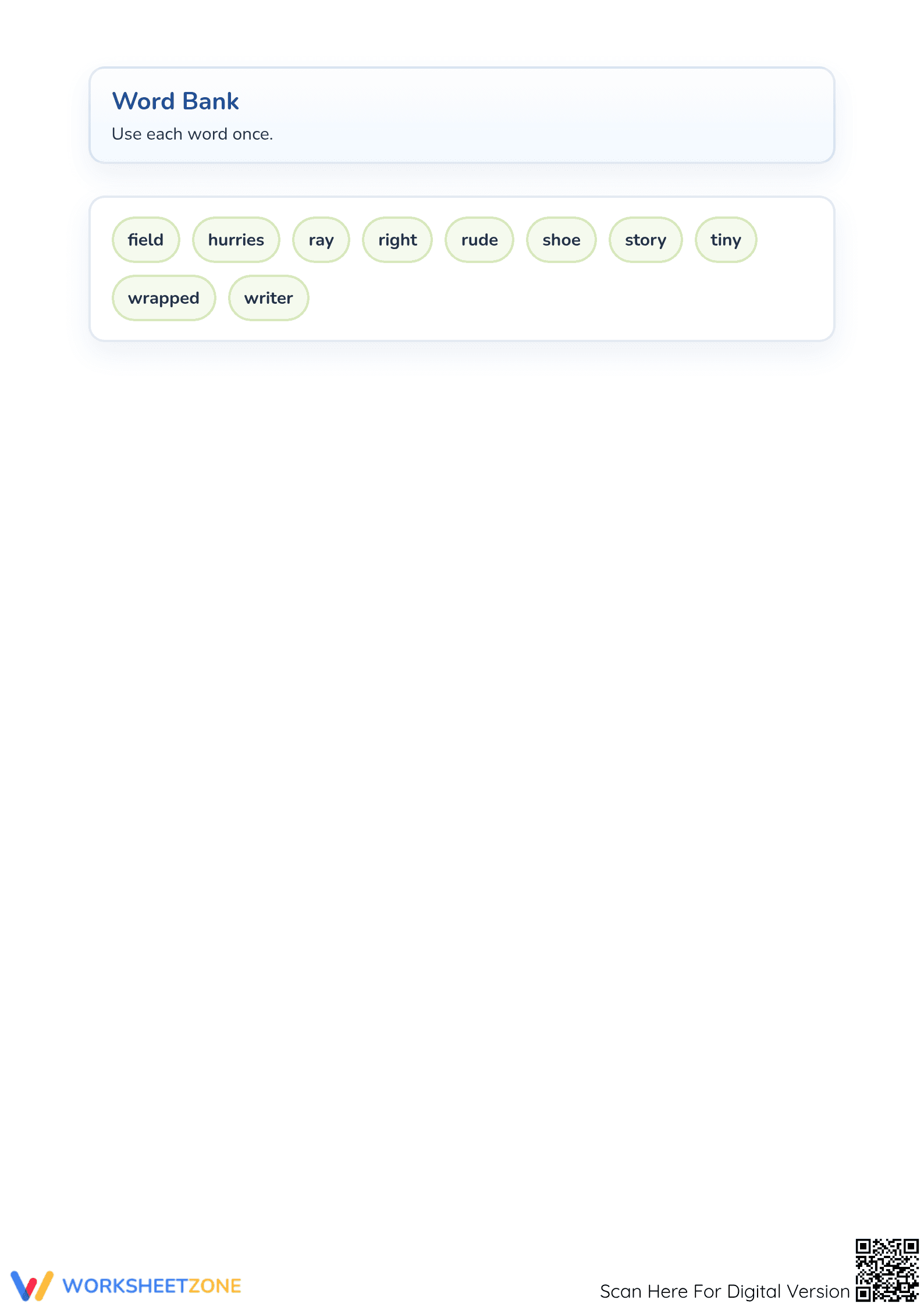
The three-page PDF package includes a visual crossword grid, a comprehensive list of ten clues divided into "Across" and "Down" categories, and a scaffolded word bank. Each clue provides a target word, such as "author" or "minuscule," which students must match with a corresponding synonym from the bank before populating the puzzle grid correctly.
Skill Progression
- Guided Practice: Students engage in initial identification by selecting matching pairs from the provided 10-word bank, reducing cognitive load during the acquisition phase.
- Supported Practice: Learners transition to application by categorizing clues into the spatial layout of the crossword, reinforcing the relationship between definitions and synonyms.
- Independent Mastery: Students verify word lengths and spelling against the grid, ensuring a self-checking mechanism that solidifies the correct usage of each lexical term.
This approach follows a gradual-release model, moving students from simple recognition to successful independent completion.
Standards Alignment
The primary focus is CCSS.ELA-LITERACY.L.3.5, which requires students to demonstrate understanding of word relationships. By identifying synonyms, learners satisfy the specific grade-level demand to distinguish shades of meaning among related words. This standard code can be copied directly into lesson plans, IEP goals, or district curriculum mapping tools to ensure rigorous instructional alignment.
How to Use It
This resource is ideal for use during the independent practice phase of a vocabulary lesson. Teachers can distribute the puzzle after a direct instruction session on synonyms to assess student comprehension. For a formative assessment tip, observe students as they utilize the word bank; those who can match words without frequent referral to the list demonstrate a higher level of lexical automaticity. The expected completion time for this 10-problem set is 15 to 20 minutes.
Who It's For
Designed primarily for 3rd-grade students, this worksheet also serves as an excellent remedial tool for 4th graders or an enrichment activity for advanced 2nd graders. It pairs naturally with a synonym anchor chart or a short reading passage where students are tasked with replacing underlined words with their crossword-matched counterparts to improve writing quality.
According to the NAEP 2024 framework, the ability to identify word relationships like synonyms is a critical predictor of reading comprehension success in the intermediate grades. This worksheet directly addresses the CCSS.ELA-LITERACY.L.3.5 standard by requiring students to match ten distinct lexical pairs within a logical crossword structure. Research highlighted by Fisher & Frey (2014) suggests that using word puzzles and games increases student engagement with complex vocabulary, leading to better retrieval during independent writing tasks. By providing a scaffolded word bank alongside a spatial problem-solving grid, the resource supports dual-coding of information, which enhances cognitive processing. Teachers can utilize this 10-problem set to verify that students can distinguish shades of meaning, a foundational skill for mastering more complex linguistic nuances. This printable tool ensures that vocabulary instruction remains both systematic and interactive, providing clear evidence of student progress toward grade-level mastery in English Language Arts.


