


























Views
Downloads

Grade K 3D Shapes — Printable No-Prep Worksheet
Paste this activity's link or code into your existing LMS (Google Classroom, Canvas, Teams, Schoology, Moodle, etc.).
Students can open and work on the activity right away, with no student login required.
You'll still be able to track student progress and results from your teacher account.
Mastering 3D Shapes: A Kindergarten Geometry Activity
This comprehensive worksheet guides Kindergarten students through the fundamental properties of 3D shapes. Learners will analyze and classify common geometric solids—including cubes, spheres, and cones—based on their ability to slide, stack, or roll. This resource provides structured practice to build a strong foundation in early spatial reasoning and geometry vocabulary.
At a Glance
- Grade: K · Subject: Math
- Standard:
CCSS.MATH.CONTENT.K.G.B.4— Analyze and compare 3D shapes based on their attributes.- Skill Focus: Properties of 3D shapes (slide, stack, roll)
- Format: 5 pages · 19 problems · Answer key included · PDF
- Best For: Independent practice, station work, or homework
- Time: 20–25 minutes
What's Inside
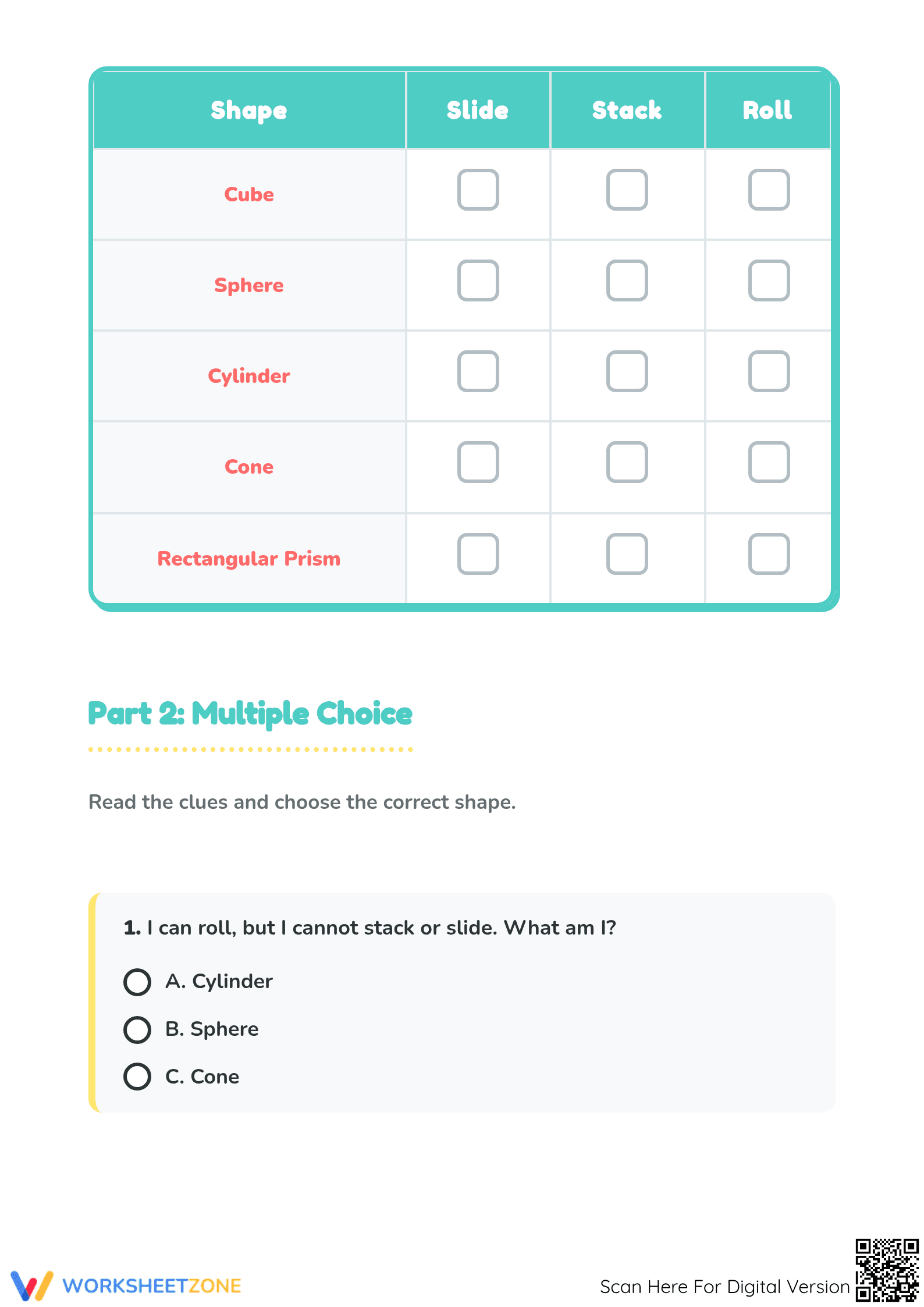
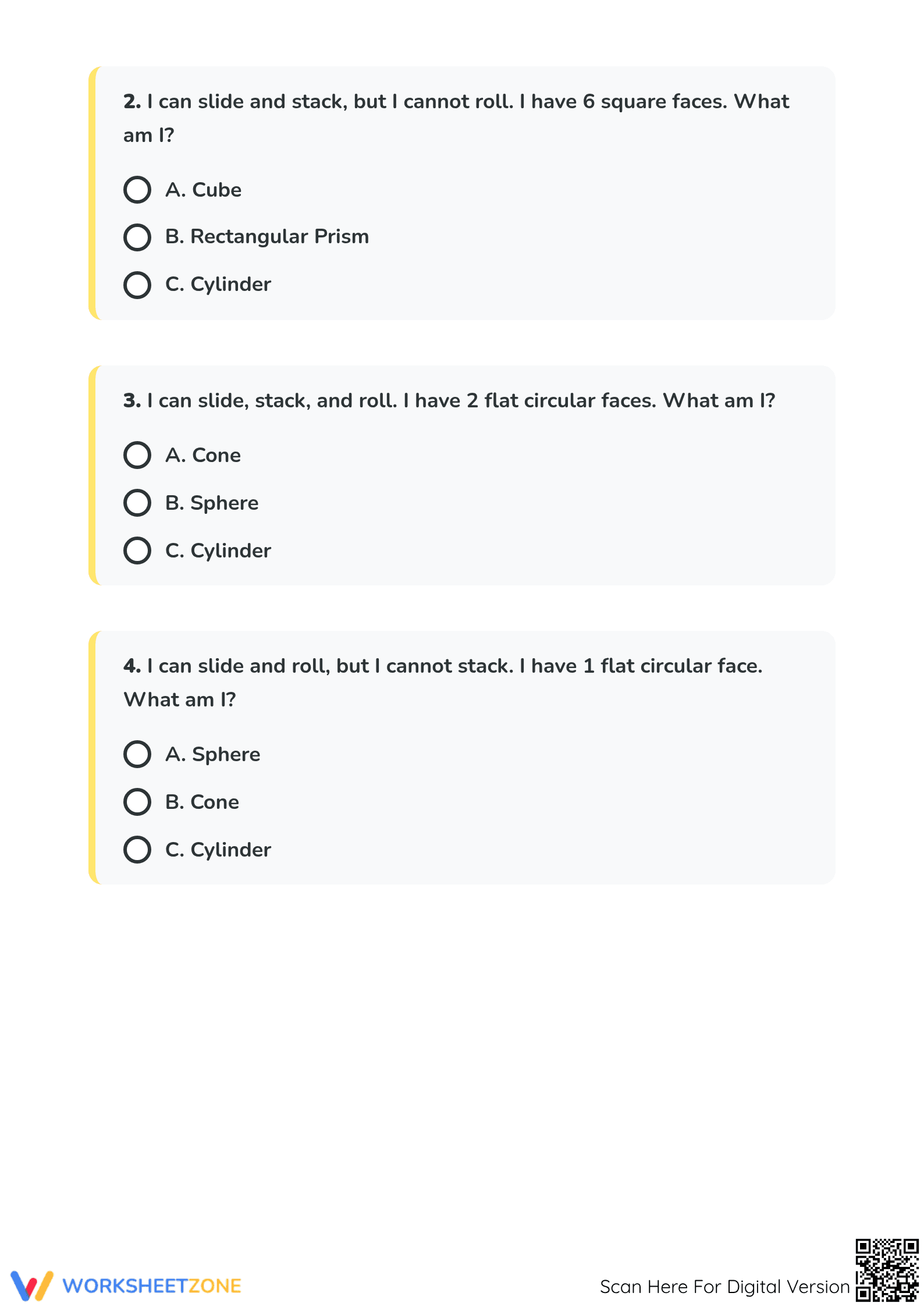
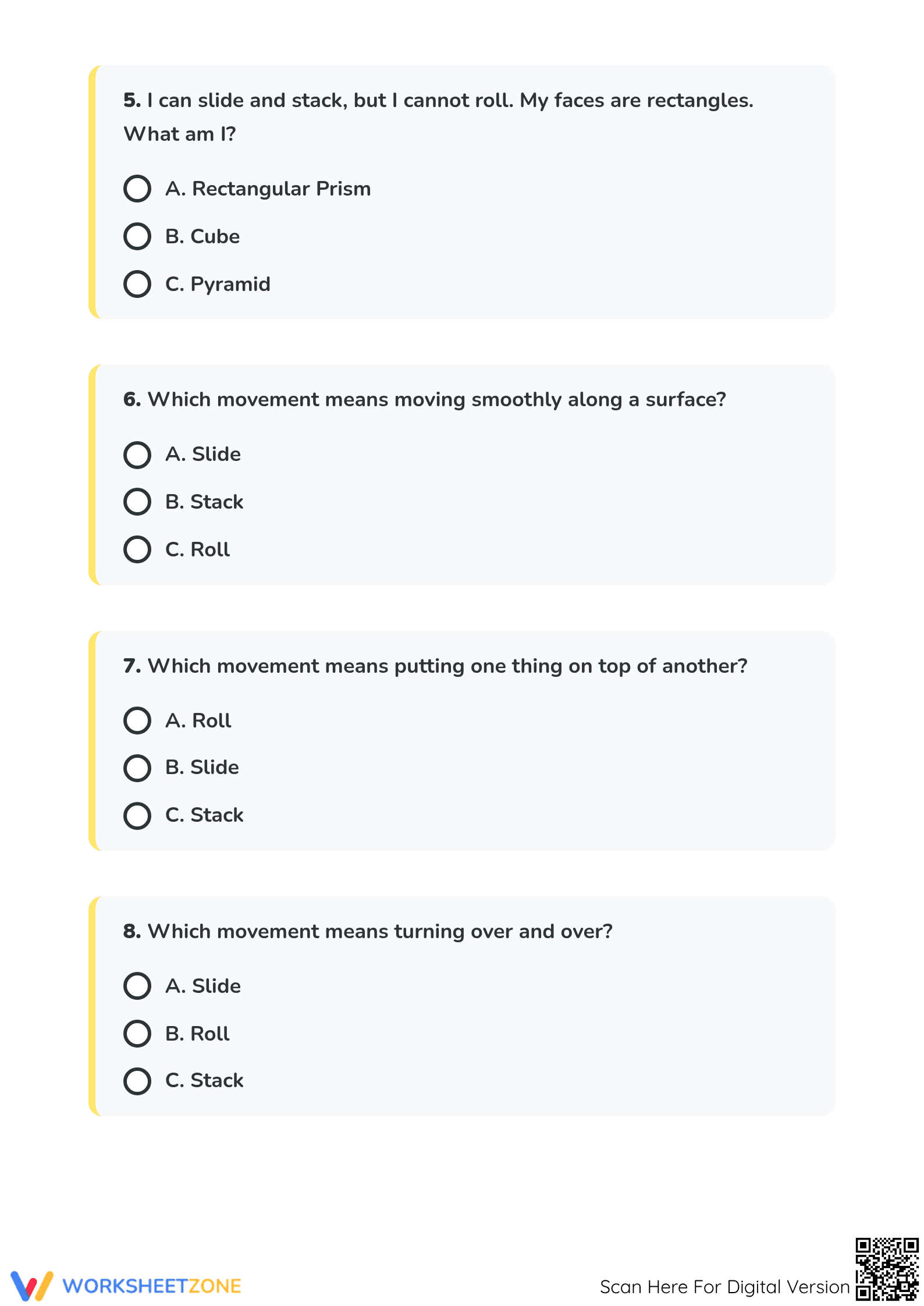
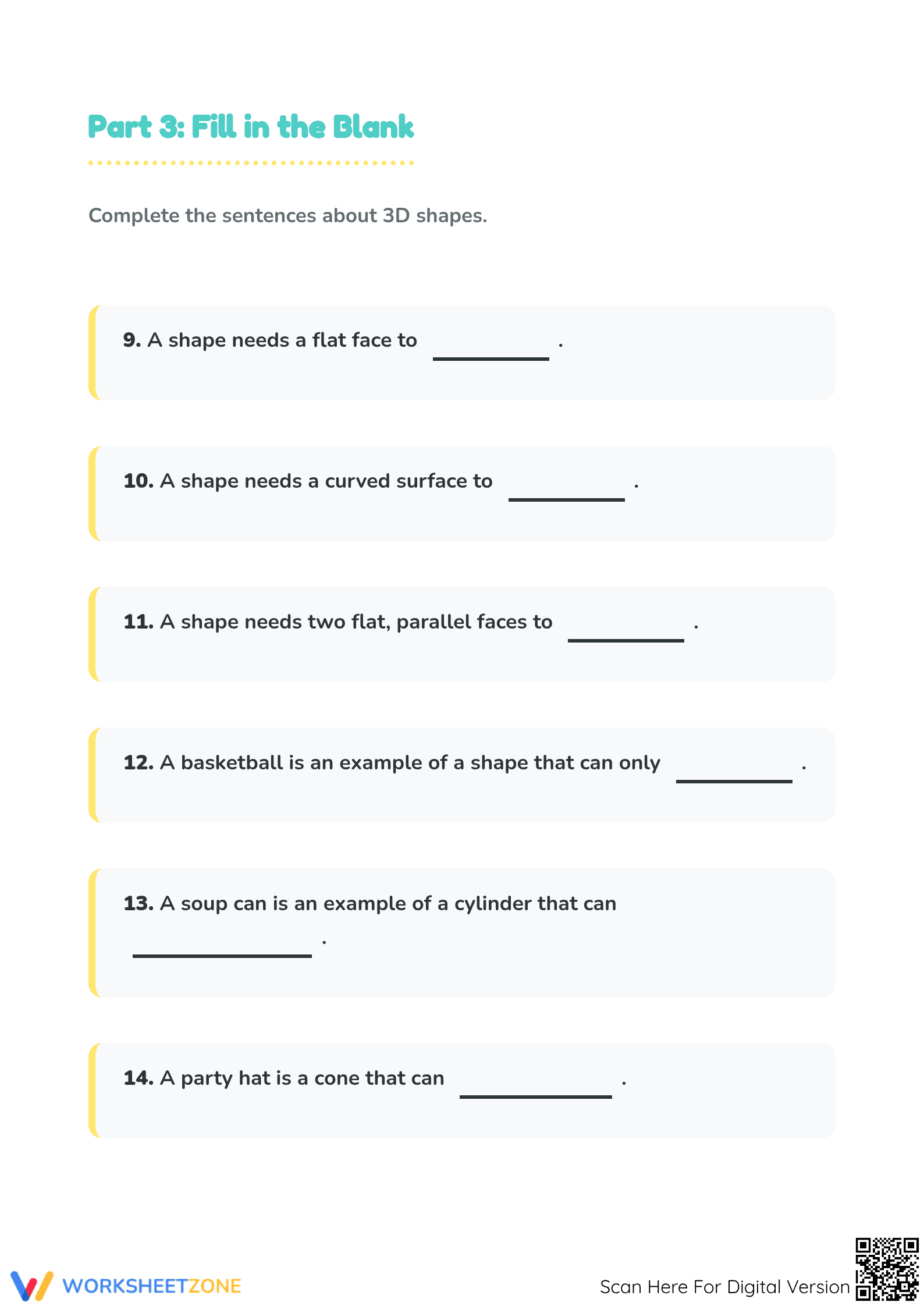
This five-page resource features varied tasks to reinforce student understanding. It starts with a table for identifying the movement properties (slide, stack, roll) for five 3D shapes. It then proceeds to eight multiple-choice questions using descriptive clues, followed by six fill-in-the-blank sentences to solidify vocabulary. A complete answer key is included for efficient grading.
A Zero-Prep Workflow for Busy Teachers
This worksheet is designed for a seamless, time-saving workflow, with total prep time under two minutes.
- Print (under 30 seconds): The resource is a single, easy-to-print PDF file.
- Distribute (under 1 minute): Hand out the five-page packet for an immediate, self-contained activity.
- Review (under 5 minutes): Use the provided answer key to quickly grade student work or lead a class review.
Its straightforward format makes it a reliable choice for substitute teacher plans.
Standards Alignment
This resource is directly aligned with CCSS.MATH.CONTENT.K.G.B.4, which requires students to analyze and compare 3D shapes by their attributes. By focusing on sliding, stacking, and rolling, this worksheet provides targeted practice for a key component of this Kindergarten standard. The standard code can be copied directly into lesson plans, IEP goals, or district curriculum mapping tools.
How to Use It
Use this versatile worksheet as a pre-assessment, a check for understanding after instruction, or as a focused homework assignment. It also functions well as an independent activity during math centers. While students work, observe how they classify shapes like the cylinder and cone to identify common misconceptions. Expect completion time to be 20-25 minutes.
Who It's For
Ideal for Kindergarten students learning to classify 3D shapes, the clear instructions make it accessible for all learners. It also serves as an excellent review for first-grade students needing to solidify geometric concepts. For deeper learning, pair this activity with physical 3D shape manipulatives so students can test the properties themselves.
Foundational skills in geometry, such as understanding the properties of 3D shapes, are critical for future mathematical success. This worksheet directly supports standard CCSS.MATH.CONTENT.K.G.B.4 by providing a structured, hands-on opportunity for students to analyze how different shapes move and interact with their environment. According to the NAEP, consistent exposure to core mathematical concepts in early grades is essential for building long-term proficiency and confidence. By engaging in concrete tasks that require them to classify objects based on physical attributes like rolling, sliding, or stacking, young learners develop the critical spatial reasoning skills that underpin more complex geometry. This approach, which aligns with research from Fisher & Frey (2014) on the efficacy of guided practice following direct instruction, helps translate abstract geometric ideas into tangible, observable characteristics. This process is a vital step in a student's cognitive development in mathematics.


